


PCB by high-density, small aperture direction, the technology towards maturity.
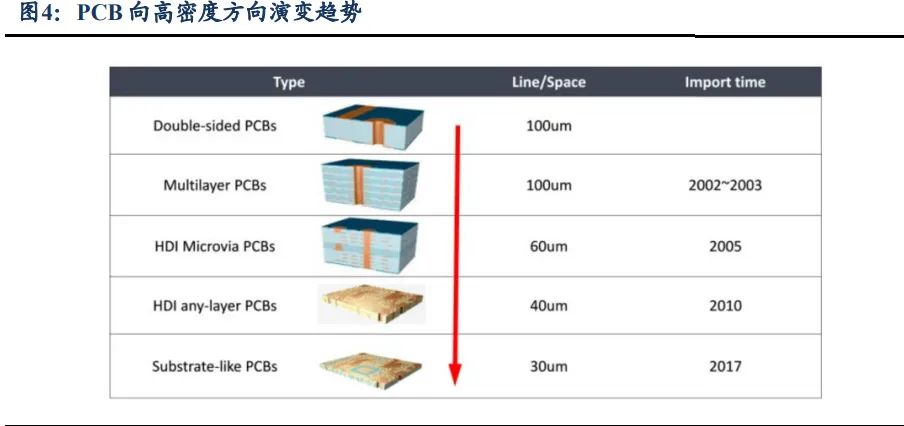
At present, PCB from the early single/double layer, multilayer boards, to HDI Micro via PCBs, HDI Any Layer PCBs, as well as the current hot class carrier board direction upgrade, the product line width line spacing gradually narrowed. HDI compared to the traditional PCB can be realized in smaller aperture, finer line width, less number of through holes, saving PCB can be routed area, significantly increase component density and improve RF interference/EMI, etc. SLP (substrate-like PCB, class carrier board), compared to HDI, can be used in a wide range of applications. Component density and improve RF interference / electromagnetic wave interference, etc. SLP (substrate-like PCB, class carrier board), compared with HDI board can be shortened from 40/50 micron line width / line spacing from HDI to 20/35 micron, the same area of the number of electronic components can be carried to the same area of twice the number of HDI, has been in the Apple, Samsung and other high-end cell phone products in use.
PCB board product process upgrades, the number of layers of copper-clad board increased, the key technical indicators of the performance level. With the upgrading of PCB products, the production process has also been adjusted to change the current PCB and IC carrier board production process there are three main, respectively, is the reduction into the method, the addition into the method and improved semi-addition into the method. Reduced into the production of fine lines in the yield is very low, and additive method is suitable for the production of fine circuits but the cost is higher and the process is not mature, half-additive method can make the signal line wiring is more compact, conductive paths between the distance between the shorter, which can significantly improve the yield, mainly used for the production of SLP (substrate-like PCB, class of carrier boards).
With the increase in product density, the number of layers of copper-clad laminates increased, copper-clad laminates accounted for about 30% of the total cost of the PCB board will increase significantly affect the cost of the PCB. Copper cladding board performance directly affects the speed and quality of signal transmission in the PCB board, generally dielectric constant (Dk) and dielectric loss factor (Df) as an index of investigation, Dk affects the speed of signal propagation, Df value mainly affects the quality of signal transmission, currently in the high-speed, high-frequency, radio frequency board products, Dk value and Df value have been realized at a significant level of reduction in the protection of information transmission. pcb boards Improvement of the performance of the press, drilling machines and other core equipment, capacity and technology level requirements have gradually increased, the capital investment requirements of enterprises to enhance.
PCB boards are widely used in various downstream products, server application growth rate is higher than the industry average. PCB is widely used in areas including communications, consumer electronics, computers, automotive electronics, industrial control, military, aerospace, medical equipment and other fields. According to Prismark data, in 2021, the global PCB market downstream the first major application for the field of communications, accounting for 32%; followed by the computer industry, accounting for 24%; and then the field of consumer electronics, accounting for 15%; the server field accounted for 10%, the market size of $ 7,804 million, is expected to reach 13,294 million U.S. dollars in 2026, a compound growth rate of 11.2%! It is the fastest growing downstream area, higher than the industry average of 4.8%.
Other downstream application fields are rapidly expanding and upgrading, and PCBs in the server field are developing in the direction of high-speed and high-frequency. PCBs are developing in the direction of miniaturization, lightweight, and multifunctionality, for example, in the consumer electronics field, PCBs need to be equipped with more components and reduced in size due to the continuous development of smartphones and tablet PCs towards miniaturization and diversification of functions. In the field of computers and servers, in the high-speed and high-frequency 5G era and the AI wave, the communication frequency and transmission rate have increased dramatically, and PCBs need to work at high frequency and high speed, have stable performance, and can take on more complex functions, and meet the technical specifications of low dielectric constant, dielectric loss factor, and low roughness. Currently, servers/memory require six to sixteen layers of boards and packaging substrates, with high-end server motherboards having more than sixteen layers and backplanes having more than twenty layers. With the increase in demand for servers in the future, PCB technology needs to be upgraded continuously.