




Reliable and stable communication interconnectivity is the lifeblood of industrial automation. Given the vast number of sensors and actuators within industrial equipment, and the multitude of systems and protocols prevalent in real-world industrial scenarios, countless traditional gateways are employed to transmit and convert data throughout the entire process. Industrial automation must account for IT systems' requirements for open data access and real-time control.
Industrial Ethernet has played a significant role in this regard, substantially enhancing the efficiency and synchronization of large-scale data transmission compared to fieldbus systems. Hardware-wise, Ethernet switching equipment comprises Ethernet switch chips, CPUs, PHYs, PCBs, and interface/port subsystems, with the Ethernet switch chip being a critical component. These chips are specialized for switching and processing large volumes of data and message forwarding, serving as application-optimized integrated circuits for networking. Major switch chip suppliers typically offer commercial-grade products with comprehensive protocol support and robust functionality.
Switch Chip Integration
Network switching functions are typically implemented at Ethernet's Layer 2 MAC. Early Ethernet switch chips generally only contained the MAC layer, relying on PHY chips at Layer 1 to establish actual Ethernet connections. With technological advancements and growing user demand for simplified system architectures, network switch chips integrating the physical layer (PHY) and link layer (MAC) emerged and gained widespread adoption.
Currently, many 10M/100M switch chips have achieved this integration. However, 10G switch chips and Gigabit ports on standard switches still typically require dedicated PHY chips. When discussing Ethernet connectivity, Broadcom is a key player. Broadcom has long been a leader in the Ethernet switch chip sector, offering the industry's most comprehensive range of Ethernet switching equipment and chips.
Regarding integration, Broadcom's Roboswitch architecture Ethernet switching solution features 5-24 port configurations supporting Fast Ethernet and Gigabit Ethernet (GbE). Within these high-speed and Gigabit Ethernet switching solutions, all functions of a high-speed switching system-including packet buffers, physical layer transceivers, media access controllers (MAC), address management, port-based rate control, and non-blocking switching fabric-are integrated into a single CMOS chip. This level of integration is exceptionally high for industrial applications.
To ensure high data processing capacity during collaborative operations, the internal logic pathways of the switch chip are extremely complex. Industry-leading architectures from major manufacturers support multiple speeds including 100M/1GE/2.5GE and 10GE, utilizing 2.5GbE/10GbE speeds to achieve high-speed uplink connections. The integrated switch chip also incorporates a CPU directly within it, enabling the design of a single-CPU-managed switching platform that supports cascading mode without requiring an external processor.
In data center scenarios and deep learning network applications, switch chips achieve even higher integration levels. For instance, the market's highest-integration, highest-bandwidth StrataXGS series features integrated single-chip solutions capable of scaling from several gigabits to several terabits.
Multi-Protocol Support
The prevalence of industrial communication protocols is widely recognized, and multi-protocol switch chips undoubtedly hold greater appeal in industrial applications, significantly reducing design complexities. ADI's FIDO5100 and FIDO5200 multi-protocol switch chips achieve protocol support through customizable settings, utilizing firmware downloaded from the host processor. This firmware is integrated into the real-time Ethernet multi-protocol switch driver and is downloaded during power-up.
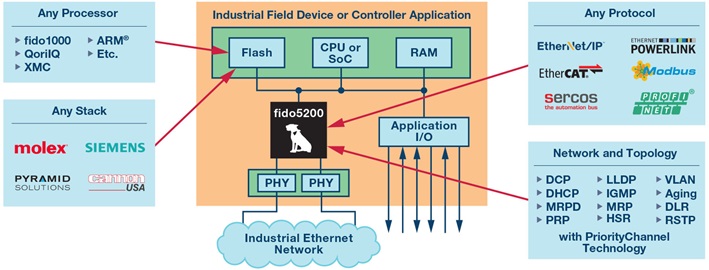 (Full protocol support, ADI)
Scalable and flexible configurations enable the switch chip to seamlessly interface with any host processor. By leveraging device drivers for specific protocols, it facilitates flexible system partitioning while offering greater freedom to utilize protocol stacks from any vendor-simply integrate the protocol stack with the multi-protocol switch chip driver. The switch chip's multi-protocol support significantly enhances efficiency in industrial automation scenarios.
Unrelenting Pursuit of Efficient Data Transmission and Real-Time Demands
Regardless of technological trends, the core requirements for efficient transmission and low latency remain constant for switch chips. This is particularly critical in industrial applications where motion control demands stringent real-time performance. The aforementioned FIDO series employs a Timer Control Unit (TCU) to implement synchronization mechanisms for various industrial Ethernet protocols, supporting EtherCAT cycle times as low as 12.5μs and PROFINET cycle times as low as 31.25μs.
Microchip's single-chip VSC75XTSN series integrates full hardware support for IEEE 1588v2 Precision Time Protocol (PTP), including hardware timestamping for all PHY-MAC interfaces and a high-resolution hardware PTP clock. This delivers sub-microsecond synchronization for a range of industrial Ethernet applications. The demand for real-time, high-efficiency connectivity continues to drive switch chips toward more efficient transmission and lower-latency synchronization.
Summary
As networks transition from traditional fieldbus and 4mA to 20mA connections to Industrial Ethernet, numerous challenges arise during the design and implementation phases of network connectivity. This has driven the evolution of Ethernet switch chips. Powerful and flexible switch chips bring industrial applications closer to achieving the ideal Industrial Ethernet connectivity.