




Recently, the international publication *Robotics & Automation* released a list of the top 22 programmable logic controller (PLC) manufacturers. Japan had as many as nine companies on the list, accounting for nearly half of the total, followed by Germany and the United States. Although there are publicly listed companies in the PLC sector in mainland China, none made it onto this list.
Programmable Logic Controllers, commonly known as PLCs, play a crucial role in equipment manufacturing, particularly in industrial robots, and can be described as the "brain" of industrial robots.
In terms of regional distribution, Japan accounted for as many as nine companies on the list, making up nearly half of the total, followed by Germany and the United States.
Regrettably, only one company from Taiwan made the list. Although there are listed companies in the PLC sector in mainland China, none have made a name for themselves in the international market, and the domestic market is currently almost entirely dominated by foreign brands.
PLC: The Mainstay of Industrial Automation
PLCs (Programmable Logic Controllers) are often referred to as the "mainstay of industrial automation" and are a type of digital electronic system widely used in modern industry.
They utilize a type of programmable memory to store programs and execute user-oriented instructions such as logical operations, sequential control, timing, counting, and arithmetic operations. Through digital or analog input/output, they control various types of machinery or production processes.
As a typical application of industrial automation, PLCs originated in the automotive manufacturing sector. Initially developed to replace relay circuits and primarily perform sequential control, PLC manufacturers later gradually added features such as analog processing, PID control, and more reliable industrial anti-interference technology. Additionally, to meet the demands of networked systems, various communication interfaces were incorporated.
Meanwhile, against the backdrop of Industry 4.0 and driven by the development of fieldbus and Ethernet technologies, the application scope of PLCs has expanded significantly. This includes emerging markets such as electronics manufacturing, industrial robotics, and CNC machine tools, as well as traditional industries requiring upgrades-such as packaging, textiles, and food and beverage. There is also strong demand for PLCs in the field of smart manufacturing, where they are responsible for programming, coordinating the movements of industrial robots, and ensuring seamless coordination with other machines on the production line.
According to research by Mordor Intelligence, the PLC market was valued at nearly $4 billion in 2019 and is projected to reach $4.3 billion by 2025, with a compound annual growth rate (CAGR) of 3.7%. The largest growth is expected to come from the automotive manufacturing sector.
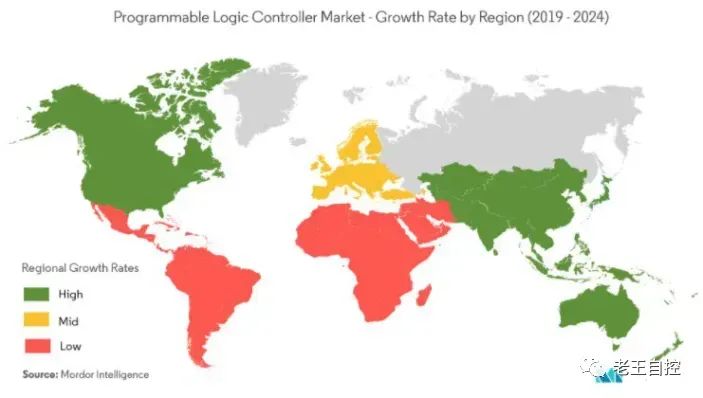
Growth in global PLC market demand over the next few years. Since Europe is already a highly developed industrial region, the growth rate of PLC demand there is moderate, whereas China and India are experiencing very high growth rates.
China has long been a major industrial manufacturing powerhouse and has now become the region with the highest demand growth outside of the United States. Unfortunately, the domestic PLC market has long been dominated by foreign manufacturers such as Rockwell, Schneider, and Siemens. The market penetration rate of domestic brands is only around 10%, and they are mostly concentrated in the low- to mid-range PLC segment, operating under an OEM manufacturing model.
Based on functionality, PLCs are generally classified into three categories: low-end, mid-range, and high-end. Low-end PLCs only possess logic operation functions, such as timing, counting, shifting, as well as self-diagnosis and monitoring; Mid-range PLCs add robust analog input/output, analog-to-digital conversion, data transmission and comparison, arithmetic operations, remote I/O, and communication networking capabilities, making them suitable for more complex control systems; high-end PLCs include functions such as matrix operations, bit logic operations, square root calculations, other special function operations, tabulation, and table transmission, and can be used for large-scale process control or to build distributed network control systems.
The leading companies in China's PLC market are primarily Xinjie Electric and Huichuan Technology, both of which are publicly listed companies with over 10 years of operation and proprietary R&D capabilities. While they currently focus on the small-scale PLC segment, they are gradually entering high-end application areas and integrating into the supply chains of major clients. The future prospects for domestic substitution are promising.
Japanese firms account for nearly half the market; no mainland Chinese companies made the list
Below are the top 22 programmable logic controller manufacturers as selected by *Robotics & Automation*.
Japanese companies dominate the list with nine entries, accounting for nearly half of the total. These are all large enterprises, including industrial automation specialists such as Mitsubishi Electric, Omron, and Hitachi Industrial Equipment Systems, as well as giants in the electronics and semiconductor sectors like Panasonic and Toshiba. This clearly demonstrates Japan's industrial strength.
German companies rank second with five entries. In addition to the renowned engineering firm Siemens, the list includes several smaller startups. A defining characteristic of these startups is that they are "small but beautiful" ("hidden champions"). Although they are small in scale and unlisted, they possess strong technical capabilities, high-quality products, and very substantial revenue. A prime example is Phoenix Contact, which employs 16,000 people yet generates an astonishing annual revenue of 2.3 billion euros.
There are two U.S. companies on the list, both long-established players in the industrial automation sector: Rockwell Automation and Honeywell.
It is worth noting that the only Chinese company on the list is Delta from Taiwan, a long-established enterprise founded in 1971 and the world's leading manufacturer of computer power supplies. The company offers a wide range of PLC equipment, covering various industries from industrial robots to smart buildings. Its products feature unique modular systems and "hot-swap" capabilities, meaning components can be replaced without halting the entire operation.
1. Siemens
SIMATIC S7-1500 CPU
As Europe's largest engineering company, Siemens is headquartered in Munich and Berlin, Germany, with a market capitalization exceeding $93 billion and annual revenue of $87 billion. According to estimates, Siemens is the clear leader in the PLC sector, holding a market share of approximately 30% to 40%. Siemens offers the MindSphere IoT operating system, as well as automation and industrial software for discrete manufacturing, industrial communications, and industrial safety.
SIMATIC is Siemens' proprietary brand for its automation product series. Public records indicate that SIMATIC controllers have evolved from the S3 series to the S7 series. Siemens states that its SIMATIC series of controllers are "suitable for every application."
2. Rockwell Automation / Allen-Bradley
Rockwell Automation integrates well-known brands in the industrial automation sector, including Allen-Bradley's control products and engineering services, as well as automation management software developed by Rockwell Software. Headquartered in Milwaukee, Wisconsin, Rockwell Automation has branches in over 80 countries and currently employs approximately 22,000 people.
As early as 1985, Rockwell Automation acquired Allen-Bradley in a massive deal valued at approximately $1.6 billion. Allen-Bradley is a long-established brand founded in 1903, the same year as Rockwell. Today, Rockwell Automation has become one of the world's largest industrial automation companies. It has a market capitalization of $25 billion and annual revenue of approximately $7 billion.
3. Mitsubishi Electric
Mitsubishi Electric's New Safety PLC
Mitsubishi Electric has a market capitalization of approximately $28 billion and is one of the larger business divisions within Japan's Mitsubishi Group, employing as many as 350,000 people. In 2017, Mitsubishi Electric's annual revenue reached $37 billion, exceeding its current market capitalization.
The company primarily engages in information and communication systems, electronic components, heavy electrical systems, industrial automation systems, automotive electrical equipment, and home appliances, and holds a leading global position in fields such as satellites, defense systems, and ventilation equipment.
4. Schneider Electric
Schneider Electric is a French multinational corporation. While it is less well-known outside the industrial sector compared to other companies on this list-partly because it has no notable consumer products-it remains a leading supplier of PLCs. One of Schneider Electric's brands, Modicon, produced the first PLC in the United States as early as 1968. Subsequently, through a series of mergers and acquisitions, Schneider Electric emerged as a major player in 1999. Today, Schneider Electric employs 135,000 people, has a market capitalization of approximately $55 billion, and generates annual revenue exceeding €27 billion.
5. ABB
This Swiss industrial giant has achieved remarkable success in recent years, launching numerous new products such as the world's first true collaborative robot, "YuMi," and the industrial IoT platform Ability. Today, ABB boasts a market capitalization of $50 billion, annual revenue of $28 billion, and a workforce of 144,000 employees.
ABB is also one of the world's largest industrial robot manufacturers, offering a wide range of PLC products, making its inclusion on this list a natural fit.
6. Honeywell Process Solutions
Honeywell Process Solutions is one of the business divisions of Honeywell International. Headquartered in the United States, Honeywell employs 114,000 people, generates annual revenue of nearly $42 billion, and has a market capitalization exceeding $103 billion. Honeywell considers itself a cutting-edge computing company and is currently competing with Google and IBM in the field of quantum computing.
The PLCs currently offered by Honeywell Process Solutions belong to its Control Edge series. The previously released Control Edge PLC was one of the first controllers to support Honeywell's Industrial Internet of Things (IIoT).
7. Omron
This Japanese company frequently launches hundreds of products at once and is an expert in PLCs, with a broad product range that includes industrial robots and sensors. Omron's PLC lineup includes both micro and modular versions; overall, it likely offers the largest number of individual models.
Founded in 1933, the company employs nearly 40,000 people, has a market capitalization of approximately $14 billion, and generates annual revenue exceeding $8 billion.
8. Hitachi Industrial Equipment Systems
Hitachi was once a globally renowned company. Today, it develops many advanced computing technologies in the industrial sector and boasts a strong product line, particularly in smart TVs.
Hitachi is a $36 billion giant with well over 300,000 employees and annual revenue nearing $90 billion. Its PLC offerings range from general-purpose models to specialized versions designed for factory engineering.
9. IDEC
Compared to some of the global giants on this list, IDEC is a smaller company with a market capitalization of $523 million and annual revenue of around $500 million.
This Japanese PLC company relies on Ethernet networking, and its devices can be accessed via a standard web browser. This means many of IDEC's customers use it for remote machine monitoring; its MicroSmart Pentra PLC enables them to monitor in real time, receive email alerts, and customize their own web pages.
10. B&R Industrial Automation
This relatively young Austrian company, founded in 1979, operates 190 offices across 68 countries. Its 2016 annual revenue was €620 million, with a workforce of 3,000 employees. These were the final figures for B&R Industrial Automation as an independent company, as ABB acquired the firm the following year for an undisclosed amount. B&R offers a wide range of industrial automation products, including PLCs.
11. Bosch Rexroth
Bosch is one of the world's leading German suppliers of household appliances. In 2001, Bosch's automation technology division merged with Mannesmann Rexroth. As a result, Bosch Rexroth has over 33,000 employees and annual revenue of approximately €5.5 billion.
Its PLC lineup includes Windows-based IoT systems with modular options, featuring real-time communication via Ethernet and the Sercos automation bus, as well as synchronized motion control capabilities.
12. Koyo Electronics Industries
Founded in 1955, this Japanese company originally manufactured radios but now specializes in industrial automation technologies such as PLCs and other electronic control devices, as well as imaging and automotive systems. Its Direct Logic brand of PLCs, alongside other brands such as Kostac PLC, offers a relatively broad product range to the market. Its parent company, JTEKT, has a market capitalization of approximately $2.7 billion. JTEKT is also a subsidiary of Toyota.
13. Delta
Founded in 1971, Delta is a long-established Taiwanese company and the world's leading manufacturer of computer power supplies. It focuses on three major business segments: "Power Supplies and Components," "Energy Management," and "Smart Green Living."
The company's business scope is impressively broad, ranging from industrial robots to smart buildings, most of which rely on PLCs for smooth operation. Consistent with its diverse business portfolio, it offers a wide variety of PLCs, including modular systems and "hot-swappable" systems, which can be replaced without halting the entire operation.
Its current market capitalization exceeds $16 billion, with over 83,000 employees and annual revenue of approximately $9 billion.
14. Eaton
Eaton is another long-standing name in the industrial sector, founded in Ireland in 1911. Today, it employs over 100,000 people and generates annual revenue of approximately $21 billion. Its current market capitalization is nearly $37 billion.
Eaton's business divisions span aerospace, automotive, and, of course, the industrial sector. Within the industrial sector, it is perhaps best known for its hydraulic, clutch, and transmission systems. Eaton emphasizes the user-friendliness of its PLCs, particularly its Easy PLC series, as well as the modular capabilities of its XC and XN devices.
15. Keyence
Keyence, a Japanese industrial automation company, consists of 16 organizations, all of which offer products in the same field, ranging from sensors and lasers to micrometers and microscopes. In the PLC sector, the company offers both compact and modular products in its KV series.
The company employs approximately 6,600 people, generates annual revenue of nearly $5 billion, and has a market capitalization exceeding $1 billion.
16. LS Electric
LS Electric is a spin-off from South Korea's LG Electronics Group. It employs approximately 3,500 people and generates annual sales of about $2 billion. Its market capitalization is approximately $1.4 billion.
The company offers a wide range of PLC products, with LG Electronics likely being its largest customer. Its product lineup includes specialized motion and positioning modules.
17. Panasonic
In the public eye, Panasonic is primarily known as an electronics company, and this is indeed true. However, it also wields significant influence in the industrial sector, serving as Japan's largest motor manufacturer and ranking among the country's top eight motor companies. In the PLC sector, Panasonic offers a full range of products, from entry-level devices to high-performance modular and scalable versions.
The company employs 270,000 people and generates annual revenue of $75 billion. Its market capitalization exceeds $23 billion.
18. Phoenix Contact
A small, privately held German company with 16,000 employees, yet it generates an impressive annual revenue of 2.3 billion euros.
Its product range is extensive and diverse, and it offers various types of PLCs, some of which are specifically designed for building infrastructure. Additionally, there is a PLC called PLCnext Control, designed specifically for industrial automation operations.
19. Pilz
This is a very small German company specializing in industrial control systems, including PLCs. With only 2,300 employees, it operates 40 subsidiaries and generates annual revenue exceeding €340 million.
According to reports, Pilz offers aesthetically pleasing PLCs suitable for "complex, interconnected factories."
20. WAGO Kontakttechnik
This is another privately held German company, also relatively small in scale with only about 8,500 employees, though its annual sales reach $1 billion.
The company's strength lies in its exceptional R&D capabilities, having developed numerous innovative technologies across various fields. Targeting high-end customers, it is described as delivering "the highest performance in extreme environments."
21. Yokogawa Electric
Yokogawa Electric is another large Japanese industrial company specializing in electrical engineering and software. It employs 18,000 people, generates annual revenue of $3.7 billion, and has a market capitalization of approximately $4.3 billion.
Interestingly, it offers only one type of PLC-the FA-M3 series-which is described as "ultra-high-speed" and "extremely stable." With this single product alone, Yokogawa has established its dominant position in the PLC market.
22. Toshiba
Toshiba has long been known as Japan's largest semiconductor manufacturer, but it is also Japan's second-largest diversified electronics manufacturer and a subsidiary of the Mitsui Group, one of Japan's three major conglomerates. Founded in 1939, the company currently employs over 140,000 people, with annual revenue of approximately $35 billion and a market capitalization of $15 billion.
Toshiba's PLC products are primarily focused on the micro-PLC market, but they are capable of performing simple sequential control for large-scale process and automation systems.