




1 Introduction
In industrial automation, wired communication methods for data transmission between mobile vehicles and central control rooms are inconvenient due to the need to drag communication cables; wireless communication methods, on the other hand, suffer from high error rates due to the harsh conditions of industrial environments. Induction-based wireless data communication (Data Transmission by Induction Radio) utilizes electromagnetic induction between a coded cable (also known as an induction bus) and an induction antenna to exchange information. Because the wireless communication range is strictly limited to 5–20 cm, this method ensures both the flexibility of locomotive movement and the reliability of communication quality, while also enabling real-time tracking of the moving locomotive's position during communication.
Electrical equipment in industrial settings, particularly variable-frequency speed control devices on moving locomotives, can generate strong harmonics that are identical to or similar to the carrier frequency of inductive wireless data communication. This co-frequency interference cannot be attenuated by bandpass filters. If effective measures are not taken at the input to suppress it, the error rate of inductive wireless data communication will increase significantly, potentially rendering the system inoperable. The Phase I coke oven electrical system retrofit at Baosteel utilized equipment imported from Japan. In actual operation, "frequent interruptions in the induction busbar communication were observed, with analysis attributing the cause to random strong interference and antenna detection distortion." Consequently, in some practical applications, inductive wireless technology has been abandoned for data communication, with only inductive wireless position detection technology being adopted.
To suppress interference in inductive wireless data communication, experts and scholars in the field have conducted extensive research. One study proposed an inductive wireless differential receiving antenna configuration, while another suggested a method using dual receiving antennas with a single transmission line. The "crossed dual transmission lines with a single receiving antenna at equal spacing" co-channel interference suppression technique for inductive wireless data communication presented in this paper can effectively suppress co-channel interference noise, improve the signal-to-noise ratio, and is suitable for ground-based position detection.
2 Basic Principles of Inductive Wireless Data Communication
To analyze the principle by which co-channel interference suppression technology improves the signal-to-noise ratio in inductive wireless data communication, we first provide a brief analysis and introduction to the basic principles of inductive wireless data communication.
2.1 Encoded Cable and Inductive Antenna
The encoded cable is flat in shape and contains several pairs of transmission lines that cross at specific points according to a defined coding scheme. The encoded cable is installed along the tracks of the mobile locomotive, with one end connected to the central control room.
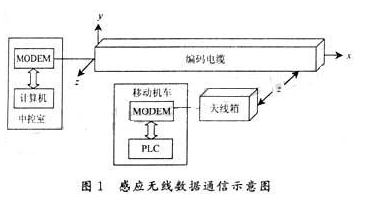
The induction antenna consists of two sets of coils-one serving as the transmitter antenna and the other as the receiver antenna-encased in a plastic box, commonly referred to as the antenna box. The antenna box is mounted on the moving locomotive and connected to the locomotive's control cabinet. The antenna box moves with the locomotive and maintains a distance of 5–20 cm from the coded cable at all times. See Figure 1.
When the antenna box is positioned close to the encoded cable, each pair of transmission lines in the encoded cable induces a response in the coils within the antenna box, thereby establishing a short-range wireless communication channel between the antenna box and the encoded cable.
2.2 Analysis of the Amplitude and Phase of the Induced Signal
Figure 2 shows a schematic diagram of transmission line L laid flat alongside the antenna coil. In Figure 2, the width of the antenna and the spacing between the two intersecting transmission lines in the encoded cable are both equal to W, where W = 2r.
Definition: The center point of the antenna coil is defined as the antenna coil position; the region between two intersections of transmission line L is referred to as region K of transmission line L (K = I, II, III, …), and the distance d represents the deviation of the antenna coil position x from the centerline of the corresponding region K.
Using the antenna coil as the transmitting coil, we analyze the induced electromotive force e generated in the communication transmission line. According to the theory of electromagnetic induction, when a current i = Imsinωt flows through the antenna coil, the induced emf e in the transmission line is e = di/dt. Here, the mutual inductance coefficient M is a function of the antenna coil's position (x, y, z). Assuming that y and z remain constant as the antenna coil moves along the x-direction, then:
e = f(x)ωImcosωt
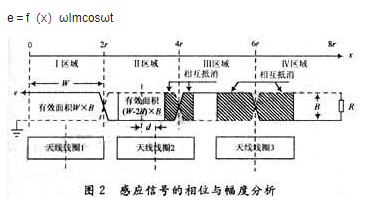
Because there is a junction, the induced emf eI generated in region I of the transmission line is out of phase with the induced emf eII generated in region II. If we take the phase of eI as the reference, let
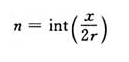
When n is even, the induced emf e in the transmission line is in phase with eI; when n is odd, e is out of phase with eI, and the phase coefficient is (–1)n.
When the distance z between the transmitting coil and the encoded cable is small, the magnetic flux lines generated by the transmitting coil can be approximated as being uniformly distributed along the x-direction and passing perpendicularly through the transmission line. Therefore, the magnitude A of the induced electromotive force e generated in the transmission line is proportional to the effective induction area of the transmission line. As shown in Figure 2, when the antenna coil is at position 1 (d = 0), the effective induction area S = W × B is at its maximum, and A = Amax. At position d = r of antenna coil 3, the effective induction area S = 0, and A = 0. At the position of antenna coil 2, the effective induction area S = (W – 2d) × B. We obtain:
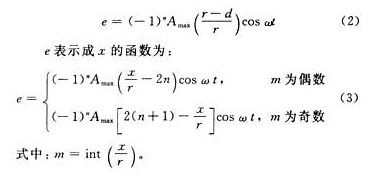
Conversely, if a current is passed through the communication transmission line and the antenna coil is used as the receiving coil, Equations (1) through (3) still hold true based on the principle of mutual inductance.
3 Interference Noise Suppression Techniques
To suppress interference, particularly co-channel interference noise, the most effective approach is to prevent interference noise from entering the receiving end. Therefore, the design philosophy is as follows: by implementing a reasonable design for the receiving end in the control room-the encoded cable communication transmission line-and the receiving end on the vehicle-the receiving antenna-interference noise is attenuated while communication signals are attenuated as little as possible, not attenuated at all, or even amplified, thereby achieving the goal of improving the signal-to-noise ratio.
3.1 Design of Two Transmission Lines Crossing a Single Receiving Antenna at Equal Spacing
In the "design of two transmission lines crossing a single receiving antenna at equal spacing," two pairs of crossed communication transmission lines, L0 and L1, are arranged within the encoded cable. A single transmitting antenna and a single receiving antenna are used; the receiving antenna is formed by winding conductors in a crossed pattern over multiple turns, and can therefore be regarded as consisting of receiving coil 1 and receiving coil 2. The spacing between the crossed transmission lines, the spacing between the crossed receiving antennas, and the width of the transmitting coil are all W. As shown in Figure 3.
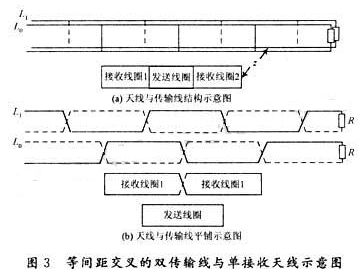
Figure 3(a) shows the actual structure and a schematic diagram of the operation. Figure 3(b) is a simplified schematic diagram of transmission lines L0 and L1, the transmit antenna, and the receive antenna, laid out flat for ease of analysis; in actual applications, W = 20 cm.
3.2 Analysis of Transmission Line Interference Suppression
When a signal current is applied to the transmit antenna on the locomotive, the control center receives the signal via the communication transmission lines. To suppress interference noise, transmission line L0 is crossed at regular intervals of W. From a distance, this appears as a twisted-pair cable, providing interference noise suppression ranging from several dB to 30 dB, with an average of as much as 15 dB.
For communication signals, according to Equation (3), the amplitude AL0 of the induced signal on the communication transmission line L0 is a function of the antenna position x. When the center of the transmitting coil is aligned with any intersection point on L0, AL0 = 0, resulting in a channel dead zone. To avoid this situation, an additional pair of communication transmission lines, L1, is arranged within the coding cable, with their intersection points offset from those of L0, as shown in Figure 3. Let d0 and d1 represent the distances by which the position x of the transmitting coil is offset from the centerlines of the L0 and L1 transmission lines, respectively; then, r = d0 + d1. Let eL0 represent the signal induced by transmission line L0, and eL1 represent the signal induced by transmission line L1. In the control room's electronic equipment, the signal e'L1-which is eL1 shifted by 90°-is summed with eL0 to obtain the composite signal e. According to Equation (2), we have:
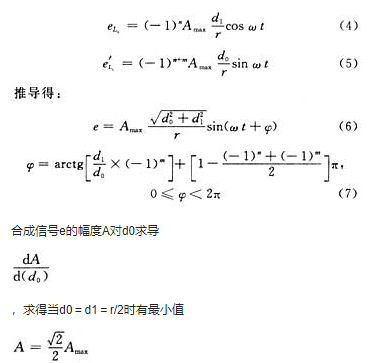
At this point, the transmit antenna is in the worst possible position. The vector diagram of e is shown in Figure 4.
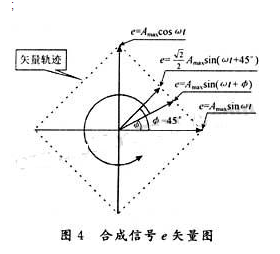
The above analysis indicates that the crossed dual-transmission-line receiver shown in Figure 3 is highly effective at suppressing interference noise. For communication signals, there is a 3 dB attenuation when the transmit antenna is in the worst-case position.
3.3 Analysis of Interference Suppression by the Receiving Antenna
For interference noise, traditional receiving antennas consist of single coils without cross-coupling and lack interference resistance. The receiving antenna shown in Figure 3, however, features receiving coils 1 and 2 that are crossed. During operation in the field, the interference noise electromotive forces eN1 and eN2 induced in the two coils are out of phase. If the noise electromagnetic waves are uniformly distributed within a small 2W area along the x-direction of the receiving antenna, then eN1 = −eN2, and the noise electromotive force extracted by the receiving antenna, eN, is eN1 + eN2 = 0.
For communication signals, the modulated signal f₀ to be transmitted by the central control room is amplified and transmitted via transmission line L₀; the signal f₁ (which is 90° out of phase with f₀) is amplified and transmitted via transmission line L₁. These two signals generate a combined electromagnetic field in the space near the coding cable, which is detected and received by the receiving antenna located near the coding cable. Since f₀ and f₁ are orthogonal, channel dead zones are avoided. The induced signals generated in a traditional receiving antenna are described by Equation (6). As shown in Figure 3, the receiving antenna generates induced electromotive forces e(1) and e(2) in receiving coils 1 and 2, respectively. Due to the characteristics of equidistant crossing, the receiving antenna satisfies the following at any position:
(1) d0(1) = d0(2), d1(1) = d1(2); according to Equation (6), the magnitudes of e(1) and e(2) are equal;
(2) If the electromagnetic field generated in region K of transmission line Li (i = 0, 1) dominates reception coil 1, then the electromagnetic field generated in region K+1 dominates reception coil 2. Due to the crossing of the transmission lines, the electromagnetic field generated in region K+1 is out of phase with that generated in region K. Since reception coil 2 is crossed with reception coil 1, after two phase inversions, the phases of e(1) and e(2) become the same.
Therefore, the induced electromotive force e = e(1) + e(2) = 2e(1) extracted by the receiving antenna from the communication signal is twice that of a conventional receiving antenna.
Additionally, when the transmit coil sends a signal, the voltage across both ends of the transmit coil is 200 Vp-p. To prevent the strong transmitted signal from damaging the receiver's preamplifier circuit, the transmit coil is placed between the two coils of the receiving antenna. In this way, the electromotive force induced in the receiving antenna by the transmit antenna signal is approximately zero.
3.4 Experimental Analysis of Receiving Antenna Interference Suppression
The experimental conditions were as follows: the total length of the transmission line was 3 m, and W = 20 mm. A set of actual inductive wireless data communication equipment was used, with a communication rate of 4800 b/s, FSK modulation, and a carrier frequency of 49 kHz. During normal operation, the peak current of the modulated signal passing through L0 was 0.07 A; the peak current of the modulated signal passing through the transmit antenna coil was 0.38 A.
During the experiment, the distance z between the transmitting coil and the encoded cable was maintained at 200 mm, and the center of the transmitting coil was kept aligned with one crossing of L0. Under these conditions, the amplitude of the induced signal voltage on transmission line L1 was measured to be VL1 = 25 mVp-p, and the amplitude of the induced signal voltage on the receiving antenna was measured to be VA = 20 mVp-p.
If a signal generator is used as the interference source and a pair of parallel wires is used for coupling to induce interference, see Figure 5. The signal generator outputs an interference voltage v = Vm sin(2πft), where f = 49 kHz and R = 130 Ω.
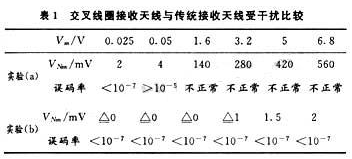
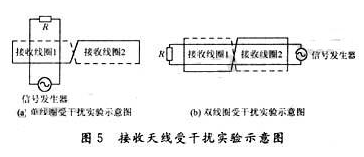 The experiment shown in Figure 5(a) corresponds to interference in a conventional receiving antenna, while the experiment shown in Figure 5(b) corresponds to interference in the crossed coils of a receiving antenna. Let VNm (peak-to-peak) denote the interference-induced electromotive force extracted from the receiving antenna. Table 1 presents the data for both experiments.
Experimental results show that the system achieves an interference noise suppression of up to 48 dB. The theoretical and experimental analyses presented above demonstrate that the use of equidistant crossed receiving antennas not only provides strong interference noise suppression but also offers a 6 dB gain in communication signals compared to traditional receiving antennas, thereby significantly improving the signal-to-noise ratio.
4 Conclusion
The interference suppression technique involving "crossing dual transmission lines with a single receiving antenna at equal distances" has been applied in a computer-based centralized control management system for mobile locomotives utilizing inductive wireless technology. In practical applications, this technique has proven effective in suppressing interference in industrial environments, particularly in effectively suppressing co-channel interference generated by variable-frequency speed control devices, thereby ensuring the reliability of data communication. Of course, the interference suppression technology for inductive wireless data communication proposed in this paper only addresses noise suppression at the receiving end. For electronic equipment operating in harsh industrial environments, additional measures such as grounding and shielding must be implemented; these are beyond the scope of this paper.