



Industrial robot is a set of machinery, electronics, control, computers, sensors, artificial intelligence and other multidisciplinary advanced technology in one of the modern manufacturing industry in the important automation equipment. Robotics, CNC technology and PLC technology are known as the three major supporting technologies for industrial automation. Robotics technology and its products are developing very rapidly, and have become the automation tools for flexible manufacturing system (FMS), factory automation (FA), computer integrated manufacturing system (CIMS), as well as an important part of industry 4.0 intelligent factory.
1. Industrial robot system composition and performance indicators
1) Industrial Robot System Composition
An industrial robot is a multi-jointed manipulator or a multi-degree-of-freedom machine device oriented to the industrial field, which can perform work automatically, and is a kind of machine that relies on its own power and control ability to realize various functions. It can accept human command, or run according to a pre-programmed program, modern industrial robots can also be based on artificial intelligence technology to develop the principle of program action. A typical industrial robot is shown in Figure 1. Industrial robots can be divided into three generations according to the level of technological development: the first generation of demonstrative reproduction robots, the second generation of perceptual robots, and the third generation of intelligent robots.
The first generation of industrial robots consists of three main parts in terms of external structure: the operator (or robot body), the controller and the demonstrator. For the second and third generation of industrial robots also includes perception system and analysis and decision-making system, which are realized by sensors and software respectively.
(1) Operator: The main body of the machine that is used to accomplish various operational tasks, which mainly contains a robotic arm, a drive unit, a transmission unit, and internal sensors.
(2) Controller: It is the device to control the robot body to complete certain actions according to the instructions and sensor information, which is the key part to determine the function and performance of the robot, and also the fastest updating and developing part of the industrial robot.
(3) Teacher: It is the human-machine interaction interface of the robot, through which the operator can program the robot or manually manipulate the robot to move.
Industrial robots are functionally composed of 3 main parts and 6 subsystems. 3 main parts are mechanical part, control part and sensing part. 6 subsystems are drive system, mechanical structure system, human-machine interaction system, control system, sensing system, and robot-environment interaction system.
2) Industrial robot performance index
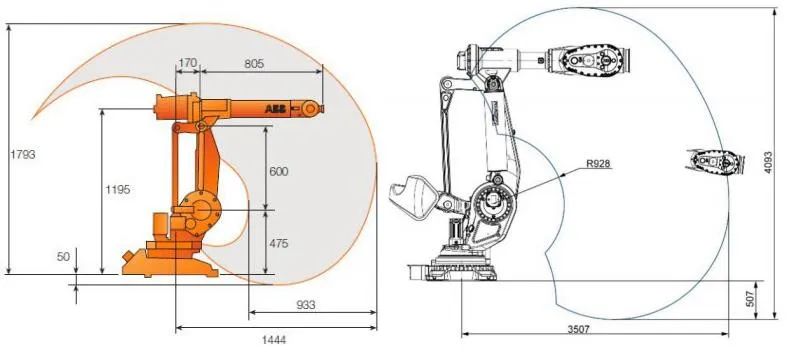
The performance index of industrial robots is the technical data provided by the robot manufacturer at the time of product delivery, reflecting the scope of application and work performance of the robot, which is a must consider when selecting a robot. Although the technical data provided by the robot manufacturer is not exactly the same, the structure of industrial robots, applications and user needs are not the same, but its main performance indicators are generally: degrees of freedom, work accuracy, working range, rated load, maximum working speed.
It is important to note that a robot may have singularities within its operating range. Singularities are points where joints lose degrees of freedom in certain directions due to constraints in the robot structure. Singularities are usually found at the edges of the workspace, and when singularities are grouped together, they are referred to as "voids". When the robot moves near a singularity, the attitude of the joints changes drastically due to the gradual loss of degrees of freedom, which results in a large load on the drive system and overload. Therefore, for robots with singularities, their operating range also requires the removal of singularities and cavities.
2. Control of industrial robots
1) Characteristics and requirements of industrial robot control
The movements of the joints of most industrial robots are independent of each other, and coordination of multiple joints is required in order to achieve positional accuracy of the robot end-effector. Therefore, the industrial robot control system is more complex than an ordinary control system and has the following characteristics:
(1) It is essentially a nonlinear system.
(2) It is a multivariable control system composed of multiple joints, and there is coupling between the joints.
(3) It is a time-varying system whose dynamic parameters change with the change of joint motion position.
(4) It is required to measure and analyze the environmental conditions and control instructions, and automatically select the best control law.
(5) It has high repeatable positioning accuracy and good system rigidity.
(6) Position overshooting is not allowed, otherwise collision may occur, and the dynamic response should be fast.
Considering that industrial robot control has the above characteristics, the following basic requirements must be met when designing the industrial robot control system:
(1) Coordinated control of multi-axis motion to produce the required work trajectory.
(2) High positional accuracy, a large speed range.
(3) The static differential rate of the system should be small, i.e., the system is required to have good rigidity.
(4) Position without overshooting, fast dynamic response.
(5) Acceleration and deceleration control is required.
(6) The speed error coefficient of each joint should be as consistent as possible.
(7) From the operation point of view, the control system is required to have a good human-machine interface, minimize the operator requirements.
(8) From the point of view of the cost of the system, it is required to reduce the hardware cost of the system as much as possible, and more use of software servo methods to improve the performance of the control system.
2) industrial robot control mode
From the control characteristics and control requirements of industrial robots, the realization of the control of industrial robots involves a number of elements, which are mainly divided into the bottom layer control of the robot and the upper layer control. Among them, the bottom layer control includes the robot body (i.e., the mechanical part), the drive circuit part, the sensor part, and the control strategy (e.g., PID control). The upper layer control includes the robot's motion analysis, path planning, and the software part of the robot [4]. According to different categorization methods, robot control can be classified in different ways. According to the controlled object can be divided into position control, speed control, force control, torque control, force/position hybrid control, etc. These are mainly the bottom layer control, and the main control methods are now explained.
(1) industrial robot position control: the purpose is to make the robot joints to realize the pre-planned movement, and ultimately ensure that the industrial robot end-effector running along the predetermined trajectory, usually using AC servo system or DC servo system to achieve.
(2) Industrial machine manpower (torque) control: the need to analyze the robot end-effector and the environment of the constraints state, and according to the constraints to develop control strategies. In addition, a force sensor needs to be installed at the robot end to detect the contact force between the robot and the environment. The control system processes this force information according to the pre-established control strategy, and then controls the robot to perform operations in the uncertain environment that are compatible with that environment, so that the robot can complete complex operational tasks.
(3) Industrial robot speed control: usually realized simultaneously with position control. For example, in the case of continuous trajectory control mode, industrial robots need to control the speed of moving parts and implement acceleration and deceleration according to predetermined instructions, in order to meet the requirements of smooth movement and accurate positioning. Because the industrial robot is a kind of working condition (or travel load) variable, inertia load large movement machinery, to deal with the contradiction between fast and smooth, must control the start acceleration and deceleration before stopping the two transition motion section. And in the whole movement process, speed control is usually necessary.
3) Intelligent control of industrial robots
The intelligent control method of industrial robots mainly refers to the operation under uncertain or unknown conditions, the robot needs to obtain information about the surrounding environment through sensors, make decisions according to its own internal knowledge base, and then control the various actuators to autonomously complete the given task, which belongs to the upper level of robot control. If intelligent control technology is used, the robot will have strong environmental adaptability and self-learning ability. Intelligent control methods are closely related to the development of artificial intelligence such as artificial neural networks, fuzzy algorithms, genetic algorithms, expert systems and so on. The application of neural network algorithms in mobile robots is used as an example to illustrate the combination of intelligent control and industrial robots.
Taking the mobile robot shown in the figure as an example, the camera is installed on the top of the mobile robot to obtain the three-dimensional image of the obstacle. An ultrasonic sensor set is mounted in front of the mobile robot (directly below the camera) to obtain distance information between the obstacle and the mobile robot.
The fusion of visual and ultrasonic sensor information is carried out using neural network methods and output to the next level to recognize the type of obstacle, which enables the mobile robot to avoid obstacles when walking in an uncertain environment and improves its navigation ability. The main steps for industrial robots to utilize intelligent information for integrated decision making to avoid obstacles are as follows:
(1) While the robot is traveling, the ranging system carries out environmental detection at short intervals to determine whether the mobile robot needs to slow down and whether it needs to take samples from the CCD camera based on the distance information about the obstacle obtained by the ultrasonic sensor.
(2) When the distance of the obstacle from the mobile robot is medium as detected by the ranging system, the speed of the robot is reduced; when the distance of the obstacle from the mobile robot is close, a two-dimensional image of the obstacle in question is acquired from the CCD camera, and the coordinates of its left and right edges are extracted.
(3) The information about the obstacle obtained from the ultrasonic sensor and the CCD camera is grouped and preprocessed, and sent to the BP neural network controller for fusion.
(4) The BP neural network controller, which has been pre-learned with the knowledge of obstacle avoidance, makes the corresponding decision of obstacle avoidance according to the information collected by the external multi-sensors and avoids the obstacles.
References
[1] Zhu Hongqian. Industrial robot technology [M]. Beijing: Machinery Industry Press, 2019. [2] Chen Wanmi. Robot control technology [M]. Beijing: Machinery Industry Press, 2017. [3] Guo Tongying, An Dong. Robotics and its intelligent control [M]. Beijing: People's Posts and Telecommunications Press, 2014. [4] Zhang Xianmin. Robotics and its application [M]. Beijing: Machinery Industry Press, 2017. [5] Zhang Xinxing. Fundamentals of industrial robot application [M]. Beijing: Beijing Institute of Technology Press, 2017.