




This article addresses common challenges faced by designers in the industrial automation field when developing position detection interfaces for motor control-specifically, detecting position in applications requiring higher speeds and smaller sizes. Utilizing information captured from encoders to precisely measure motor position is critical for the successful operation of automation and machinery. Fast, high-resolution, dual-channel synchronous sampling analog-to-digital converters (ADCs) are essential components of such systems.
Introduction
Accurate motor rotation information such as position, speed, and direction is essential for producing precise drives and controllers for emerging applications, such as assembly machines that mount micro-components onto PCB areas with limited space. Recently, motor control has begun to miniaturize, enabling new surgical robotics applications in the healthcare industry and new drone applications in aerospace and defense. Smaller motor controllers are also driving new applications in industrial and commercial assembly. For designers, the challenge lies in meeting the high-precision requirements of position feedback sensors in high-speed applications while integrating all components within limited PCB space for installation inside miniature packages, such as robotic arms.
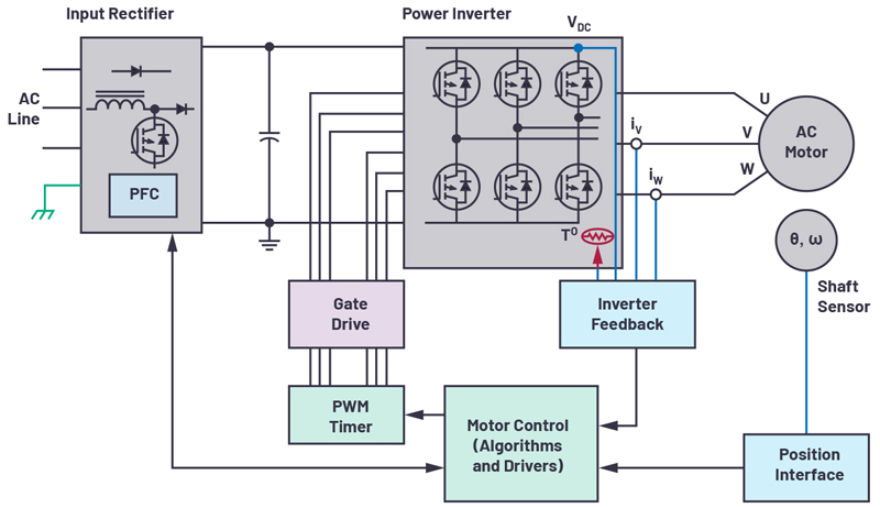 Figure 1. Closed-Loop Motor Control Feedback System
Motor Control
The motor control loop (as shown in Figure 1) primarily consists of a motor, a controller, and a position feedback interface. The motor rotates the shaft, driving the robotic arm to move accordingly. The motor controller manages when the motor applies force, when it stops, or when it continues rotating. The position interface within the loop provides the controller with speed and position information. For assembly machines handling miniature surface-mount PCBs, this data is critical for proper operation. These applications all require accurate position measurement of rotating objects.
Position sensors must possess extremely high resolution to precisely detect the motor shaft's position, pick up corresponding micro-components, and place them at the correct locations on the board. Additionally, higher motor speeds demand greater loop bandwidth and lower latency.
Position Feedback Systems
In low-end applications, position detection may be implemented using incremental sensors and comparators. However, high-end applications demand more complex signal chains. These feedback systems incorporate position sensors followed by analog front-end signal conditioning, an ADC, and an ADC driver. Data passes through these components before entering the digital domain. The most precise position sensor is the optical encoder. An optical encoder consists of an LED light source, a marked disk attached to the motor shaft, and a photodetector. The disk features opaque and transparent masked areas that block or allow light to pass. The photodetector detects these light signals, converting the on/off light pulses into electronic signals.
As the disk rotates, the photodetector (synchronized with the disk's pattern) generates small sine and cosine signals (at the mV or µV level). This configuration is typical for absolute position optical encoders. These signals enter analog signal conditioning circuits (usually comprised of discrete amplifiers or analog PGAs to obtain signals up to 1 V peak-to-peak range), typically to match the ADC input voltage range to the maximum dynamic range. Each amplified sine and cosine signal is then captured by the drive amplifier of a synchronous sampling ADC.
Each channel of the ADC must support synchronous sampling to acquire sine and cosine data points simultaneously, as these combined points provide the axis position information. The ADC conversion results are sent to an ASIC or microcontroller. The motor controller polls the encoder position during each PWM cycle and uses this data to drive the motor according to received commands. In the past, to integrate into limited board space, system designers had to sacrifice either ADC speed or channel count.
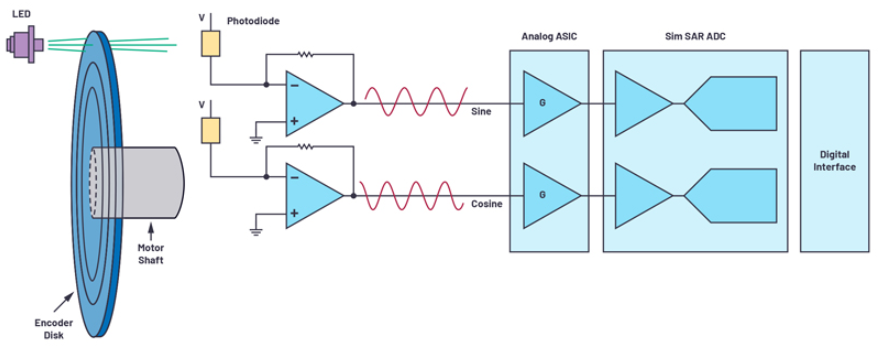 Figure 2. Position Feedback System
Optimize position feedback
As technology continues to advance, motor control applications requiring high-precision position detection are constantly innovating. The resolution of optical encoders may be determined by the number of finely photolithographed slots on the disk, typically ranging from hundreds to thousands. By feeding these sine and cosine signals into high-speed, high-performance ADCs, encoders with higher resolution can be created without requiring system changes to the encoder disk. For instance, sampling the encoder's sine and cosine signals at a lower rate captures only a limited number of signal values, as illustrated in Figure 3; this limits the accuracy of position capacitance. In Figure 3, sampling at a higher rate with the ADC allows acquisition of more detailed signal values, enabling more precise position determination. The ADC's high-speed sampling rate supports oversampling, further improving noise performance and eliminating some digital post-processing requirements. Simultaneously, the ADC's output data rate can be reduced, meaning it supports slower serial frequency signals, thereby simplifying the digital interface. Motor position feedback systems are mounted on the motor assembly, which in some applications may be extremely compact. Therefore, size is critical for fitting the encoder module into the limited PCB area available. Integrating multiple channel components within a single miniature package offers significant space savings.
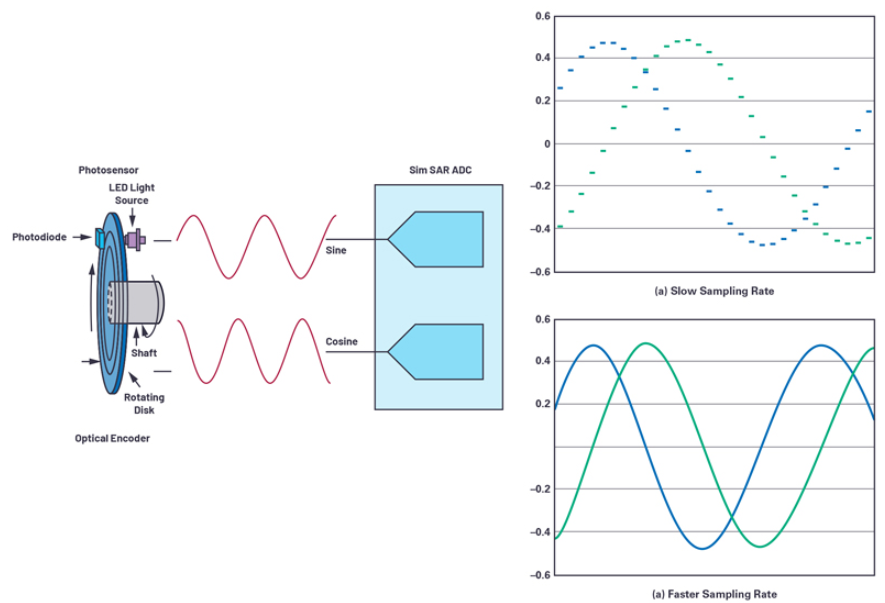 Figure 3. Sampling Rate
Design Example of Optical Encoder Position Feedback
Figure 4 illustrates an example of an optimized solution suitable for optical encoder position feedback systems. This circuit easily interfaces with absolute-type optical encoders, then readily captures the differential sine and cosine signals from the encoder. The ADA4940-2 front-end amplifier is a dual-channel, low-noise, fully differential amplifier used to drive the AD7380. The latter is a dual-channel, 16-bit, fully differential, 4 MSPS synchronous sampling SAR ADC housed in a compact 3 mm × 3 mm LFCSP package. The on-chip 2.5 V reference voltage source enables this circuit to be implemented with a minimal number of components. The ADC's VCC and VDRIVE, along with the amplifier driver's supply rails, can be powered by LDO regulators such as the LT3023 and LT3032. When these reference designs are interconnected (e.g., using a 1024-slot optical encoder generating 1024 sine and cosine cycles per encoder disk revolution), the 16-bit AD7380 samples each encoder slot across 216 codes, increasing the encoder's overall resolution to 26 bits. The 4 MSPS throughput rate ensures capture of detailed sine and cosine cycle information along with the latest encoder position data. This high throughput enables implementation of on-chip oversampling, reducing the time delay when the digital ASIC or microcontroller feeds precise encoder position feedback to the motor. Another benefit of the AD7380's on-chip oversampling is the potential to add an additional 2 bits of resolution, which can be combined with the on-chip resolution enhancement feature. This resolution enhancement further improves accuracy, achieving up to 28 bits. Application Note AN-2003 provides detailed information on the AD7380's oversampling and resolution enhancement capabilities.
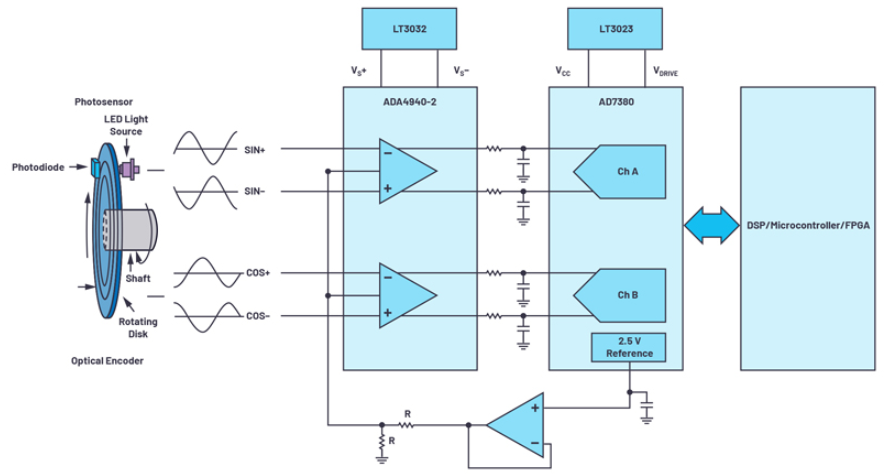 Figure 4. Optimized Feedback System Design
Conclusion
Motor control systems demand higher precision, faster speeds, and greater miniaturization. Optical encoders serve as motor position detection devices. Therefore, the optical encoder signal chain must deliver high accuracy when measuring motor position. High-speed, high-throughput ADCs accurately capture information and transmit motor position data to the controller. The AD7380's speed, density, and performance meet industry requirements while enabling higher precision in position feedback systems and optimizing system implementation.
Author
Jonathan Colao