





Industrial automation is gradually promoted, with the development and use of industrial automation, more and more industrial automation problems are exposed. In order to improve your understanding of industrial automation, this article will provide an overview of how to eliminate electrical noise within industrial automation systems. If you are interested in what this article is about to explore, read on. If you have a strong interest in industrial automation knowledge, you can turn to the editorial previous articles Oh.
Industrial automation systems use microprocessors, digital signal processors (DSPs) and sensor networks to control electromechanical processes. These components are highly sensitive, but operate in an environment filled with electrical noise from motor drives, electromagnetic interference (EMI), and various other sources.
Electrical noise is typically transmitted through the central direct current (DC) power backplane in factory automation equipment. Isolation transformers can remove unwanted noise, but how do you use a transformer on a DC power supply? Use a flyback power converter.
Isolated power supplies can provide noise immunity by eliminating ground loops and transients caused by other devices on the same power bus. Isolated power supplies can also provide protection against dangerously high voltages for sensitive components and humans. The flyback converter is a simple design that contains few components and provides current isolation between input and output.
Flyback converters are derived from reverse buck-boost converters and use coupled inductors or flyback transformers (whose turns ratio is multiplied by the input voltage) instead of inductors. Figure 1 shows the basic circuit diagram of a flyback converter. When the MOSFET switch is turned on, current begins to flow and the magnetic flux in the primary coil increases, storing energy in the core. Due to the polarity of the transformer, the induced voltage in the secondary coil is negative, which causes the diode to be reverse biased while the output capacitor supplies the load. When the switch is closed, the current and flux in the primary coil decreases, creating a positive voltage in the secondary coil, forward biasing the diode and transferring the energy stored in the core to the load.
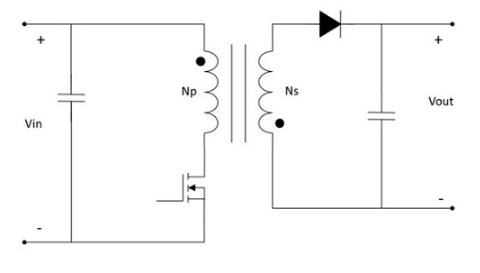 Figure 1: Basic circuit of a flyback converter
Flyback converters are commonly used in industrial installations. A typical application is programmable logic controller (PLC) input/output (I/O) modules powered from a 24V backplane. To ensure reliable performance, isolated power supplies are required to protect the I/O modules from noise. Flyback converters add the advantage of being able to provide a variety of output voltage rails - both positive and negative - to meet the needs of a wide range of processors, field-programmable gate arrays (FPGAs), analog-to-digital converters (ADCs), and amplifiers.
To meet industrial market needs and to validate the use of flyback converters, TI has released the LM3481 flyback evaluation module (EVM), shown in Figure 2. This design accepts a wide input voltage range of 5V to 32V, provides a stabilized isolated output of 12V, and is capable of delivering 2A of current to the load. This enables designers to evaluate the performance and operation of the LM3481 low-side FET controller in an isolated flyback design.
A common disadvantage of flyback converters is their lack of efficiency. Typical flyback converters have an efficiency of about 60-75%. This is primarily due to inductive losses in the transformer and the voltage drop across the rectifier diode. By careful design of the transformer and selection of the switching frequency, the LM3481 flyback EVM can achieve almost 90% efficiency, as shown in Figure 3.
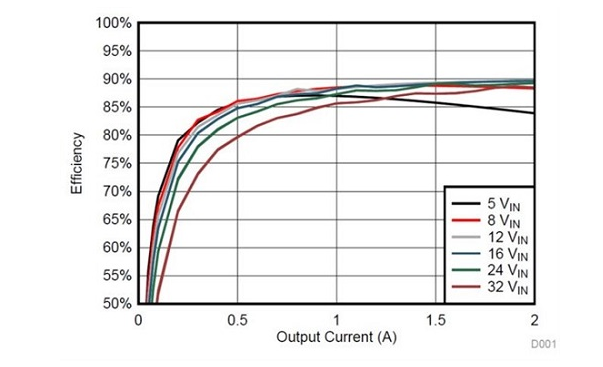 Figure 3: Efficiency of LM3481 Flyback EVMs
Another important performance of a flyback converter is that it can achieve good linear voltage regulation, in other words, the converter can provide a stable output voltage in the face of fluctuating input voltage. In industrial installations, input voltage fluctuations can be caused by factors such as heavy loads turning on and off or variable frequency motor drives. the LM3481 flyback EVM can achieve ±0.1% linear voltage regulation over a wide input voltage range. Providing a stable output voltage protects critical components and prevents unwanted noise from entering the circuit.
Flyback converters are simple and flexible converters that provide immunity to interference and high voltage isolation, solving the challenges of power supply design in many industrial applications. Buy the LM3481 Flyback EVM, a highly efficient voltage regulator platform, today and start exploring the possibilities of isolated power supplies!