




This paper focuses on the role of microcontrollers (MCUs) in industrial automation, specifically examining how they provide real-world interfaces for sensors and actuators. It discusses the integration of high-performance cores, such as ARM®'s Cortex™-M3, with precision and specialized peripherals such as Analog Devices' ADuCM360 and EMF32 series. It also examines relatively new protocols for this application domain, specifically referencing low-end MCUs including Infineon's XC800 and XC16x series and Texas Instruments' MSP430F2274, as well as dedicated transceivers like Maxim's MAX14821.
Microcontrollers integrate increasing hybrid-signal capabilities and processing power, yet other developments are extending the lifecycle of low-end microcontrollers.
By definition, microcontrollers (MCUs) are redundant, lacking direct interfaces to the "real world." They are designed to serve as central hubs for inputs and outputs, executing conditional responses and managing sequential and parallel processes. Their role is defined by control, and their programmable nature means this control is managed by logic. However, they are fundamentally designed as interfaces to the analog world, thus heavily reliant on analog-to-digital conversion. Typically, it is the digital representation of an analog parameter-often from some form of sensor-that drives the control process, a fact no more evident than in automation applications.
Precise Performance
Commercial pressures demand that data conversion processes critical to their operation be handled cost-effectively on-chip, driving higher levels of mixed-signal integration. Furthermore, increased integration brings greater processing burdens upon the core.
Their low cost and flexibility mean MCUs are often freely employed, but manufacturers across industries now strive to consolidate functionality for cost, complexity, or security reasons; where dozens of MCUs might once have been used, now only one may suffice.
Thus, it's unsurprising that simple 4-bit devices have evolved into highly complex 32-bit processing engines, with the ARM Cortex-M series becoming the core choice for many suppliers.
Blending high-performance processing cores with precise, stable analog conversion is no simple task. CMOS excels at high-speed digital, but instantiating sensitive analog peripherals can be challenging. One company with deep expertise in this domain is Analog Devices, Inc. Its ADuCM series of fully integrated data acquisition systems are designed for direct connection to precision analog sensors. This approach not only minimizes component count but also preserves accuracy by eliminating analog and/or digital stages.
For example, the converter implemented on the ARM Cortex-M3-based ADuCM360 is a 24-bit Sigma Delta ADC, forming part of the device's analog subsystem. This includes a programmable current excitation source and a bias voltage generator, but more importantly, internal filters-one for precision measurements and another for fast measurements suited to detecting large variations in the source signal.
Deep Sleep Sensing
MCU manufacturers recognize the critical role sensors play in automation and have begun developing optimized analog front ends with dedicated interfaces for inductive, capacitive, and resistive sensors.
Some of these front ends are even designed to operate autonomously, such as the LESENSE (Low Energy Sensor) interface in Energy Micro's ultra-low-power MCU series. It incorporates an analog comparator, a DAC (digital-to-analog converter), and a low-power sequencer, allowing it to be configured by the MCU's core and then operate while the rest of the device remains in deep sleep mode.
The sequencer operates from a 32 kHz clock and controls activity, while the comparator output can be configured to generate an interrupt to wake the CPU. The DAC can be selected as either a comparator reference or a drive source. LESENSE technology also incorporates a configurable decoder that can be set to generate interrupts only when multiple sensor conditions are simultaneously met. Digi-Key offers Energy Micro's EFM32 Tiny Gecko Starter Kit, which includes a LESENSE demonstration. Energy Micro's Tiny Gecko series of MCUs, based on the ARM Cortex-M3 and operating at frequencies up to 32 MHz, targets industrial automation applications such as temperature, vibration, pressure, and motion sensing.
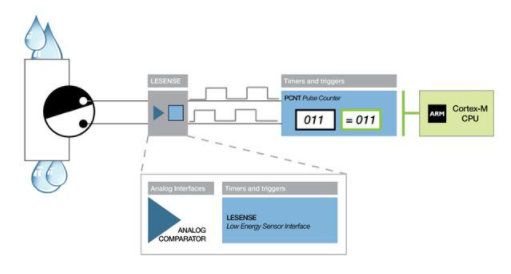 Figure 1: Energy Micro's low-power sensor interface, LESENSE, provides flexible sensor connectivity for industrial control and automation systems.
IO-Link
The introduction of a powerful new sensor and actuator interface is helping many manufacturers extend the lifespan of 8-bit and 16-bit devices in industrial automation. The protocol behind this interface is called IO-Link and has gained support from numerous leaders in industrial automation, particularly MCU suppliers.
IO-Link utilizes a 3-wire unshielded cable with a maximum length of 20 meters, making it suitable for retrofitting smart sensors and actuators into existing installations. It requires "intelligence" at each end, typically implemented in an MCU. However, due to the protocol's relative simplicity, it can be accommodated within low-cost 8-bit MCUs-precisely what many manufacturers are now developing.
The protocol (also known as SDCI, standing for Single-Point Digital Communication Interface, and standardized under IEC 61131-9) was developed as a peer-to-peer communication solution that can be easily embedded within sensors and actuators, granting them a degree of "intelligence." Therefore, it is not intended to replace existing communication layers like fieldbus, Profinet, or HART, but rather to work alongside them by making it easier for low-cost MCUs to interface with high-precision sensors and actuators.
The consortium behind IO-Link believes it can significantly reduce system complexity while introducing useful features like real-time diagnostics through parameter monitoring. When integrated into fieldbus topologies via gateways (also implemented by MCUs or PLCs), complex systems can be centrally monitored and managed from the control room. Sensors can be remotely configured, partly because IO-Link-compliant sensors know more about themselves than "conventional" sensors.
First, their identity (and manufacturer's) is embedded within the sensor in XML format, available upon request. This allows the system to immediately recognize the sensor and understand its capabilities. More importantly, IO-Link enables sensors (and actuators) to provide continuous, real-time data streams to the controller. In fact, IO-Link facilitates three types of data exchange: process data, service data, and events. Process data is transmitted cyclically, while service data is exchanged non-cyclically and always upon request from the IO-Link master. Service data can be used to read and write parameter data to/from the device.
IO-Link provides a simpler way for MCUs to interface with smart sensors, enabling system engineers to develop more intelligent industrial automation solutions.
Numerous MCU suppliers have joined the IO-Link Consortium, which recently became a Technical Committee (TC6) within PI (PROFIBUS and PROFINET International). Fundamentally, IO-Link provides controllers-including MCUs and PLCs-with a standardized method for identifying, controlling, and generally communicating with sensors and actuators that adopt this protocol. The list of manufacturers offering compatible devices is growing, alongside increasing support from MCU manufacturers.
Support comes in part from specialists like German design house Mesco Engineering, which is collaborating with multiple semiconductor manufacturers to develop IO-Link solutions. Its partner roster includes Infineon, STMicroelectronics, Atmel, and Texas Instruments. For instance, Infineon has ported Mesco's IO-Link stack to its XC800, an 8051-compatible 8-bit MCU that delivers intelligence at the device (sensor/actuator) end of the link. Infineon is also enabling IO-Link support for its 16-bit devices, including the XE16x series.
Mesco's stack has also been ported to Texas Instruments' low-power MSP430 series-another 16-bit MCU based on a proprietary core. Specifically, it targets the MSP430F2274.
Manufacturers are also developing a range of discrete IO-Link transceivers, such as Maxim's MAX14821. This transceiver targets IO-Link devices and 24 V binary sensors/actuators, serving as the physical layer interface for an MCU running the data link layer protocol (Figure 3). Two internal linear regulators generate the common sensor and actuator power requirements at 5 V and 3.3 V, and the device is configured and monitored via an SPI interface. It also features an IO transceiver interface capable of operating at voltages up to 36 V.
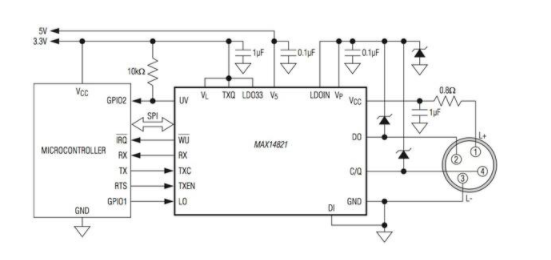 Figure: Maxim's IO-Link transceiver provides a physical layer interface for MCUs running data link layer protocols.
As IO-Link achieves higher levels of penetration, it appears that more manufacturers are integrating these physical interfaces with other dedicated peripherals on MCUs for industrial automation applications.
Industrial automation has always relied on the integration of measurement and control. Despite the increasing introduction of networking in recent years, the interface between the digital and analog domains has remained relatively unchanged. However, with the introduction of IO-Link, sensors and actuators are now being developed that can connect to MCUs in more sophisticated ways. Point-to-point connections not only provide a simpler method for interfacing control elements but also offer an effective way to extend the capabilities of low-end MCUs.