


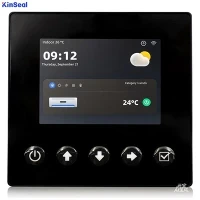


The industrial robot controller is the brain of the industrial robot system, responsible for receiving instructions, processing data, and controlling the robot's movement and operation. The design and performance of the controller has a direct impact on the flexibility, accuracy and efficiency of the robot. The following are the main functions of industrial robot controllers and an introduction to these functions:
Motion Control :
- Trajectory planning: The controller needs to plan the robot's trajectory according to the task requirements, to ensure that the robot can move in accordance with the predetermined path.
- Speed control: the controller should be able to accurately control the robot's moving speed, in order to adapt to different operational requirements.
- Acceleration control: In order to ensure the smoothness of the robot's movement and reduce mechanical wear, the controller needs to control the acceleration.
Force control:
- Force Feedback: When performing delicate maneuvers, the controller needs to be able to sense the forces of the robot's interaction with the environment and adjust the motion accordingly.
- Impedance control: When working with humans or in uncertain environments, controllers need to adjust the robot's impedance to changes in external forces.
Sensor Integration:
- Data Acquisition : The controller needs to integrate various sensors such as vision, touch, force, etc. to acquire information about the environment.
- Data Processing : The controller should be able to process sensor data for real-time analysis and decision making.
Programming and Task Planning:
- Programming interface: The controller provides a programming interface that allows the user to write or modify the robot's control program.
- Task Planning: The controller is able to automatically plan the robot's sequence of actions according to the task requirements.
Communication and Networking:
- Internal communication: The controller needs to communicate with the various components of the robot to coordinate their work.
- External communication: The controller can communicate with other systems or devices, such as PLC, MES, etc., to realize data exchange and cooperative work.
Safety control :
- Emergency stop : The controller can stop the robot's movement immediately when abnormal conditions are detected to ensure safety.
- Safety Zone : The controller can set up a safety zone to prevent the robot from entering areas that may cause injury or damage.
Diagnostics and Maintenance:
- Condition Monitoring : The controller can monitor the status of the robot in real time, including temperature, pressure, current, etc.
- Fault Diagnosis: The controller can diagnose robot faults and provide appropriate maintenance recommendations.
User Interface:
- User Interface: The controller provides a user-friendly interface for programming, monitoring and debugging.
- Remote Control: The controller supports remote control, allowing the user to operate the robot from a location far away from the robot.
Adaptability and Flexibility:
- Multi-tasking: The controller is capable of handling multiple tasks, adapting to different working environments and needs.
- Modular design: The controller adopts a modular design, which is easy to expand and upgrade.
Energy Management:
- Energy Optimization: The controller is able to optimize the robot's energy consumption and improve energy efficiency.
- Energy Recovery: Where possible, the controller can recover the energy used in robot motion.