



PLCs are programmable logic controllers, or simply programmable controllers, that act as microcomputers that help control automated systems. They are part of industrial computers used in a number of industries, including manufacturing, agriculture, food, and medical/healthcare. The goal is to control machines with as little human intervention as possible.
The first PLC was invented for GM in the late 1960s by Dick Morley, a mechanical engineer who founded Modicon/Schneider Automation, Inc. This PLC was a game changer in the world of automation.
Prior to the invention of the PLC, hard-wired systems were used that required careful rewiring and relocation of relays to meet different needs. This was time consuming and error prone.
GM needed a better way to increase production, but they lacked the expertise. They needed an engineer to build a system to meet their needs, and Dick Morley, whose company, Bedford Associations, bid on the "Modicon" project, created the PLC.
After his creation proved to be a success, he founded Modicon and quickly learned that PLCs were a viable solution to many of the problems faced by manufacturing and industrial companies.PLCs became very popular.
When you use PLCs in industrial environments, they are designed as solid-state devices with few components. They are designed to withstand excessive use and harsher conditions where there is more exposure to cold/refrigeration, heat, moisture, dust, etc. The PLC is very popular. The five main components work together within the programmable controller, and if you have any, you will recognize most of them with knowledge of how the component computers work.
- Central Processing Unit (CPU) - interprets data, executes programs and transmits outputs
- Communication interface - receives and transmits network data from remote PLCs
- Input and output interfaces - receive and send data from external/remote devices
- Memory - stores data that the CPU must run on
- Power supply - power supply that converts AC voltage to DC voltage
A home or work computer usually operates with Windows, MacOS, or Linux, while a PLC usually uses OS-9 or VxWorks.
A PLC can be a block (a single box) that fits into a small box. A brick can be expanded. There are also modular PLCs that fit into racks and allow multiple modules with different functions.
What are the functions of a PLC?
The most common use of a PLC is to act as a relay. It will often run scanning cycles to read inputs, perform actions that the inputs tell it to perform, and then complete the outputs.
It starts with input monitoring, where the PLC scans the data inputs and transfers them to the microprocessor. Engineers program the microprocessor to recognize the criteria provided in the data and use those values to perform the changes specified in the program.
Once the decision-making steps of logic programming are complete, the PLC begins to control switches, motors, relays, and other devices that make up the outputs of the system.
For example, in a large warehouse, boxes are sealed and addresses are bar-coded before entering a conveyor belt. Along the way, a scanner reads the barcode and processes the data to determine whether the package is being sent domestically or internationally. It can then direct the box to an open chute and guide the package to a conveyor that will continue on to international shipments.
Another example is something you experience every day. You are traveling down the road and the light ahead of you turns red. Before you can stop, a fire truck approaches you from behind, and the green light turns as fast as the red light. That's a working PLC. the PLC interacts with a technical first responder who must turn the lights on immediately. Or, when a pedestrian approaches the street, the lights change to allow the pedestrian to cross the street. that's another example of a working PLC.
Tips for choosing the best PLC for your company's needs
How do you determine which PLC model is best for your needs? Some factors to consider are:
- Connectivity - does your system have the right number of input and output ports and is it the right type of PLC you plan to install?
- Electrical capacity - you need to make sure that the PLC you choose matches the voltage of your electrical system.
- Environmental considerations - how warm or cold is the area where the PLC is located? If you are involved in food processing and run equipment in extreme temperatures, make sure the PLC has a compatible temperature tolerance range.
- Hardware compatibility - The PLC must be compatible with your computer's mechanical and hardware.
- Location - Your location can also affect the availability of certain models of programmable controllers.
- Memory - Do you have enough memory (both RAM and ROM) to properly run the PLC?To run smoothly and efficiently, you must have enough RAM and ROM to complete the process.
Your engineering and programming team needs to be involved. Although PLC programming software is typically programmed in C, it may not be your team's preference. It is not for everyone.
PLC and robotics go hand in hand to improve efficiency, safety and speed
The use of robotics in automated manufacturing has taken off. Robots must be programmed, which as you can imagine can take a lot of time.
Visual programming makes it very easy, but using drag-and-drop commands from a tablet. PLC code is easy to change to meet the different purposes the robot serves, getting the robotic system up and running in minutes.
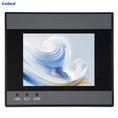
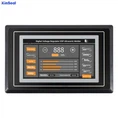
Kinseal Hmi
Suitable for a wide range of industries, multiple sizes available, great for:
- Automated warehouses and buildings
- Car charging
- Chemical industry
- Food and Beverage Manufacturing and Packaging
- General Automation
- Injection Molding
- Inspection Machines/Scanners
- Machine Tools