


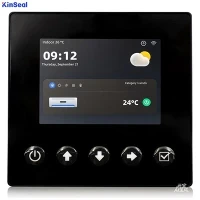


Industrial Personal Computers (IPCs) and Programmable Logic Controllers (PLCs) are two extremely important devices in the field of industrial automation. They play critical roles in automated control systems, but their functions and application scenarios differ. This article will provide a detailed overview of the relationship between IPCs and PLCs, as well as their applications in industrial automation.
I. Industrial Personal Computers (IPCs)
An industrial personal computer is a computer system specifically designed for industrial environments. Compared to standard computers, IPCs offer stronger resistance to interference, higher stability and reliability, and greater adaptability. IPCs are widely used in industrial automation, smart manufacturing, robotics control, and other fields.
1. Hardware Features
The hardware features of industrial PCs primarily include the following:
(1) High-Performance Processors: Industrial PCs typically utilize high-performance processors to meet the computational demands of industrial automation systems.
(2) Extensive Interfaces: Industrial PCs feature a wide range of interfaces, such as serial ports, parallel ports, and USB ports, facilitating connections with various external devices.
(3) Strong expandability: Industrial PCs offer excellent expandability, allowing for the addition of various functional modules as needed, such as hard drives, memory, and graphics cards.
(4) Interference resistance: Industrial PCs possess excellent interference resistance, enabling them to operate stably in harsh industrial environments.
(5) Thermal management: Industrial PCs incorporate superior thermal management designs to ensure they do not overheat during prolonged operation.
2. Software Features
The software features of industrial PCs primarily include the following:
(1) Real-time operating system: Industrial PCs typically use real-time operating systems to ensure system responsiveness and stability.
(2) Comprehensive development tools: Industrial PCs provide a wide range of development tools, such as programming software and debugging tools, to facilitate secondary development by users.
(3) Support for Multiple Programming Languages: Industrial PCs support various programming languages, such as C, C++, and Python, to meet the needs of different users.
(4) Easy Integration: Industrial PCs offer excellent integration capabilities, allowing them to connect and work seamlessly with other devices.
II. PLC (Programmable Logic Controller)
A PLC is an electronic device specifically designed for industrial control, offering high reliability, flexibility, and ease of use. PLCs are widely used in various industrial automation systems, such as production lines, machinery, and power systems.
1. Hardware Features
The hardware features of a PLC primarily include the following:
(1) Modular Design: PLCs employ a modular design, allowing for the flexible combination of various functional modules as needed.
(2) Extensive I/O Interfaces: PLCs feature a wide range of input and output interfaces, enabling convenient connection to various devices such as sensors and actuators.
(3) Interference Resistance: PLCs possess excellent interference resistance, enabling them to operate stably in harsh industrial environments.
(4) Easy to Expand: PLCs offer excellent expandability, allowing various functional modules to be added as needed.
(5) Programming Interfaces: PLCs typically include programming interfaces, making it convenient for users to program and debug.
2. Software Features
The software features of a PLC primarily include the following:
(1) Dedicated Programming Languages: PLCs typically use dedicated programming languages, such as ladder diagrams and sequential function charts, which are easy to understand and use.
(2) Real-time Capability: PLCs offer excellent real-time performance, enabling rapid response to changes in external signals.
(3) Programmability: PLCs are highly programmable, allowing for customization through programming and debugging as needed.
(4) Easy Integration: PLCs offer excellent integration capabilities, enabling seamless connection and collaboration with other devices.
III. The Relationship Between Industrial PCs and PLCs
Industrial PCs and PLCs each have their own characteristics and advantages in industrial automation systems. Their relationship can be summarized as follows:
1. Complementary Functions
Industrial PCs and PLCs are functionally complementary. Industrial PCs are primarily used for data processing, human-machine interaction, and network communication, while PLCs are primarily used for real-time control, logic decision-making, and data processing. In practical applications, industrial PCs and PLCs typically need to work together to jointly accomplish the various tasks of industrial automation systems.
2. System Integration
In industrial automation systems, industrial PCs and PLCs require system integration. Through proper system integration, data exchange, signal transmission, and coordinated control between industrial PCs and PLCs can be achieved, thereby enhancing the stability and reliability of the entire system.
3. Collaborative Operation
Industrial PCs and PLCs must work collaboratively within industrial automation systems. The industrial PC can serve as the host computer, handling functions such as data processing and human-machine interaction, while the PLC acts as the field device, managing real-time control and logical decision-making. This collaboration ensures the efficient operation of the entire system.
4. Complementary Roles
In certain application scenarios, industrial PCs and PLCs can complement each other. For example, in some complex industrial automation systems, both industrial PCs and PLCs may be required to perform different functions simultaneously. In such cases, they can work together to fulfill the system's various tasks.
Applications of Industrial PCs and PLCs in Industrial Automation
Production Line Automation
In production line automation, industrial PCs and PLCs can work together to achieve automated control of the production line. The industrial PC handles functions such as data processing and human-machine interaction, while the PLC handles real-time control and logic decision-making.