




Abstract
What does Industrial Ethernet mean? Industrial Ethernet plays a vital role as it is capable of supporting a variety of networking protocols to implement deterministic real-time communication control.
"Industrial Ethernet" (IE) refers to the use of Ethernet in industrial environments, especially those employing predeterministic and real-time control mechanisms.
Hardware, software, and services are the most important elements when it comes to providing communication solutions for factory automation, and Industrial Ethernet is used in a wide variety of industries, including oil and gas, aerospace and defense, energy and power, electrical and electronics, automotive and transportation, and chemical. Within Industrial Ethernet, protocols such as TSN, OPC-UA, EtherCAT, Profinet, ethernet/IP, CC-link IE, and Modbus are used in a wide variety of targeted applications.
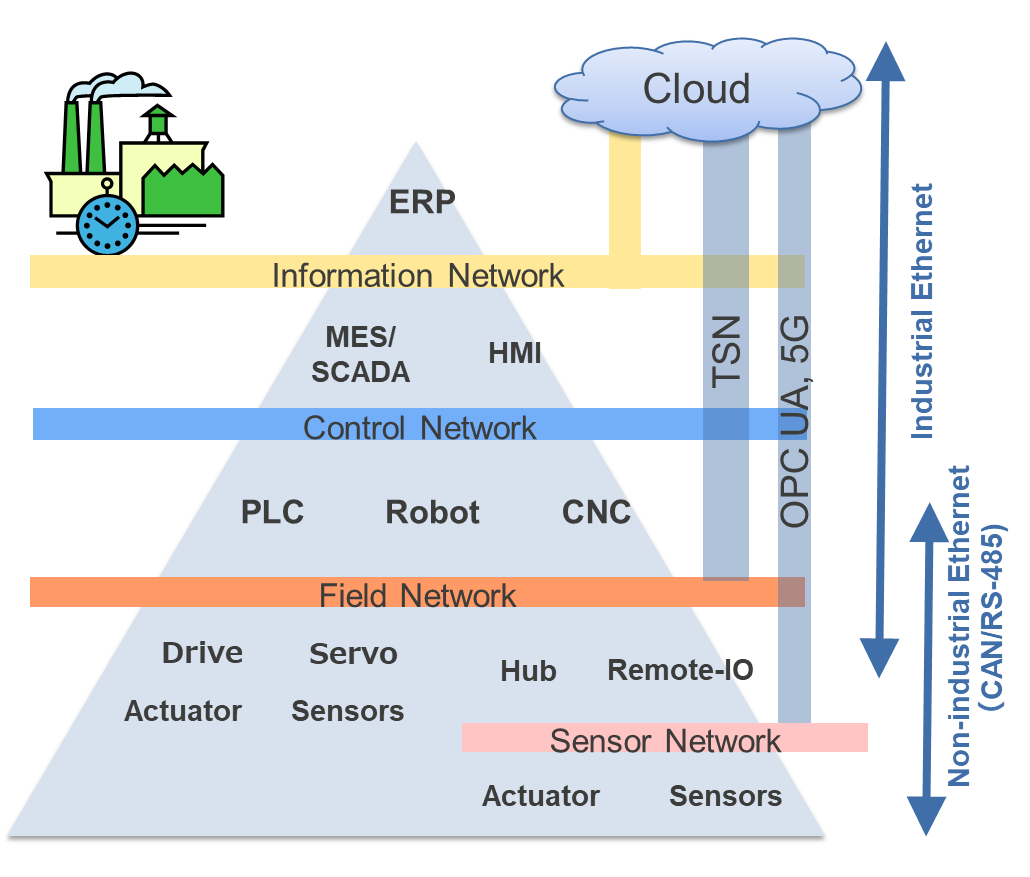 Industrial Ethernet Architecture
Time-sensitive networks, often referred to as TSNs, are one of the key entities that form the core of the information-physical systems of Industry 4.0, which is driven by the more deterministic Industrial Ethernet (see Figure 2). In order to achieve this, operational technology (OT) networks and information technology (IT) networks from higher levels of manufacturing need to be merged, and these systems must have some kind of presentation in cyberspace in order to function properly. However, the vast majority of contemporary Industrial Ethernet standards require the use of proprietary hardware and protocols, which makes network convergence very difficult. To address these changes and requirements, Renesas offers targeted products/solutions related to Time Sensitive Networking (TSN).
The IEEE 802.1 TSN Task Force has integrated IEEE standards (see Figure 3) to support real-time predictable behavior and vertical and horizontal scalability of TSN technology.
The Renesas R-IN32M4-CL3 SoC was one of the first controllers to support CC-Link IE TSN Class B, while the R-IN32M2 SoC family and the RX72M MCUs also have solutions that support CC-Link IE TSN Class a. These solutions enable high-speed, high-capacity communications that can be realized without software real-time operating systems and external components.
The Open Platform Communications Unified Architecture (OPC UA) created by the OPC Foundation is used for industrial automation M2M communications. The architecture is applicable to all industrial components, including industrial sensors and actuators, control systems, which are used for command and control of industrial processes. And it is a layered, adaptable, trusted and open standard protocol.
The OPC UA system architecture models clients and servers as interacting partners, and each system may contain multiple clients and servers. Figure 4 below illustrates an architecture containing a combination of servers and clients.
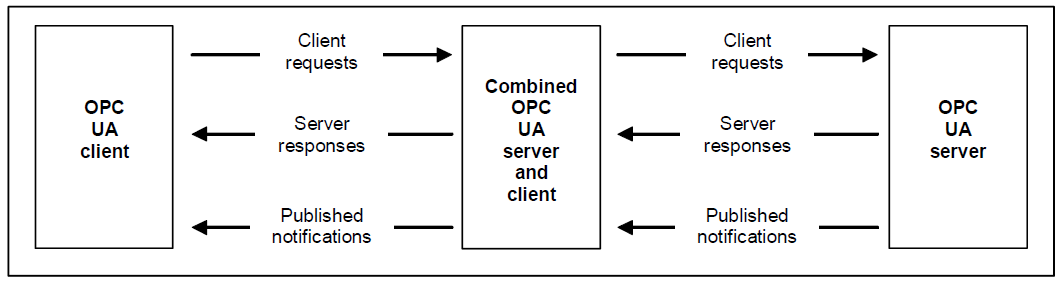
OPC-UA Broad Architecture
EtherCAT
EtherCAT is an Ethernet-based fieldbus system maintained by the EtherCAT Technology Group. The protocol is used by and for devices that simultaneously perform high-speed data acquisition and real-time control. With its high performance, low cost and flexible topology, EtherCAT has become one of the industry's leading protocols. Renesas has expanded its device control and networking portfolio with Renesas' proprietary core of new RXv3 third-generation CPUs and 32-bit RX72M, RX72N, and RX66N MCUs for industrial automation that integrates device control and networking functionality on a single chip (see Figure 5).
To meet the needs of industrial automation, Renesas has introduced a range of microcontrollers for EtherCAT connectivity. Among them, the RX72M comes with a 240 MHz processor, up to 4 MB of flash memory and 1 MB of RAM, with a wide range of peripherals and interfaces such as Ethernet, USB, CAN, SPI, I2C and more. This adaptable microcontroller has become the first choice for many industrial applications.

A number of key features of the RX72M, RX72N and RX66N
PROFINET
The PROFINET standard is an open, standardized industrial Ethernet protocol for data transfer in automation environments that facilitates communication between controllers and devices.PROFINET's cyclic and acyclic protocols define diagnostics, functional safety, alarms and other forms of data exchange. Renesas Electronics' TPS-1 is a PROFINET (IRT)-enabled PROFINET IO device-on-chip solution that simplifies the implementation process and provides equipment manufacturers with fast, simple and cost-saving integration of PROFINET IO device interfaces.
PROFINET is a fieldbus protocol commonly used in industrial automation applications and supports the PROFIBUS DP (Decentralized Peripheral) and PROFIBUS DP-V1 (Version 1) protocols, which are widely used in industrial automation applications for communication between PLCs and other devices. global umbrella organization for PROFIBUS and PROFINET technologies PROFIBUS & PROFINET INTERNATIONAL (PI) lists the RX72M MCU in its recommended MCU/MPU/LSI for fieldbus support. Therefore, the RX72M MCU is a versatile choice for industrial automation applications.
Ethernet/IP
Ethernet/IP is a protocol that allows Ethernet-connected industrial automation devices to interact. It is one of three Ethernet-based industrial automation protocols created by the Open DeviceNet Vendor Association (ODVA), the other two being PROFINET and EtherCAT. ethernet/IP provides both cyclic and acyclic communication, and can be communicated over TCP/IP and UDP/IP. This makes it a versatile protocol that can be used in industry from small control systems to large distributed systems.Industrial devices such as PLCs, HMIs, sensors, and other automation devices can be communicated and controlled in real time using Ethernet/IP, which provides scalable, high-speed communication using Ethernet and IP.
Ethernet MAC
Ethernet MAC (Ethernet Media Access Control) is a unique identifier for a device's Network Interface Controller (NIC), which is used to enable Ethernet network communications. The FreeRTOS-based Flexible Package (FSP) support enables the adoption of other RTOSes and middleware.
In addition, Renesas supports a comprehensive partner ecosystem to provide a range of software and hardware building blocks that will work out-of-the-box with Renesas MCUs. This ecosystem will help accelerate the development of IoT applications, including core technologies.
As already emphasized, today's factory floors require a common, robust deterministic and non-deterministic Ethernet framework to enable the highest degree of industrial network connectivity. As the market leader in this area, Renesas solutions cover a wide range of industrial Ethernet requirements and are known for their performance, reliability and ease of use. For industrial automation and other applications, these systems are designed for high-speed data transfer, low latency and low power consumption. To accelerate adoption, Renesas offers a variety of development and solution kits to help engineers quickly create value-added Industrial Ethernet solutions.