


What is CAN Bus
CAN bus is a serial communication protocol widely used in automotive, industrial automation, and other fields. It enables multiple devices to share communication lines for transmitting data and control signals. There are two distinct versions of CAN bus: CAN 2.0A and CAN 2.0B. CAN 2.0A supports 11-bit standard identifiers, while CAN 2.0B supports 29-bit extended identifiers. CAN bus topologies include bus, star, and hybrid configurations. The bus topology is most common, connecting all node devices and requiring terminating resistors at both ends of the bus.
Why Surge Protection is Necessary
CAN bus systems are susceptible to electromagnetic interference (EMI) and electrical interference (EMI), which can cause transmission errors and hardware failures. Surge protection introduces protective circuits into the CAN bus system to guard against these disturbances. Surge protection circuits on the CAN bus can safeguard the bus through absorption, reflection, or suppression mechanisms.
Current automotive electronics standards involving EMC testing primarily fall into two categories:
1: Conducted transient testing for power supply systems
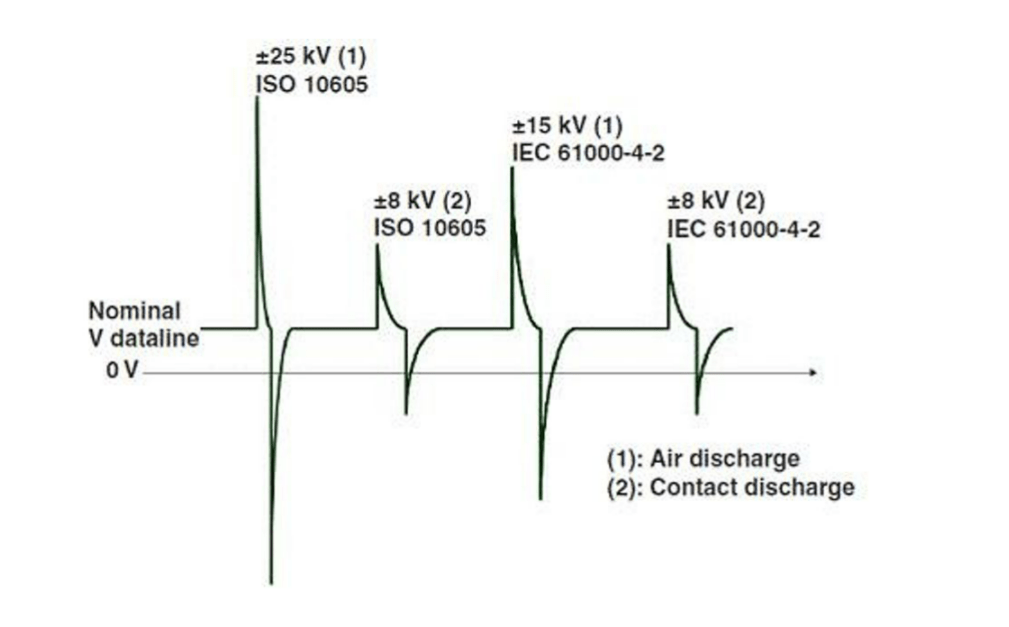
2: Electrostatic Discharge (ESD) and Surge Testing for Communication Interfaces
Power supply testing includes: Pulse 1(a) simulates transient events caused by inductive loads when power is abruptly disconnected; Pulse 2(a) simulates transients from inductive loads in wiring harnesses due to sudden current interruption; Pulse 2(b) simulates transients from fan or wiper motors when operating power is removed; Pulse 3(a)(b) simulates transient pulses generated during switching processes. Pulse 5 simulates the load dump transient waveform during battery power loss.
The Importance of Surge Protection Design for CAN Bus
Failures in the CAN bus can lead to severe consequences, including equipment damage, safety incidents, and data loss. Therefore, robust surge protection design is critical for ensuring system reliability and stability. Additionally, considering the operating environment of the CAN bus, surge protection must also feature interference resistance, high-temperature tolerance, vibration resistance, and high reliability.
In automotive environments, where frequent human contact occurs, electrostatic discharge (ESD) events, electrical overstress (EOS) events, and electrical fast transient (EFT) events are common during vehicle operation. These pose potential threats to moving vehicles. While CAN transceiver chips incorporate some ESD immunity in their design, their level falls far short of system-level testing requirements. Consequently, protective design for CAN communication interfaces becomes critically important.
Methods for CAN Bus Surge Protection Design
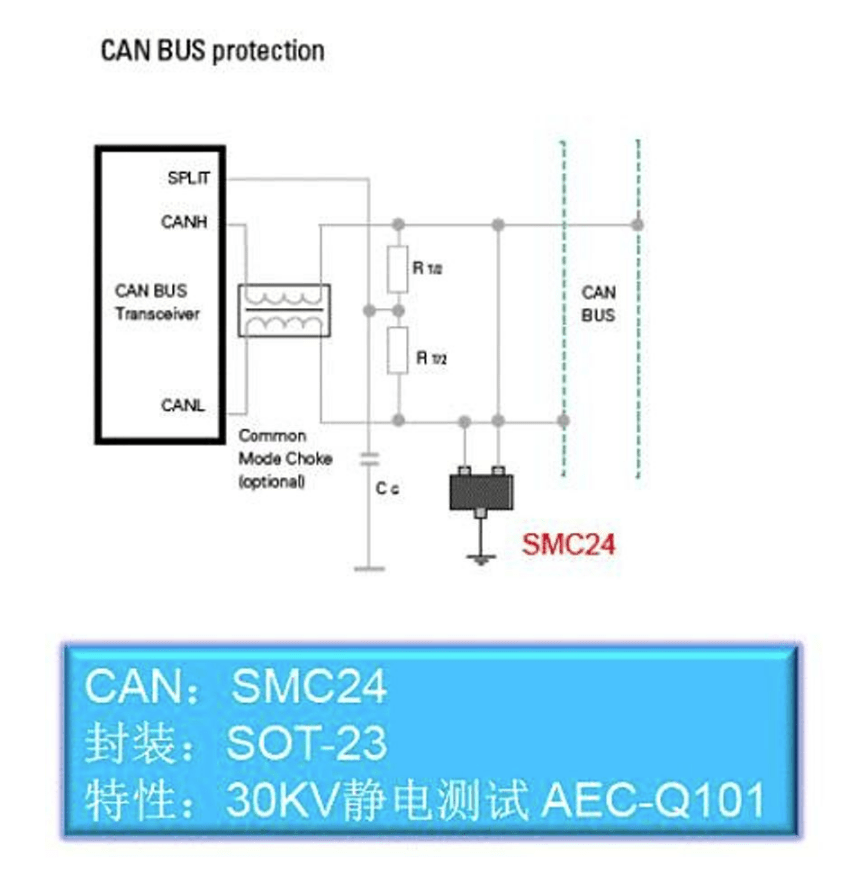
CAN bus surge protection methods involve components such as resistors, capacitors, TVS diodes, and transient voltage suppressors (TVS). Among these, TVS diodes are commonly used protection elements, offering advantages like fast response, low leakage current, and high energy absorption. In practical applications, selecting appropriate surge protection methods and components requires consideration of specific application scenarios and requirements.
Implementation of CAN Bus Surge Protection Circuits
CAN bus surge protection circuits can be implemented using either discrete component circuits or integrated circuits. Discrete component circuits consist of multiple independent components, offering strong customizability and ease of maintenance and upgrades. Integrated circuits, conversely, integrate multiple components onto a single chip, providing advantages such as compact size, low power consumption, and cost-effectiveness. In practical applications, the appropriate circuit implementation method must be selected based on the specific application scenario and requirements.
Examples of CAN Bus Surge Protection Design
This article presents several common examples of CAN bus surge protection circuits to aid readers in better understanding the subject. For instance, to address electrical interference issues within CAN bus systems, surge protection can be achieved using capacitive filter circuits or RC filter circuits. Conversely, for electromagnetic interference problems, components such as TVS diodes and transient voltage suppressors can be employed for surge protection.
ESD Device Placement Recommendations
a) Position devices as close as possible to input terminals or connectors.
b) Minimize the path length between devices and protected lines.
c) Keep parallel signal paths to a minimum.
d) Avoid running protected conductors parallel to unprotected conductors.
e) Minimize all conductive loops on printed circuit boards (PCBs), including power and ground loops.
f) Minimize the length of transient return paths to ground.
g) Avoid using shared transient return paths to common ground points.
h) Utilize ground planes, multi-layer PCBs, and ground vias whenever possible.
Summary
This article summarizes the importance, design methods, and implementation approaches for CAN bus surge protection. It is hoped that this document will help readers better understand CAN bus surge protection and enhance system reliability and stability in practical applications. It should be noted that when designing CAN bus surge protection, the system's operating environment and application scenarios must be fully considered, and appropriate surge protection methods and components should be selected.