


Now many people in the industrial control of PLC, DCS, SCADA system concept is more confusing, confused, today to take you to understand these systems and concepts.
PLC - Controller
DCS - Controller + Network + Software + I/OAcquisition
SCADA-Data collection + System monitoring +Network + Software
I. PLC control system
PLC is what we usually call a programmable logic controller, originally evolved by replacing the secondary circuit of electrical control: relays, intermediate relays, time relays, etc. A programmable logic controller is a digitally-operated device that has a programmable memory for storing instructions and performing specified functions.
PLC will do logic, arithmetic, timing, counting and sequencing functions to control various machines in industrial processes. We can use PLC to automate industrial processes such as controlling industrial machinery in factory assembly lines. The accuracy and speed of operation can be increased by utilizing PLC. Thus, PLC will take inputs from devices like limit switches, proximity sensors, pressure sensors etc.
The conversion of logic signals in the PLC and high and low level signals in the field will be done by the I/O module which will also perform signal isolation.The activities of the PLC system will be run intelligently by the processor which will be executed according to the program inside the PLC and also it will control the process equipment.The PLC will check the input devices and then execute the program after that it will either energize or shut down the output devices connected to it.
PLC control system advantages:
- Reliability
- Programming flexibility
- High operating speed
- Fast response time
- Simple troubleshooting
- Low cost of ownership
PLC control system disadvantages:
- High requirements for programmers
Application Scenarios:
- Food processing
- Material processing
- Machine Tools
- Conveyor systems
- Robot manufacturing and control
II.DCS System
In a DCS system, the entire process will be divided into a certain number of subsystems. Each subsystem will be controlled by its own controller. Thus, we can describe a DCS as a large process control consisting of a certain number of controllers, each controlling its own subsystem. The system will divide the plant into zones and assign separate controllers to each zone of the plant. The entire DCS system will be connected as an independent control system through a communication bus.The DCS system will be connected to a communication network for communication and monitoring.All the controllers in the DCS system will be connected through the network for communication.
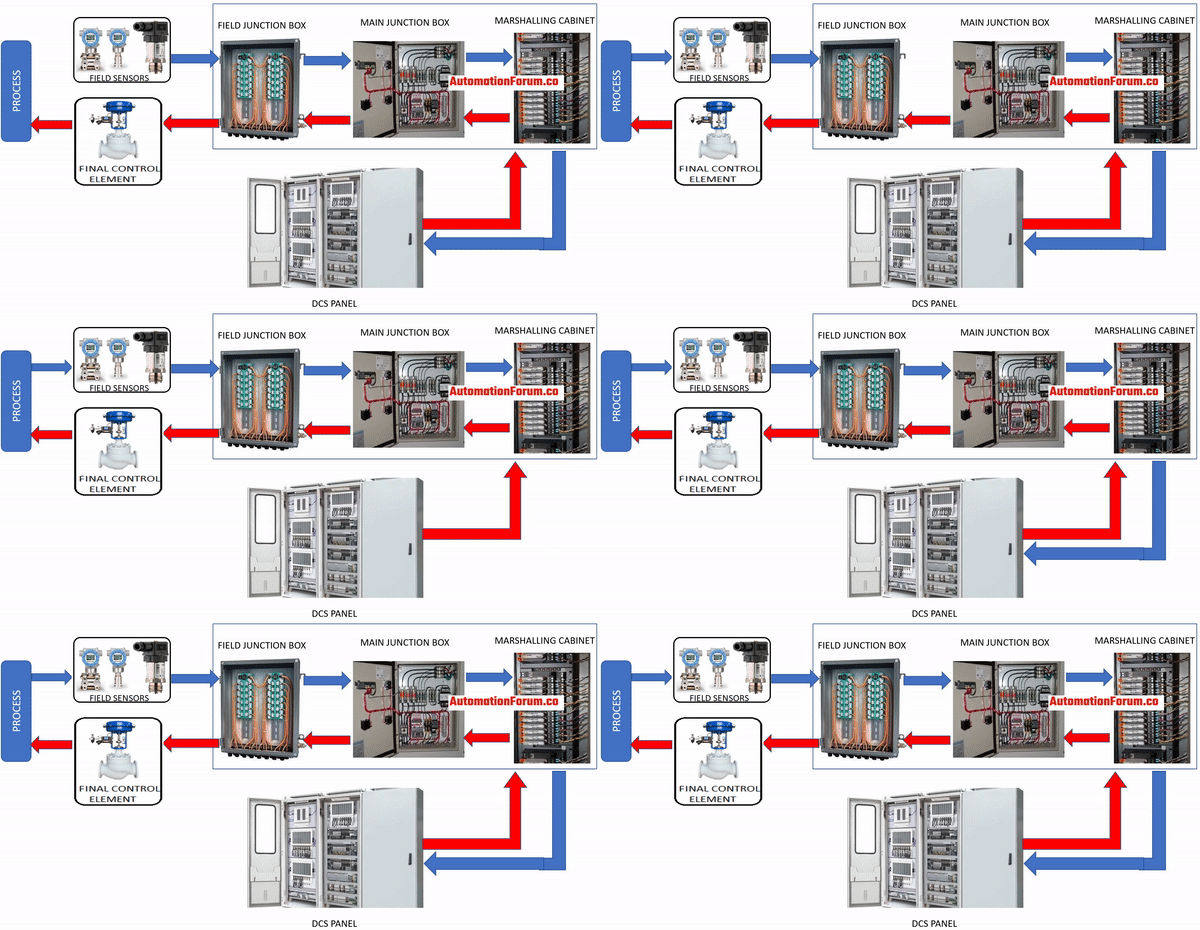
The DCS will collect data from the field devices and examine that data, which it will then use to control the specified process. Thus, based on the data received from the field devices and collected from another part of the plant, it will be used to control the process. The field device will transmit the process, signal to the field junction box, which will reach the grouping cabinet through the main junction box. This signal will be transmitted to the DCS panel through the blocking cabinet. Then, based on the signals received, the appropriate control signals will be transmitted from the DCS panel to the final control elements.
Functions realized by the DCS system:
control
Data Acquisition
Alarms
Logging and report generation
Historical data storage
system diagnostics and security
Advantages of DCS systems:
Separate controllers are used to control different processes, as the failure of one control station does not affect the entire plant.
Redundancy
can access a large amount of current information from the data highway
can monitor past process condition trends
reduces system overloads
Reliability
Good speed
Process information can be visualized by the user in different formats
Disadvantages of DCS systems:
Expensive
requires regular maintenance
more vulnerable to cybersecurity threats if not properly protected
DCS system application industries:
Power plants
Oil and gas industry
Chemical industry
Water treatment systems
Pharmaceutical manufacturing
III. SCADA system
SCADA is an acronym for Supervisory ControlAnd Data Acquisition, i.e. "Supervisory Control and Data Acquisition". Therefore, the SCADA system monitors the communication between the remote site and the control center through a two-way communication channel. So it cannot strictly be called a complete control system, SCADA is software that is positioned on top of the integrated hardware. SCADA will allow the operator to monitor the status of the equipment and based on that, the operator can control the process, and the operator can also view all the process parameters from a single centralized control room.
SCADA System Main Functions
Data Acquisition
It will display status information and measurement data to the operator
Control
The operator can control the equipment based on the received data
Data Processing
It checks the quality and completeness of the data
Labeling
Identifies specific experimental objects or equipment to prevent them from unauthorized operations
Alarms
Operator alarms in case of unplanned or unwanted operations
Logging
All operator entries, alarms, and selected entries are logged
Trend analysis
It will plot measurements on selected gauges to provide information on trends such as one minute, one hour, etc.
Historical Reporting
This will save and analyze historical data which is useful for controlling future processes.
SCADA System Advantages
is easy to maintain
provides access to real time data
implementation tools are advanced
is reliable
continuous operation
equipment maintenance
communication over long distances
can monitor the complete process remotely
Disadvantages of SCADA systems
Implementation will require some special skills
will only process data when the system is available
Compatibility with PLC needs to be verified
SCADA system application industries:
Power generation, transmission and distribution
Water and wastewater
Building Facilities and Environment
Manufacturing
Public transportation
Traffic signals
Iron and steel industry
Chemical industry
IV.Difference between SCADA system and PLC and DCS system:
SCADA is a control system architecture that utilizes computers, network data communications and graphical user interfaces for advanced process management.PLC and DCS have hardware packages but SCADA does not have this.SCADA will not send some binary or analog signals to the field devices to control the process.SCADA will only control the process by using some controllers such as PLC, DCS or PID and other controllers to control the process. Thus, these controllers will control the field devices and the process will be supervised or controlled by SCADA. Command signals to control the process will be given to SCADA and these command signals will be sent to PLC/DCS/PID controllers to control the process. Therefore, we can think of SCADA as software that can communicate with PLC and DCS.
Comparison table of PLC system, DCS system, SCADA system:
| PLC | DCS | SCADA | |
| Function | Independent process control | Whole plant control | Provide different equipment, different areas, different plant |
| Speed | Faster than DCS & SCADA | Faster than SCADA | Slower than DCS |
| Networking | Depending on project requirements | All units are integrated through the network | All units are integrated through the network |
| Communication | Communication does not require large bandwidth | Requires large bandwidth for communication | Requires large bandwidth for communication |
| Error | High chance of error | There are many controllers, so less chance of error | Small chance of error |
| Cost | Low | High | High |
| Major Brands | Rockwell Siemens Schneider |
Honeywell, Yokogawa, Siemens Central Control Technology Hollis | Rockwell, Siemens, Schneider, Configuration King 3D Force Controls |
| Monitoring Range | Short distances | Whole plant | Long distances |
| System Components | Hardware | Hardware, monitoring software, network devices | No hardware or software platform |
| Flexibility | High | Complex architecture, inflexible | Complex and inflexible architecture |
| Process Change | Can be | Not possible | Not possible |
| Applications | For specialized applications | For complex applications | For large industries (remote monitoring required) |
V. How do we choose to use PLC system, DCS system, SCADA system?
If we need to control a single process then we can use PLC which can also have wide use in industrial plants. PLC has faster scanning time as compared to DCS so it can be used for safety interlocking.PLC can also be used for controlling a specific manufacturing process.PLC can also replace relays and have good handling of control loops.
When we need to control the whole plant we can use DCS.
DCS can be used where failure of process control may lead to high losses, such as in chemical plants.
Since DCS has extensive network characteristics, it can easily identify the failure. In order to determine the output of the plant, the industrial network has become so important that the PLC has become a part of the DCS.
If you need controller redundancy then you can go for DCS so if any controller fails then we have a redundancy of controllers. If it is a large system and you also need access to a lot of previous data then you can go for DCS.
SCADA is a software and not a controller like DCS and PLC, basically it collects data and monitors the whole plant.SCADA is used in large industries where data collection, data transmission and remote plant monitoring is required.SCADA systems are used in power generation and transmission units, oil and gas and it is also used in many chemical plants where frequent monitoring is required.SCADA will transmit data and commands to PLC and DCS to transmit data and commands to control specified processes.