



CAN bus technology is becoming increasingly widespread. However, due to severe electromagnetic interference in fields such as industrial equipment and industrial automation, ensuring normal CAN bus communication is particularly important. This article will analyze the causes of electromagnetic interference in bus networks using high-speed CAN FD transceivers, as well as specific solutions for improvement.
Electromagnetic Compatibility Analysis in CAN FD Networks
In the design of electronic products, electromagnetic compatibility (EMC) performance has a significant impact on the system and is critical to its normal and stable operation. Mandatory restrictions on the electromagnetic compatibility of electronic products have already been implemented worldwide, and EMC performance has become a key indicator of product quality.
Electromagnetic compatibility primarily encompasses two aspects: one is the adverse electromagnetic interference generated by the product itself, known as electromagnetic interference emission (EMI); the other is the product's sensitivity to external electromagnetic signals, known as electromagnetic susceptibility (EMS). The interference source, coupling path, and sensitive equipment are the three essential elements of electromagnetic compatibility, and none can be omitted.
Electromagnetic interference signals can be coupled through two pathways: conducted and radiated. Depending on the coupling mechanism, interference is classified into common-mode interference and differential-mode interference. Common-mode interference occurs between all signal lines (including signal lines, data lines, and power lines) and ground, while differential-mode interference occurs between signal lines.
Measures to improve electromagnetic compatibility (EMC) fall into three categories: enhancing the EMC performance of the electronic equipment itself, using shielding technology to suppress radiated coupling, and employing isolation to suppress conducted coupling.
1. EMC Design
The design of the master and slave circuit boards is critical to the system's EMC, and a circuit board's ability to emit and receive electromagnetic radiation is often consistent. Therefore, improving a circuit board's immunity to interference also suppresses its electromagnetic emissions. The key factors in PCB EMC design include the following:
Component Selection and Layout
Select components with good EMC performance and prioritize surface-mount packaging whenever possible. Arrange components logically, placing related components as close together as possible to minimize lead lengths between parts. In particular, the crystal oscillators serving as clock sources for microcontrollers and CAN controllers must be placed according to specifications; otherwise, they will fail to oscillate.
Proper Ground Layout to Reduce Ground Impedance
The ground potential serves as the reference potential for all signals. Ideally, all ground points on the PCB should be at the same potential; however, due to ground impedance, potential differences exist between ground points. Therefore, ground impedance should be minimized as much as possible. The most effective method is to use a multilayer board with a dedicated ground plane in the middle.
Stabilizing the Power Supply
Unideal conditions, such as transient effects during logic gate output state transitions and the presence of power line impedance, inevitably introduce noise into the power supply lines. This noise not only causes abnormal circuit operation but also generates significant electromagnetic radiation. In addition to using a power line mesh to reduce the inductance and impedance of the power lines, storage capacitors can also be employed.
2. Electromagnetic Radiation and Electromagnetic Shielding
Electromagnetic shielding is one of the key methods for addressing electromagnetic compatibility issues. It does not interfere with the normal operation of circuits and does not require circuit modifications. The effectiveness of a shield is measured by its shielding performance, which consists of two components: reflection loss and absorption loss. Maintaining the electrical continuity of the shield is critical to its effectiveness. CAN bus cables are highly susceptible to both radiating and receiving interference.
The loop area between the two wires in a twisted-pair cable is very small, and the currents induced in any two adjacent loops are in opposite directions, thereby canceling each other out. The tighter the twist in the twisted-pair cable, the more pronounced this effect becomes. To reduce crosstalk between the two CAN buses in the network system, each pair of twisted-pair cables should be shielded separately, and any unused conductors in the cable should be connected to signal ground.
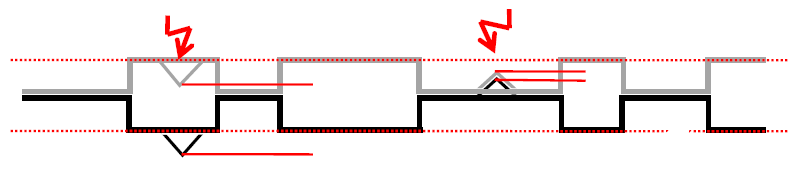 Increase the twisting density; ground the shield
3. Conducted Interference and Signal Isolation
During normal system operation, components that generate significant conducted interference include switching power supplies, servo drives, and I/O control devices. However, the most harmful type of interference is transient interference, which is characterized by short duration, high amplitude, and low power.
Forms of transient interference include: fast electrical pulse groups generated when the state of a motor changes; surges caused by lightning or high-power switching on cables; and electrostatic discharge (ESD) induction. Conducted interference is predominantly common-mode, though some differential-mode interference also occurs. EMC measures used in the system to ensure the reliability of CAN bus communication include: signal protectors, transient voltage suppressor (TVS) diodes, isolated transceivers, and optical isolation.
Signal Protector
External dedicated signal protectors eliminate interference; for example, the ZF-12Y2 absorbs interference, and the CANFDbridge acts as an isolator.
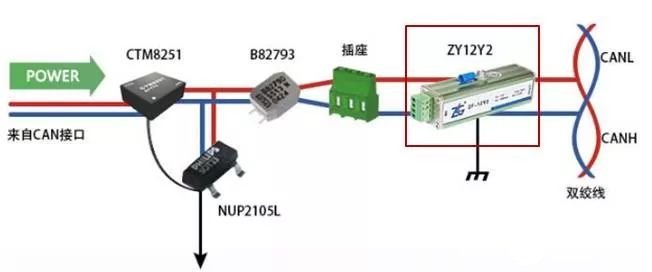 Signal Protector and CANFDBridge Isolation
Transient Voltage Suppressor (TVS)
Transient voltage suppressors are connected in parallel between the signal line and signal ground to protect cables from high-voltage surges caused by lightning strikes or electrostatic discharge. When the voltage across the TVS exceeds a certain threshold, the device rapidly conducts, thereby dissipating the surge energy and limiting the voltage amplitude to a specific range.
Isolated Transceivers
Isolation is an ideal solution for addressing conducted interference, offering excellent electrical insulation and interference immunity. When selecting an isolated transceiver, transmission delay must be the primary consideration, as it affects both the transmission distance and quality of the bus. It is recommended to use the magnetically isolated CTM5MFD to design the interface transceiver circuit.
Optical Isolation
Optical isolation is an ideal solution for addressing conducted interference issues, as it offers excellent electrical insulation and interference immunity. When selecting optocouplers, two parameters must be considered: propagation delay and common-mode rejection (CMR). Provided that the propagation delay meets the data communication baud rate requirements, models with high common-mode rejection should be selected whenever possible. The method for measuring the common-mode rejection capability of an optocoupler is the maximum common-mode voltage rise (fall) rate (CMH/CML) that the output can withstand while remaining high (low). After implementing optical isolation, power supply isolation must also be employed.
Summary
The radiation from various sources of interference is complex, and completely eliminating electromagnetic interference is an impossible task. However, based on the fundamental principles of electromagnetic compatibility, measures can be taken to minimize electromagnetic interference and keep it within the system's tolerable limits, thereby ensuring the reliable operation of the system or equipment. The improvement measures outlined above can effectively enhance the electromagnetic compatibility performance of CAN FD devices.