




In modern life, motors are widely used in home appliances, automotive electronics, industrial control, and many other applications, and every motor can't run without a suitable driver chip. NanoMicro offers a wide selection of motor driver products. This video will focus on common motor types and inductive load applications to help you better understand how to choose the right motor driver chip.
Types and applications of common inductive loads
Motor is essentially an energy conversion device, through the electromagnetic induction principle of electrical energy into kinetic energy, mainly divided into brush DC motor (BDC), brushless DC motor (BLDC) and stepper motor (Stepper) three categories, in addition to motors, relays and solenoid valves also belong to common inductive loads, whose driving principle is similar to that of motors.
In daily life, motors are widely used in a variety of electrical equipment and are almost ubiquitous. For example, in automobiles, functions such as window lifting and lowering, seat adjustment, mirror adjustment, power tailgate control, and door locking all rely on different types of motors as core components.
How Motor Driver Chips Work
A typical H-bridge motor driver chip shown in the figure below, the chip is composed of four MOS tubes inside the H-bridge (HS1, HS2, LS1, LS2), the chip outputs OUT1 and OUT2 are connected to the two brushes of DC brush motors, the chip inputs are connected to the control unit to control the internal MOS tubes and thus control the outputs and the motor windings in the size and direction of the current.
Forward
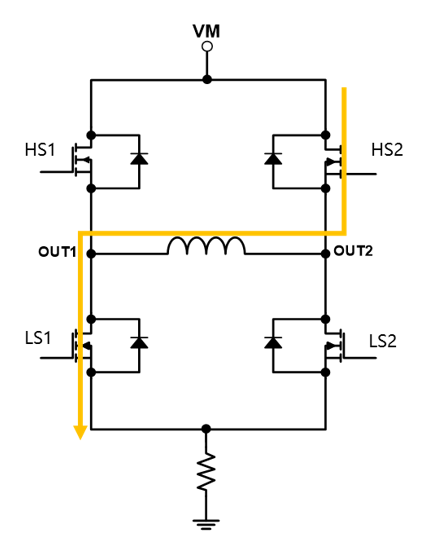
Reverse
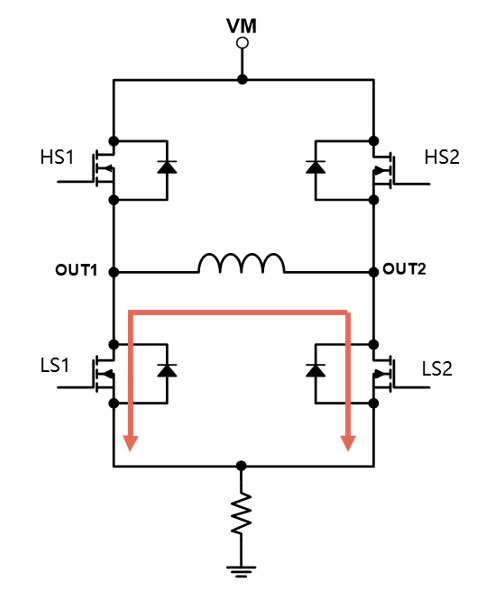
Slow decay
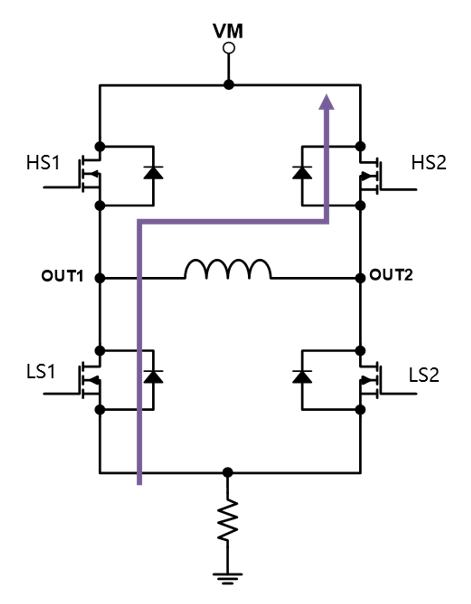
Fast decay
Forward: current flows from OUT1 to OUT2, realizing the forward rotation of the motor.
Reverse: current flows from OUT2 to OUT1, realizing the reverse rotation of the motor.
Slow decay: At the same time, the two lower tubes of LS1 and LS2 are energized, and the winding current is slowly drained to the ground to realize the winding discharge, i.e. brake or slow recession.
Fast decay: If LS1 and HS2 are turned on at this time, a negative voltage will be applied to both ends of the winding, and the winding current will be absorbed by the power supply quickly, i.e. fast decay.
The above four operating modes precisely adjust the motor's operating state by controlling the switching state of MOS tubes to meet various application requirements.
Bipolar Stepper Motor Drive
By supplying orthogonal currents with multiple degrees of subdivision to both windings, the direction and magnitude of the magnetic field vectors inside the motor can be accurately controlled, thus realizing precise position control of the stepper motor.
The higher the interpolation of the current, the better the positional accuracy and smoothness of the stepper motor control. Depending on the degree of subdivision, there are common modes such as 4 subdivision, 16 subdivision, 32 subdivision and so on.
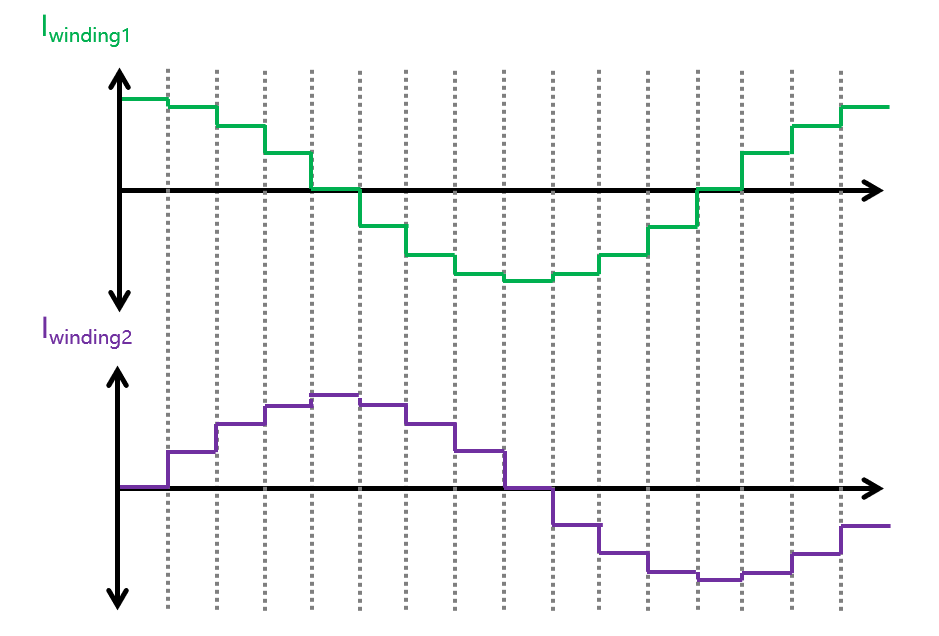
Schematic diagram of ¼ step breakdown
For the stepper driver chip, in addition to the internal H-bridge drive, more important is the precise control of the output interpolation current. Take 1/4 subdivision mode as an example, there are four subdivisions of the current value within the 90° potential angle, and the current of the two windings is a sine wave with 90° phase difference.
Driver chip through the control algorithm and modulation circuit, precise control of the H-bridge for current modulation, so that the current in the motor winding is exactly the waveform and size of our settings, while sampling the output current to achieve feedback control.
For stepper motor driver chip need to pay attention to the chip parameters are: operating voltage, phase current size, type of control signal, maximum subdivision degree, current modulation and recession mode and protection functions.