



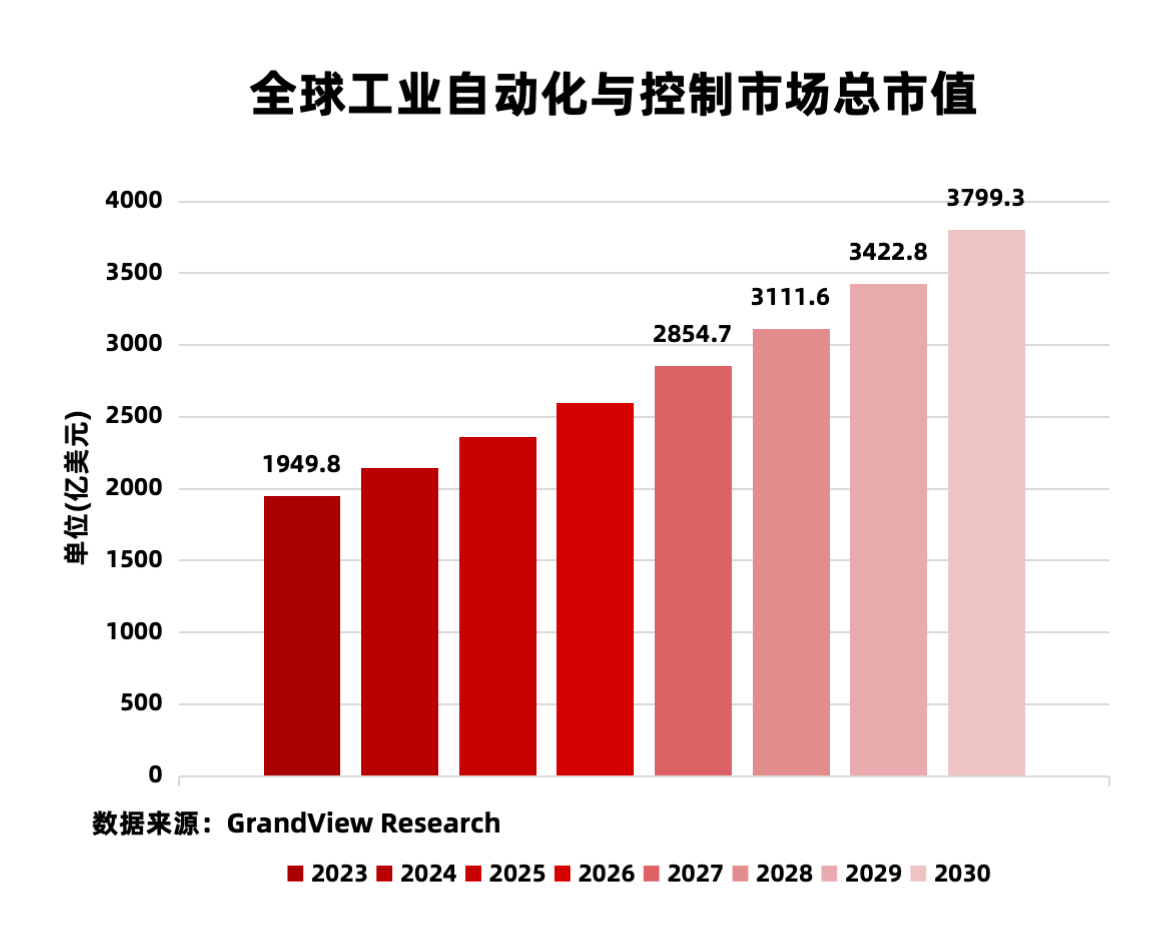
Based on recent developments in the industrial manufacturing sector, the industrial automation and control market remains in a phase of rapid growth. Driven by rising labor costs, pressure to reduce expenses and increase efficiency, and manufacturers' intense need to meet deadlines, demand for automation control technologies in factories has reached unprecedented levels. According to statistics and projections from Grand View Research, the industrial automation and control market was valued at approximately $194.99 billion last year, with this figure projected to reach $379.93 billion by 2030.
China's Industrial Control Market Emerges as a Major Player
China's industrial control market has also undergone significant changes. According to national data, China's industrial sector maintained steady growth in 2023, with new growth drivers accelerating. Among large-scale industrial enterprises, the added value of equipment manufacturing increased by 6.8% year-on-year, accounting for 33.6% of the total added value of large-scale industrial enterprises. The added value of high-tech manufacturing grew by 2.7%, representing 15.7% of the total added value of large-scale industrial enterprises.
Why does a certain gap exist between the global and domestic markets? This is largely attributable to the national policy support for manufacturing transformation and upgrading. Since the release of the 14th Five-Year Plan, the nation has placed unprecedented emphasis on the transformation and upgrading of the industrial manufacturing sector. Within the goal of enhancing the core competitiveness of manufacturing, there is a strong focus on developing industrial control equipment such as distributed control systems and programmable logic controllers, while also achieving breakthroughs in components like advanced controllers and high-precision servo drive systems. The rapid development of hot industries like new energy vehicles has driven factory digital transformation, with provinces and cities rolling out subsidy policies for digital intelligent benchmark demonstration factories.
Industrial Control Upstream, Midstream, and Downstream Supply Chain
Next, let's examine the upstream, midstream, and downstream supply chain of industrial control. The upstream primarily consists of control/communication chips, design IP, sensors, components, and PCBs. The midstream, based on different industrial control processes, is divided into the execution layer, drive layer, control layer, and operational monitoring. The execution layer includes control valves and motor drives; the drive layer encompasses variable frequency drives and servo systems; the control layer covers HMIs, DCS, and PLCs; and operational monitoring incorporates instruments and industrial vision systems. The downstream segment of industrial control encompasses numerous specialized industries, including several that have gained significant traction in recent years: 3C manufacturing, new energy vehicles, energy storage, servers, petrochemicals, and rail transit.
From a semiconductor perspective, the upstream industrial control sector can be categorized into four major segments: industrial sensors, industrial control chips, design IP, and industrial FPGAs. Industrial sensors, as core components of the perception layer (or feedback layer) in the midstream of industrial control, play a vital role in optimizing industrial processes and providing asset monitoring and protection. Foreign manufacturers include ON Semiconductor, Precision Electronics, SICK, Keyence, Beckhoff, Honeywell, Omron, Datalogic, and Leica Geosystems. Domestic players encompass SmartSens, NXMicro, Cognex, Beiyang Group, XCMG, Minghao Sensing, XiaoAowei, Meixin Semiconductor, and Feien Microelectronics.
In the industrial control chip and module sector, most manufacturers focus on developing general-purpose MCUs. Key players include international firms such as TI, ADI, ST, Microchip, Infineon, NXP, ON Semiconductor, and Renesas, alongside domestic manufacturers like JiHai Semiconductor, Huada, Zhongying Electronics, Xinwang Microelectronics, Fengteng Technology, Artel, Jucheng Semiconductor, Nuvoton, Vanguard, Times, Hangshun, Saiyuan, Guoguo Technology, Dongtu Technology, Zhongke Jingshang, Xinhai Technology, and Zhaoxin.
Simultaneously, as differentiated demands increase, design IP has become an indispensable component for upstream chip manufacturers, encompassing both core IP and interface IP. International players include Arm, Synopsys, Cadence, Imagination, Renesas, and Sifive, while domestic firms include PingTouGe, Andes Technology, VeriSilicon, and CanSemi.
Finally, industrial FPGAs see significant demand in rapidly developing sectors like industrial robotics and high-precision equipment, where multi-axis, high-performance servo control is increasingly critical. Consequently, FPGAs remain widely deployed in servo drives, CNC systems, and industrial automation. They also find applications in industrial communications, such as serving as EtherCAT masters or slaves. International manufacturers include AMD (Xilinx), Intel (Altera), Lattice, and Microchip. Domestic manufacturers include Gowin Semiconductor, Anlu Technology, and Unisoc.
Next, we'll use some upstream products as examples to illustrate emerging trends in the industrial control market. First is robot motor control. Industrial applications requiring the integration of processing and real-time communication-such as robot motor control-demand higher real-time processing performance while supporting a wide range of industrial communication protocols. However, it's also crucial to select an MCU with sufficient performance headroom for future expansion and additional features.
Within such integrated architectures, motor control often requires a single MCU to manage multiple axes. Consequently, the MCU must incorporate high-performance real-time processing cores, such as R5F or DSP, alongside real-time communication interfaces like EtherCAT. Take TI's AM2343x multi-core industrial MCU shown in the diagram as an example. It can integrate up to four Cortex-R5F cores, providing ample performance for multi-axis motor control in robotics while also supporting expansion with industrial communication protocols like EtherCAT.
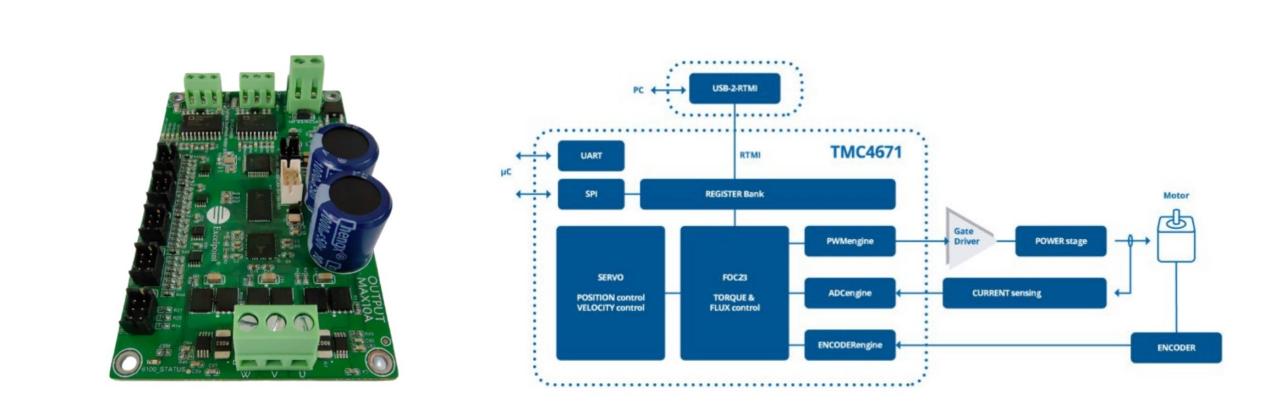
Next is the fully integrated servo control chip. Servo controllers are devices used to regulate servo motors, serving as a vital component in modern motion control systems. They are widely deployed in automated equipment such as industrial robots and CNC machining centers. Servo control chips provide magnetic field orientation control for motors while pursuing higher drive efficiency and dynamic performance. The diagram illustrates Shijian's fully integrated servo motor control solution based on the TMC4671, providing field-oriented control for brushless DC motors, permanent magnet synchronous motors, 2-phase stepper motors, brushed DC motors, and voice coil motors. It is termed "fully integrated" because all control functions are consolidated within the hardware, alongside integrated ADCs, position sensor interfaces, and position interpolators. Consequently, this controller solution is suitable for diverse servo applications.
Next, let's examine the control layer's HMI. Taking high-end industrial HMIs as an example, they require support for multi-display capabilities, higher resolutions and frame rates, and enhanced graphics performance to enable more complex visual interaction designs. Take the HPM6800 series MCU from Xianji Semiconductor as an example. Beyond integrating a high-performance RISC-V core, this chip also incorporates VeriSilicon's 2.5D GPU IP, delivering sufficient graphics performance for HMI applications. Beyond this, non-touch voice-controlled HMIs often prioritize compact designs while requiring support for pre-programmed and multilingual command inputs. Renesas' voice HMI ASSP MCU, the R9A06G150, exemplifies this approach.
Improving condition monitoring and diagnostics while achieving overall system optimization represents a core challenge in today's use of mechanical facilities and technical systems. This topic is increasingly critical not only in industrial settings but wherever mechanical systems are employed. Traditionally, machines were maintained according to schedules, with delayed maintenance risking production downtime. Today, people predict remaining machine lifespan by analyzing operational data. Key parameters like temperature, noise, and vibration can be leveraged from recorded data to determine optimal operating conditions and even required maintenance intervals. This approach prevents unnecessary wear and tear while enabling early detection of potential issues and their root causes.
Similarly, image sensors for industrial vision inspection are seeing growing demand in the industrial equipment sector to enhance production efficiency and ensure product yield rates. In this context, image sensors used for machine vision inspection must not only perceive visible light but also strengthen their ability to detect light in invisible wavelengths, such as the short-wave infrared (SWIR) spectrum. Take Sony's IMX992/993 image sensors as an example. They integrate Sony's proprietary SenSWIR technology, combining 3.45-micron pixels. The IMX992 achieves 5.32 megapixels, enabling high-resolution imaging and improving accuracy in various industrial inspection and measurement applications.
Specialized chips are often required for specific industrial communication protocols, such as EtherCAT. As one of China's first manufacturers to launch EtherCAT slave controller chips, Yasin Electronics introduced the AX58100 in 2019. Subsequently, it released dual-core EtherCAT slave controllers with 2/3 ports, delivering higher efficiency while enabling interconnection with all systems supporting standard EtherCAT communication protocols. Applications include digital signal I/O control, sensor data acquisition, robotic axis control, and EtherCAT-to-IO-Link master gateway functions. The image on the right shows the TL3568 industrial core board developed by Chuanglong Technology using entirely domestic components. Designed around Rockchip's RK3568 processor, it can also be used to build EtherCAT masters. EtherCAT masters do not require dedicated chips; they can be implemented purely in software. For example, integrating the EtherCAT master protocol into RT-Thread enables real-time control of servo motors and remote I/O.
Finally, industrial FPGAs offer hardware logic implementation with advantages like high-speed parallel processing, abundant I/O units, and functional multiplexing. However, they face limitations in flexible control and complex communication protocols. This leads us to SoC FPGAs, which integrate hard-core processors within the FPGA architecture. This reduces system power consumption and cost while minimizing motherboard footprint. They retain the programmable flexibility of FPGAs while maintaining compatibility with the hard processor ecosystem. Take Anlu Technology's SALDRAGON series FPSoC released last year as an example: it offers optional integration of either a dual-core Arm Cortex-A35 or a single-core 64-bit RISC-V processor, allowing full utilization of both ecosystems.
Industrial Communication: Ethernet's Dominance Continues to Strengthen
After decades of evolution and iteration, industrial communication methods primarily fall into three categories based on physical implementation: industrial Ethernet, fieldbus, and industrial wireless networks. Within industrial Ethernet, emerging technologies like EtherCAT, PROFINET, and EtherCAT now dominate. Fieldbus systems encompass PROFIBUS DP, Modbus-RTU, and CC-Link. Industrial wireless networks, which have only recently emerged in industrial networking, include well-known connectivity solutions such as Wi-Fi, Bluetooth, and 5G.
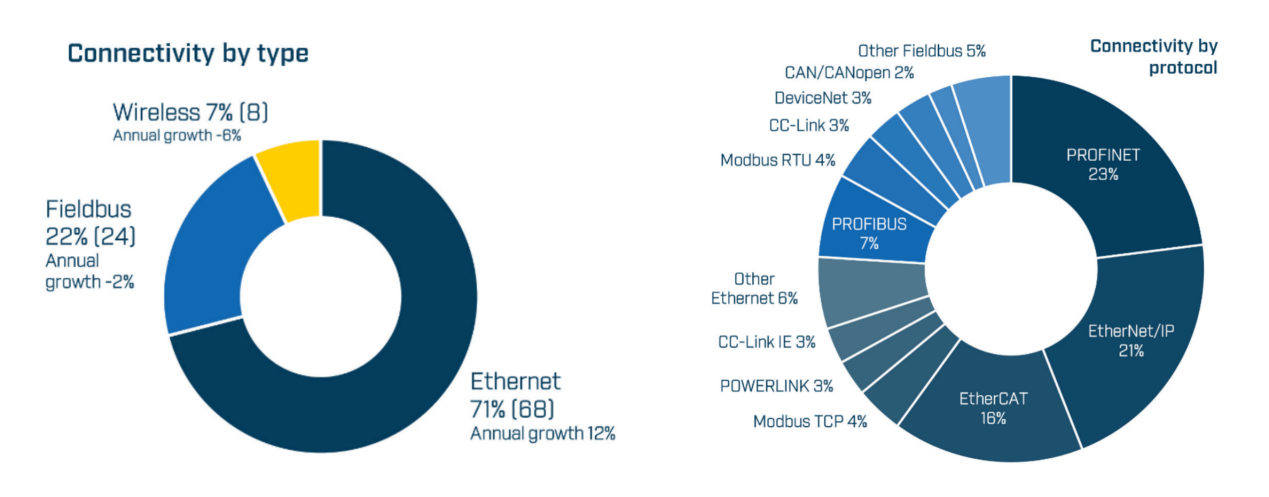
According to HMS statistics, Industrial Ethernet continued to dominate new node installations in 2023, with its market share rising from 68% the previous year to 71%-a significant 12% increase. While PROFINET, EtherNet/IP, and EtherCAT remain the three dominant players in the market, the popularity of PROFINET and EtherCAT is steadily growing. Compared to wireless connectivity, fieldbus still accounts for a significant portion of new nodes. However, it has lost sufficient market momentum and relies solely on equipment, machinery, and factories continuing to use these well-functioning, time-tested fieldbus devices.
Wireless connectivity maintains overall stability. Despite persistent calls for fully wireless factories, adoption remains limited due to the need for extensive cable re-routing and the challenge of creating environments supporting wireless machine access and mobile industrial equipment.
The erosion of industrial bus market share stems primarily from the substantial advantages offered by Industrial Ethernet over traditional industrial buses. The foremost benefit is speed: Unlike serial-based industrial buses, Industrial Ethernet achieves significantly higher speeds, exceeding 100Mbps. Even the most widely used PROFIBUS industrial bus, specifically the high-speed PROFIBUS DP variant for factory automation, has a maximum configurable speed capped at 12Mbps. Second is its more flexible topology. For complex industrial network deployments, industrial buses using large daisy-chain configurations create networks highly susceptible to failures. Industrial Ethernet, however, employs flexible topologies like star networks to build faster, more reliable industrial networks.
Finally, industry alliances drive adoption. Take Profinet (dominant in Industrial Ethernet) and Profibus (dominant in industrial buses) as examples: though both are promoted by PI, since 2016, Profinet has surpassed Profibus in new device node installations. With comprehensive brownfield and greenfield migration solutions now available, this gap continues to widen.
As more devices, sensors, and systems connect to industrial networks, underlying wireless technologies like Wi-Fi, LoRaWAN, and DECT-2020 NR enable the feasibility of wirelessly collecting and sharing critical industrial data. However, as 5G deployment and technological evolution mature, the industrial manufacturing market is increasingly turning its attention to cellular network technologies-previously rarely used in industrial networks due to concerns over speed and latency. Despite this, industrial wireless networks remain challenging to adopt as the primary solution in certain harsh RF environments. Moreover, unless supported by telecom operators, cellular wireless networks like 5G struggle to guarantee the required network quality in factory settings.
In terms of market share, 5G adoption in industrial wireless networks remains limited. This is because 5G industrial wireless networks are deployed differently from other networking methods, primarily through the direct construction of fully connected 5G factories. Driven by the 5G+Industrial Internet initiative, the number of projects nationwide has surpassed 8,000. The Ministry of Industry and Information Technology (MIIT) has selected and published the "2023 5G Factory Directory" featuring benchmark projects, with total construction investment reaching 9.73 billion yuan. The three major telecom operators have also actively participated in the direct construction of industrial networks for 5G factories.
Final Thoughts
Market trends indicate that the industrial automation and control sector remains in a rapid development phase, particularly in China, where national policies supporting manufacturing transformation and upgrading have provided significant impetus. Secondly, bolstered by advancements in the upstream semiconductor industry, China's industrial automation sector is shifting from scale expansion to quality enhancement. Domestic substitution for high-end industrial control equipment is no longer merely a slogan. In industrial communications, while industrial bus systems face growth challenges, industrial Ethernet is accelerating its replacement pace. Industrial wireless networks show a slight overall slowdown in growth, yet 5G factory deployments are accelerating, particularly in the domestic market.