


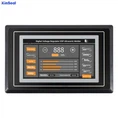


Below is an introduction to several fundamental functions of industrial automation at Siemens Automotive Plants! (Applicable not only to the VASS standard but also to Tesla's SICAR).
VASS Standard:
Tesla's SICAR Standard
Control Function Requirements (SICAR) for Body Shops Proposed by Siemens:
Stop: Pause
End of Cycle: Halt at cycle completion
Home Position: Return to original position
Single Step: Activate single-step operation
Step+1: Execute single-step operation
Empty Line: Clear the production line
Without Part: Run empty
Stop at End of Cycle: (Halt bei Taktende) (End of Cycle)
Key Terms: Automatic, Start/Stop, Part Present/Absent at Station.
After the production process concludes, the system maintains its home position. No release mechanism for component removal is provided (slides remain in the station), and station activation is abandoned. This function is employed in each protective circuit.
The current process concludes, and equipment including the robot remains in its home position.
Components are not further conveyed from the equipment but remain in place. Note that components from fixtures or equipment may change position at the home position. Under no circumstances should the fixture be opened in this case!
This function applies only to radio stations. Handling robots may position components in a standby position.
When automatic mode is activated, the corresponding HMI button is enabled, and the variable .xSK6_TE := (bVisuTasten = Byte#32);(VASS) SYSTEM_DB".HMI_Panel[x].IN_Ext. Req_StopEndCycle(SICAR)
In the VASS standard, the intermediate device state satisfies the cycle-end stop condition, after which K40 is deactivated.
IF xK40A
OR (ST_BA.K6_TE AND ST_BA.K6_AnwTE AND NOT ST_BA.K94_Lstop)
OR(ST_BA.K6_TE AND ST_BA.K93_AnwLeer AND ST_BA.K93_Leer)
OR(Not ORT AND ST_BA.ExtStop)
ORNOT K16_NotHalt
ORNOT K61_Antr
ORST_BA.K36_PESIStoe
OR(NOT K51_KON AND NOT ST_BA.KWE7)
ORNOT K52_StVo
ORxFSCAN
ORReset_Aus
OR(NOT ST_BA.K23_BaHand AND NOT ST_BA.K9_BaAuto AND NOT ST_BA.K8_BaEinzelbet AND NOT Cfg.X1)
ORNOT STEU_EIN
ORST_BA.KWE2_Rob
ORST_BA.KWE2_Rob_UBA
ORxTMP_BIT1 THEN
xHM_K40 := False;
END_IF;
Empty Cycle: (Production without Parts) (Without Part: Empty Run)
Keywords: Automatic, Continuous Operation, No Parts at Station.
1. In PoT operation, no requests/transfers are sent to the conveyor system.
2. In chain-type PoT operation, the clipboard in the cell/ARG must be considered.
3. Specifications for Accumulation Conveyors and Container Stations:
PoT operation must also be feasible with stacking conveyors and container stations.
For this purpose, robot programming in PoT must be executed as follows: The robot moves its own UP to a sufficient distance before the part to be removed, then closes the gripper without actually removing the part.
Stacking conveyors no longer employ PoT operation since partial removal does not occur.
No request for container exchange is set. Container stations do not employ PoT operation.
In automatic preselection mode (i.e., when the START button flashes), activation occurs via HMI buttons or corresponding buttons on the button box.
Variable SYSTEM_DB".HMI_Panel[x].IN_Ext. DryRun(SICAR),xSK92_PoT:= (bVisuTasten = Byte#128);(VASS)
In the VASS standard, FC10 is used to simulate part signals for emulating empty runs.
Empty Line: (Empty Run System Anlage leer fahren)
Keywords: Automatic, Start Interrupt, Station Without Parts.
After selecting the function, the lead loading station is blocked, and components in the production station, storage station, and robot gripper are installed. Subsequent insertion stations are further released based on components still to be installed (insertion of protective window/light with indirect protection). Memory is not cleared.
This function must be terminable at any time, and automatic restart of part production must be ensured.
When the system is empty, the start of each BA must be deactivated and the selection reset.
This function acts on the protective circuit and is selected individually for each protective circuit using a preselection button.
Cross-ARG selection should be possible. This means a separate button on the user interface.
The solution is via FB preselection and must be transmitted to another ARG via PN-PN coupler.
The automatically generated protection circuit "Empty" remains unaffected here.
Activation occurs by clicking the HMI button (possible in manual, automatic, and automatic preselection states), with the corresponding variable
corresponding variable SYSTEM_DB".HMI_Panel[x].IN_Ext. EmptyLine(SICAR), xSK93_Leer:= (bVisuTasten = Byte#64) Or ST_BA.K93_Leer_SR;(VASS)
In the VASS standard, K40 closes when the medium-voltage device status meets the line empty condition.
IF xK40A
OR(ST_BA.K6_TE AND ST_BA.K6_AnwTE AND NOT ST_BA.K94_Lstop)
OR (ST_BA.K6_TE AND ST_BA.K93_AnwLeer AND ST_BA.K93_Leer)
OR(Not ORT AND ST_BA.ExtStop)
ORNOT K16_NotHalt
ORNOT K61_Antr
ORST_BA.K36_PESIStoe
OR(NOT K51_KON AND NOT ST_BA.KWE7)
ORNOT K52_StVo
ORxFSCAN
ORReset_Aus
OR(NOT ST_BA.K23_BaHand AND NOT ST_BA.K9_BaAuto AND NOT ST_BA.K8_BaEinzelbet AND NOT Cfg.X1)
ORNOT STEU_EIN
ORST_BA.KWE2_Rob
ORST_BA.KWE2_Rob_UBA
ORxTMP_BIT1 THEN
xHM_K40 := False;
END_IF;