



01
industrial camera
Industrial cameras, also known as video cameras, compared to traditional civilian cameras (video cameras), it has a high image stability, high transmission capacity and high interference immunity, etc., most of the industrial cameras on the market are based on CCD (Charge CoupledDevice) or CMOS (Complementary MetalOxide) chip cameras. Semiconductor) chips.
02
Camera classification
According to the chip type: CCD camera, CMOS camera;
According to the structural characteristics of the sensor: line array camera, surface array camera;
According to the scanning mode: interlaced scanning camera, progressive scanning camera;
According to the resolution: ordinary resolution cameras, high-resolution cameras;
According to the output signal mode: analog camera, digital camera;
According to the output color: monochrome (black and white) camera, color camera;
According to the output signal speed: ordinary speed cameras, high-speed cameras;
According to the response frequency range: visible light (ordinary) cameras, infrared cameras, ultraviolet cameras, etc..
03
CCD and CMOS
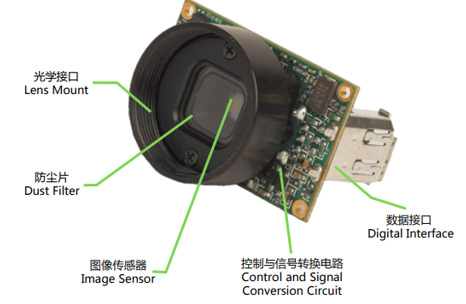
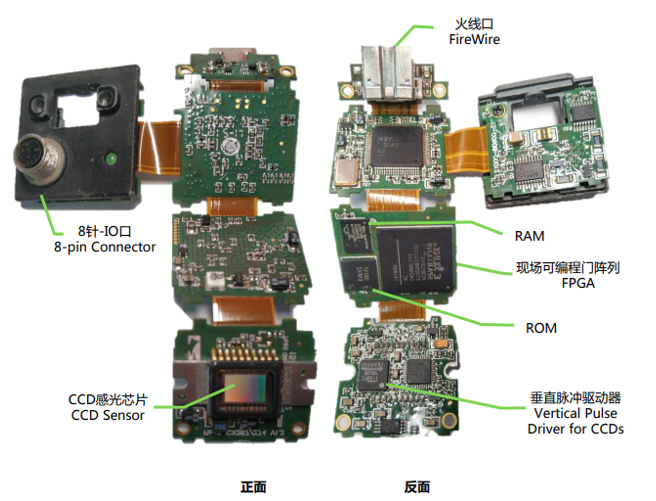
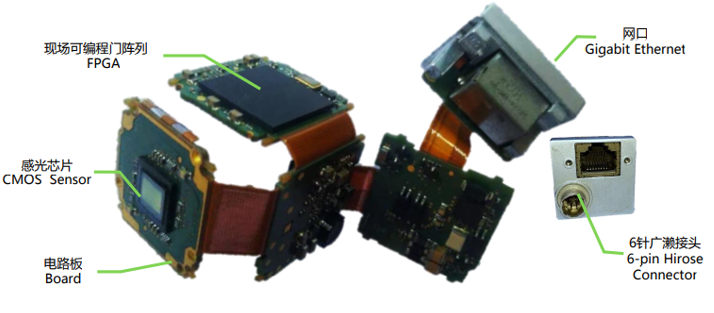
CCD is currently the most commonly used image sensors for machine vision, CCD camera by the dust sheet, sensor chip, FPGA, RAM and ROM, FireWire port and I / O interface, etc. Composition. Principle of operation: the light from one side of the object to be photographed is focused to the CCD chip through the optical lens, and the CCD completes the conversion of light and electric charge, storage, transfer and reading under the driving pulse of the driving circuit, thus converting the optical signal to electrical signal output. the outstanding feature of CCD is to use electric charge as the signal, unlike other devices which use current or voltage as the signal. As a functional device, CCD has the advantages of no burn, no hysteresis, low voltage operation and low power consumption compared with vacuum tube.
The development of CMOS image sensors first appeared in the early 1970's, and rapidly evolved in the early 1990's with the advancement of manufacturing process technology for Very Large Scale Integrated Circuits (VLSI) CMOS refers to the process of manufacturing image sensors rather than to a specific imaging technology. CMOS image sensors integrate photosensitive element arrays, image signal amplifiers, signal reading circuits, analog-to-digital conversion circuits, image signal processors, and controllers on a single chip, which has the advantage of programmed random access to local pixels. Currently, CMOS image sensors are widely used in high-resolution and high-speed applications for their good integration, low power consumption, high-speed transmission and wide dynamic range.
Difference: When strong light irradiation CCD sensor, the collected image will appear halo (Blooming) and trailing (Smear) phenomenon, seriously affecting the image quality.
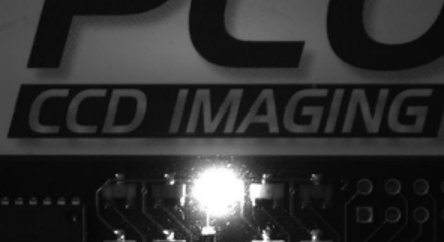
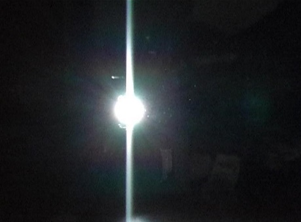
Solution: Adjust the camera gain; reduce the light or exposure time to increase the CCD readout rate; select the CMOS chip (structural solution).
04
Basic Camera Terminology
Pixel: The basic light-sensitive unit on a light-sensitive device, i.e., the smallest unit on the image recognized by the camera (each small frame in the picture is a pixel).
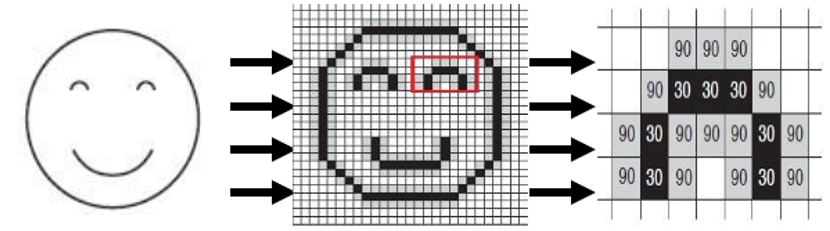
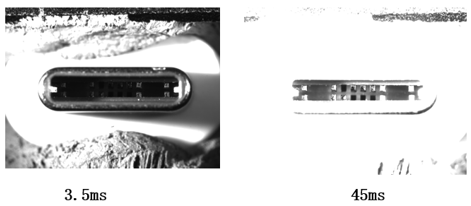
Pixel and pixel size: Pixel is the constituent unit of the chip, which is the basic unit to realize the conversion of optoelectronic signals. Image element size is generally micron-level (3-10 microns) Image element depth: the number of bits of data per pixel, for black-and-white cameras, the image element depth is set at the number of gray scale from dark to light gray scale. Generally commonly used is 8bit, there are 10bit, 12bit, and so on. Exposure time: It is the time interval from the shutter opening to closing of the camera, the longer the exposure time, the brighter the picture, and at the same time, the worse the anti-vibration ability. When taking pictures of moving objects, the longer the exposure time, the longer the drag produced. Excessively long exposure times reduce the camera's frame rate.
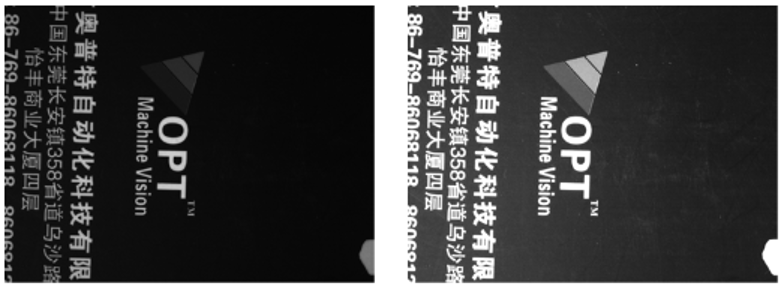
Resolution: the actual size represented by a single individual pixel on an image, resolution = field of view/number of pixels (in the same direction). Frame rate: Unit is FPS (frame per second), i.e. frame per second, it means how many images the camera can capture per second, 1 image is 1 frame. For example, 15 frames per second means that the camera can capture a maximum of 15 images per second. In general, the larger the resolution of the camera, the lower the frame rate. The maximum frame rate is one of the important performance parameters of the camera, mainly depends on the acquisition speed, data conversion speed and data transmission speed. Line Frequency: The speed of the line array industrial camera is the line frequency in KHz. e.g. 12KHz means that the line array industrial camera can collect up to 12000 lines of image data in 1 second. Gain: Expand the digital information of the picture at the same time, when the picture is dim, it can increase the contrast and brightness to improve the imaging effect. But when the picture is already bright, expanding the gain will be counterproductive.
Noise: Interference signals formed in the camera chip circuit and signal transmission circuit, resulting in images that are not physically reflected in the image. Drag: The phenomenon of repeated imaging of the same object, on a picture, when shooting motion pictures.