


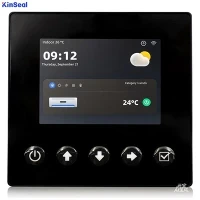


As a typical application of industrial automation, PLC was initially made to replace the relay line, sequence control is mainly generated, and later PLC manufacturers gradually increased the analog operation, PID function and more reliable industrial anti-interference technology and other functions, and with the demand for networked to increase a variety of communication interfaces, accompanied by the development of fieldbus technology and Ethernet technology, PLC's application is more and more extensive. With the development of fieldbus technology and Ethernet technology, the application of PLC is getting wider and wider.
What is PLC
Programmable controller (Programmable Controller) is a member of the computer family, designed and manufactured for industrial control applications. Early programmable controllers were called Programmable Logic Controllers (PLC), or PLCs for short, and were mainly used to realize logic control instead of relays.
The International Electrotechnical Commission (IEC) issued a third draft standard for programmable controllers in 1987. Programmable controllers are defined in the draft as follows:
"A programmable controller is an electronic system of digital arithmetic operations designed for application in an industrial environment. It uses programmable memory to store instructions within it for performing logical operations, sequential control, timing, counting, and arithmetic operations, and to control various types of machinery or production processes through digital and analog inputs and outputs. Programmable controllers and their related peripherals should be designed in accordance with the principle of easy to link with industrial systems as a whole, and easy to expand their functions".
With the development of technology, the function of this device has greatly exceeded the scope of logic control, so today this device is called programmable controller, abbreviated as PC, but in order to avoid confusion with the personal computer (Personal Computer) abbreviation, so the programmable controller abbreviated as PLC.
Development of PLC
The world's first PLC
General Motors (GE) in 1968, in order to adapt to the continuous updating of automobile models, the production process is constantly changing the need to achieve small batch, multi-species production, hoping that there is a new type of industrial controller, which can do to minimize the re-design and replacement of electrical control systems and wiring, in order to reduce costs and shorten the cycle.
The design requirements at the time is to draw on the advantages of both relays and computers: relay control system is large, low reliability, complex wiring, not easy to change, difficult to find and troubleshooting difficulties, poor adaptability to changes in the production process, but simple, easy to understand, inexpensive; powerful, flexible computer (programmable), good versatility, but programming is difficult; the use of the control process-oriented, problem-oriented The use of control-oriented process, problem-oriented "natural language" programming, so that people who are not familiar with the computer can also quickly master the use.
In 1969, the U.S. Digital Equipment Corporation (DEC) developed the first PLC, in the United States General Motors automated assembly line trial, a success.
This new type of industrial control device with its simple to understand, easy to operate, high reliability, general flexibility, small size, long service life and a series of advantages, and soon in the United States to promote the application of other industrial areas, to 1971, has been successfully applied to food, beverage, metallurgy, paper and other industries.
Early 70's
Only logic operations, timing, counting and other sequential control functions, just to replace the traditional relay control, usually called programmable logic controller (Programmable Logic Controller).
In 1971, Japan introduced this new technology from the United States, and soon developed Japan's first PLC. 1973, Western European countries also developed their first PLC, China began development in 1974. In 1977, industrial applications began.
Mid 70's
Microprocessor technology is applied to PLC, so that PLC not only has a logic control function, but also increased arithmetic operations, data transmission and data processing functions.
After the 80s
With the rapid development of microelectronics technology such as large-scale and ultra-large-scale integrated circuits, 16-bit and 32-bit microprocessors are applied to PLC, so that PLC has been developed rapidly.PLC not only enhances the control function, but also improves the reliability, reduces the power consumption and volume, lowers the cost, makes the programming and fault detection more flexible and convenient, and has the functions of communication and networking, data processing and graphic display, etc. In recent years, PLC has been developed rapidly.
PLC has developed rapidly in recent years
PLC set of three electric (electric control, electric instrumentation, electric transmission) as a whole, high performance-price ratio, high reliability features, has become the core of automation engineering equipment. PLC has become a general industrial control device with computer functions, its use of the first place.
PLC has become one of the three pillars of modern industrial automation technology (PLC, robotics, CAD/CAM).
China's PLC market of the three schools
After China's reform and opening up, the United States AB, GE, MODICON, TI, Japan OMRON, Mitsubishi, Fuji, Germany Siemens and other manufacturers of products continue to enter our country, and occupy an important position in the industrial control system in various industries.
Europe: Germany's Siemens (SIEMENS), AEG and France's TI company
United States: A-B (Allen-Bradly) (its products accounted for about 50% of the U.S. PLC market share), GE (General Electric), Modicon (MODICON) company, Texas Instruments (T1) company, Goethe (Gould) company, Westinghouse
Japan: Mitsubishi Electric (Mitsubishi Electric), OMRON (OMRON), FUJI (Japan's main development of small and medium-sized PLC, in the world's small PLC market, Japanese products accounted for about 70% of the share. In China, the sales of OMRON products in the first place.)
At present, the domestic market and South Korea, Taiwan and other PLC products; now the market has appeared in the series of domestic PLC, its price is relatively inexpensive, cost-effective.
In 1974, China began to copy the second generation of PLC products from the United States, but failed to promote it due to component quality and technical problems and other reasons. It was not until 1977 that China developed the first PLC with practical value, and began mass production and application in the control of industrial processes.
PLC structure and the role of each part
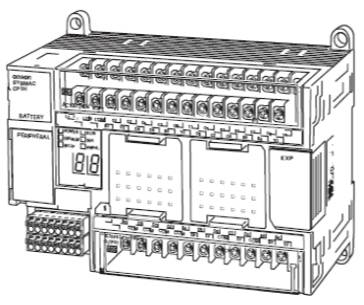
PLC types, functions and instruction systems are not the same, but the structure and working principle is similar, usually by the host, input/output interfaces, power expander interfaces and external device interfaces and other major parts of the PLC hardware system structure is shown in the figure below:
1, host
The host part includes the central processing unit (CPU), system program memory and user program and data memory. CPU is the core of PLC, which is used to run the user program, monitor the status of input/output interfaces, make logical judgments and data processing, that is, read the input variables, complete the various operations specified in the user's instructions, and send the results to the output side and respond to the requests of external devices (such as computers, printers, etc.) and make various internal judgments. ) and make various internal judgments.
PLC's internal memory has two types, one is the system program memory, mainly for the storage of system management and monitoring programs and user programs for compilation and processing of the program, the system program has been fixed by the manufacturer, the user can not be changed; the other is the user's program and data memory, mainly for the storage of user-developed application programs and a variety of temporary data and intermediate results.
2, input / output (I / O) interface
I / O interface is a PLC and input / output devices connected to the components. Input interface accepts control signals from input devices (such as buttons, sensors, contacts, travel switches, etc.). Output interface is the host after processing the results through the amplifier circuit to drive the output device (such as contactors, solenoid valves, indicators, etc.).I / O interface is generally used in opto-electronic coupling circuits, in order to reduce electromagnetic interference, thereby improving the reliability of the I / O points that is, the number of input/output terminals is the PLC of a major technical indicators, usually dozens of points of the small machine, medium-sized machines have hundreds of points, the large-scale machine will be More than a thousand points.
3, power supply
The power supply in the figure refers to the CPU, memory, I / O interface and other internal electronic circuits configured for the work of the DC switching regulator power supply, usually also provides DC power for the input devices.
4,Programming
Programming is the PLC using external equipment, the user is used to enter, check, modify, debug the program or monitor the work of the PLC. Through the special PC / PPI cable will be connected to the PLC and computer, and the use of special software for computer programming and monitoring.
5, Input / Output Expansion Unit
The I/O expansion interface is used to connect the expansion unit, which expands the number of external input/output terminals, to the basic unit (i.e., the host).
6, External device interface
This interface can be printer, barcode scanner, inverter and other external equipment and the host connected to complete the corresponding operation.
PLC features
(A) high reliability
1,All I/O interface circuits are opto-isolated to isolate the external circuits on the industrial site from the internal circuits of the PLC.
2, the inputs are used R-C filter, the filter time constant is generally 10 ~ 20ms.
3, each module is shielded to prevent radiation interference.
4,Adopt switching power supply with excellent performance.
5,Strict screening of the devices used.
6, good self-diagnostic function, once the power supply or other soft, hardware anomalies, the CPU immediately adopt effective measures to prevent the expansion of the fault.
7, large-scale PLC can also be used by the dual CPU redundant system or three CPUs constitute a voting system, so that reliability is further improved.
(B) rich I / O interface module
PLC for different industrial field signals, such as:
AC or DC;
Switching or analog;
Voltage or current;
Pulse or potential;
Strong or weak power, etc.
There are corresponding I/O modules with industrial field devices or equipment, such as:
pushbuttons
Travel switches
Proximity switches
Sensors and transmitters
Solenoids
Control valves
Direct connection. In addition, in order to improve the operation performance, it has a variety of human-machine dialog interface module; in order to form a local industrial network, it has a variety of communication networking interface module, and so on.
(C) the use of modular structure
In order to adapt to a variety of industrial control needs, in addition to the unit type of small PLC, the vast majority of PLC are modular structure.
PLC components, including the CPU, power supply, I / O, etc. are modular design, by the rack and cable will be connected to the modules, the size and function of the system can be based on the user's own combination of needs.
(D) programming is simple and easy to learn
PLC programming is mostly similar to the ladder diagram form of relay control lines, the user does not need to have specialized knowledge of computers, so it is easy to be understood and mastered by general engineers and technicians.
(E) simple installation, easy maintenance
PLC does not require a special room, can be directly run in a variety of industrial environments. Use only a variety of equipment on site and PLC connected to the corresponding I / O terminal, can be put into operation. Various modules are equipped with operation and fault indication devices, making it easy for users to understand the operation situation and find faults.
Due to the modular structure, once a module fails, the user can quickly restore the system to operation by replacing the module.
Application areas of PLC
PLC is not only used for switching control, but also used for analog and digital control, can collect and store data, but also the control system for monitoring; can also be networked, communication, to achieve a wide range of cross-area control and management. PLC has increasingly become an important role in the family of industrial control devices.
1, for switching control
PLC control switching capacity is very strong. The control of the number of points in and out, less than a dozen points, dozens of points, more than a few hundred, thousands, or even tens of thousands of points. Because it can be networked, the number of points is almost unlimited, no matter how many points can be controlled.
The logic problems controlled can be varied: combinatorial, chronological; immediate, delayed; do not need to count, need to count; fixed order, random work; and so on, can be carried out.
PLC's hardware structure is variable, the software program is programmable, for control, very flexible. If necessary, can write more than one set, or more than one set of programs, according to the need to call. It is well adapted to the industrial field of multi-operating conditions, the need for multi-state transformation.
PLC switching control examples are many, metallurgy, machinery, light industry, chemical industry, textiles, etc., almost all industrial sectors need to use it. At present, the first PLC with the goal, but also other controllers can not be compared with it, is that it can be convenient and reliable for switching control.
2, For analog control
Analog quantities, such as current, voltage, temperature, pressure, etc., its size is continuously changing. Industrial production, especially continuous production processes, often to control these physical quantities.
As an industrial control electronics, PLC if you can not control these quantities, it is a major shortcoming. For this reason, the PLC manufacturers are in this area to carry out a lot of development. At present, not only large, medium-sized machine can be analog control, is a small machine, can also be such control.
PLC analog control, to be configured with analog and digital conversion of A/D, D / A unit. It is also an I/O unit, but it is a special I/O unit.
A/D unit is the external circuit of the analog, converted to digital, and then sent to the PLC, D / A unit, is the PLC's digital converted to analog, and then sent to the external circuit.
As a special I/O unit, it still has I/O circuit anti-interference, internal and external circuit isolation, and input and output relays (or internal relays, which is also a zone of the PLC working memory. It can be read and written) to exchange information and so on.
The advantage of analog control with PLC is that while analog control is performed, switching can also be controlled. This advantage is not available with other controllers, or the control is not realized as easily as with PLC.
3, For Motion Control
The actual physical quantities, in addition to switching, analog, and motion control. For example, the displacement of machine parts is often expressed as a digital quantity.
PLC is also based on computer technology, and increasingly improved. Therefore, it can also be used for digital control.
PLC can receive counting pulses with a frequency of up to several k to tens of k Hz. Available in a variety of ways to receive the pulse, can also be received in multiple ways. Some PLC also has a pulse output function, the pulse frequency can be up to tens of k. With these two functions, coupled with the PLC has the data processing and arithmetic capabilities, if equipped with the appropriate sensors (such as rotary encoders) or pulse servo devices (such as ring distributor, amplifier, stepper motor), it can be fully in accordance with the principle of NC to achieve a variety of control.
High- and mid-range PLC, but also the development of NC units, or motion units, can be realized point control. Motion unit can also realize curve interpolation, can control the curve movement. Therefore, if the PLC is configured with such a unit, it is possible to use the NC method for digital control.
4, for data acquisition
With the development of PLC technology, its data storage area is getting bigger and bigger. For example, the PLC of Devison, its data storage area (DM area) can reach 9999 words. Such a large data storage area can store a large amount of data.
Data acquisition can be done with a counter, which cumulatively records the number of pulses captured and regularly dumps them into the DM area.
Data acquisition can also be performed with an A/D unit, which converts analog quantities to digital quantities and then regularly transfers them to the DM area.
PLC can also communicate with the computer, the computer to read out the data in the DM area, and then by the computer to process these data. At this point, the PLC becomes the data terminal of the computer.
Power users have used PLC to record real-time user power consumption to realize different power consumption time, different pricing charging methods, to encourage users to use more power in the low point of power consumption, to achieve the purpose of rational use of electricity and power saving.
5, for signal monitoring
PLC self-test signals are many, there are many internal devices, most users do not give full play to its role.
In fact, it can be fully utilized to monitor the work of the PLC itself, or to monitor the control object.
For a complex control system, especially automatic control systems, monitoring and further self-diagnosis is very necessary. It can reduce system failures, faults or find, can improve the cumulative average trouble-free operation time, reduce the fault repair time, improve system reliability.
6, for networking, communication
PLC networking, communication capabilities are very strong, and there are constantly new structures for networking launched.
PLC can be connected to a personal computer for communication, the computer can be used to participate in the programming and management of PLC control, so that the PLC is more convenient to use.
In order to give full play to the role of computers, a computer can be implemented to control and manage more than one PLC, up to 32 units. Can also be a PLC and two or more computers to communicate, exchange information to achieve multi-location monitoring of the PLC control system.
PLC and PLC can also communicate. One to one PLC communication. Several PLCs can communicate. Can be as many as dozens or hundreds.
PLC and intelligent instrumentation, intelligent actuators (such as inverters), can also be networked communication, exchange of data, mutual operation. Can be connected to a remote control system, the system range can be as large as 10 kilometers or more.
Can form a local network, not only PLC, but also high-grade computers, a variety of intelligent devices can also enter the network. Available bus network, also available ring network. The network can also set the network. Network and network can also be bridged. Networking can be thousands of PLCs, computers, intelligent devices organized in a network.
The nodes between the nets can communicate and exchange information directly or indirectly.
Networking, communication, is adapted to the needs of today's computer integrated manufacturing system (CIMS) and intelligent factory development. It can make industrial control from the point (Point), to the line (Line) and then to the surface (Aero), so that the equipment level control, production line control, factory management control into a whole, and thus can create higher efficiency. This infinitely bright future has been more and more clearly shown in front of our generation.
With the development of smart factories and the Internet of Things, factory equipment joint control, PLC and host computer and other intelligent products, data interaction, big data applications and other areas, will greatly promote the close combination of traditional automation and network technology, with China's manufacturing industry to achieve the sublimation of the big into the strong, PLC application technology will see greater development.