


Microelectromechanical systems (MEMS) pressure sensors are widely used in aerospace, biomedicine, industrial control, and environmental monitoring because of their low power consumption, small size, low cost, and low impact on the measurement object. In some studies, piezoresistive or capacitive MEMS pressure sensors have been used to realize high-pressure measurements. However, both these piezoresistive and capacitive miniature high-pressure sensors lack full-range accuracy due to severe temperature disturbances or poor linearity.
Recently, Prof. Junbo Wang's team at the Institute of Space and Astronautical Information Innovation, Chinese Academy of Sciences (CAS) developed a composite pressure-sensitive mechanism combining diaphragm bending and volume compression for resonant miniature pressure sensors to achieve high-accuracy high-pressure measurements, according to a report by McMasters Consulting. The miniature sensor was fabricated using micromachining technology, and the experimental results show that the full-scale accuracy of the sensor is ±0.015% in the pressure range of 0.1~100 MPa and the temperature range of -10~50℃. The related research results are titled as "A resonant high-pressure microsensor based on a composite pressure-sensitive mechanism of diaphragm bending and volume compression". compression" was published in the journal Microsystems & Nanoengineering.
As shown in the figure below, the stress state of the resonator anchored to the bottom surface of the cavity can reflect the external pressure through a composite mechanism. The cavity containing the resonator can be constructed with a composite structure with diaphragm bending and volume compression. Through this composite mechanism, the researchers developed a novel resonant miniature high-pressure sensor with a miniaturized cavity reinforcing the diaphragm structure for greater range. In addition, high accuracy can be achieved by utilizing dual resonator cavities with different widths.
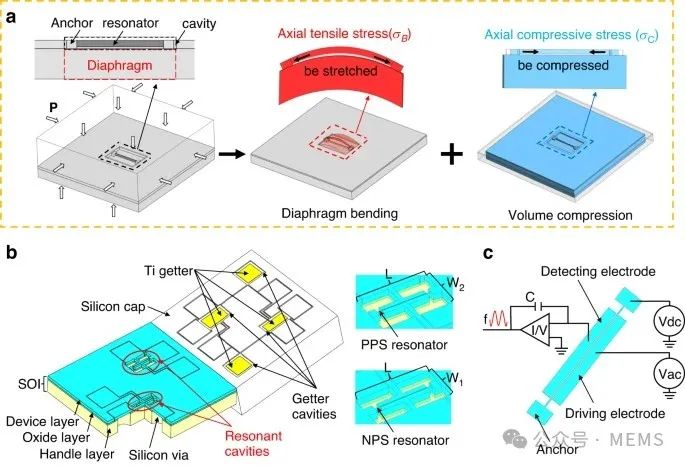
Overall design of resonant miniature high voltage sensor
Material selection was achieved by means of a 4-inch SOI wafer (40 μm for the device layer, 2 μm for the oxide layer, and 300 μm for the substrate layer) and two 4-inch silicon wafers (1 mm and 2 mm thicknesses, respectively). To avoid introducing other thermal stresses and to achieve stable thermal stress isolation, the isolation layer material is N-type silicon with low doping levels and <100> orientation. The main fabrication processes include deep reactive ion etching (DRIE), resonator release, physical vapor deposition (PVD), and wafer-level bonding.
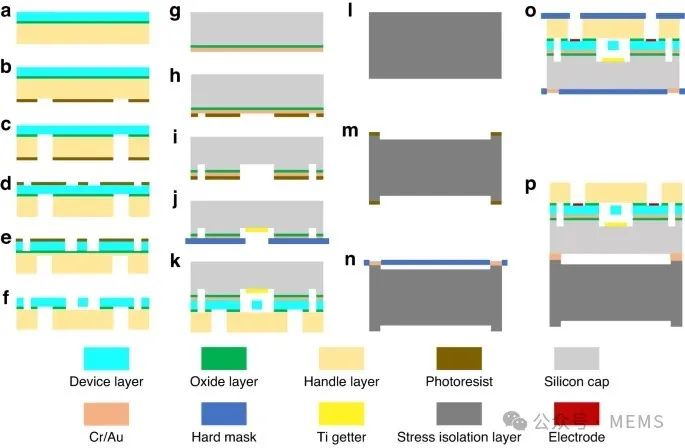
Fabrication process of resonant miniature high pressure sensor
Experimental results show that the fabricated resonant miniature high-pressure sensor has an accuracy of ±0.015% of full scale over a pressure range of 0.1 to 100 MPa and a temperature range of -10 to 50°C. The pressure sensitivity is 261.10 Hz/MPa (~ 2,033 ppm/MPa) at differential frequency. The pressure sensitivity of the differential frequency is 261.10 Hz/MPa (~ 2523 ppm/MPa) at 20°C, and the temperature sensitivities of the dual resonators are 1.54 Hz/°C (~ 14.5 ppm/°C) and 1.57 Hz/C (~ -15.6 ppm/°C) at a pressure of 2 MPa. The differential output has excellent stability in the 0.02 Hz range at constant temperature and pressure.
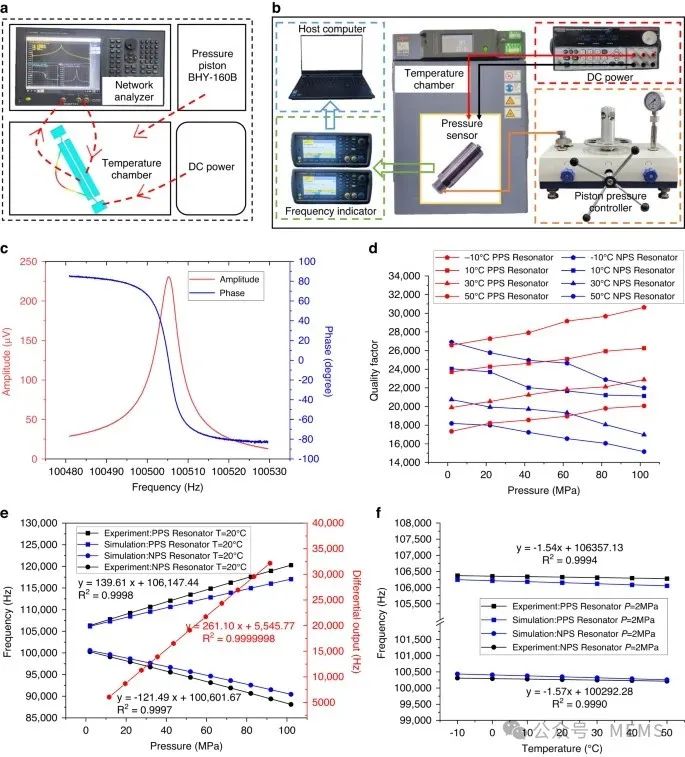
Experimental platform and test results of resonant miniature high pressure sensor
In summary, the researchers validated the composite pressure-sensitive mechanism of resonant miniature pressure sensors by effectively realizing pressure/stress conversion by combining diaphragm bending and volume compression, and developed a multicavity all-silicon resonant miniature high-pressure sensor with dual resonators. Compared with two conventional single mechanisms, the composite pressure-sensitive mechanism can realize high measurement range and high accuracy over a wide temperature range. The matched design of dual resonators with positive and negative pressure sensitivity can be easily realized by the adaptation and combination of two single mechanisms. The differential output further improves the sensitivity and realizes temperature self-compensation. The experimental results validate the high performance of this miniature sensor in terms of accuracy, quality factor, sensitivity and stability. However, the weak diaphragm structure of the microsensor based on the composite pressure-sensitive mechanism limits further expansion of the pressure range. Future work may focus on further optimization of the segregation assembly in terms of stress and aging of the sensor to improve the frequency stability of each resonator for practical applications in high pressure measurements.