




Accurate measurement of flow is very important, the use of flow sensors to monitor and measure the flow of liquids or gases in the pipeline to be measured is widely used in the field of industrial control and civil facilities.
Flow Sensor
Flow is an important parameter in industrial production. Industrial production process, many raw materials, semi-finished products, finished products are in a fluid state. The flow of the fluid becomes the key to determine the composition and quality of the product, and is also an important basis for production costing and rational use of energy. In addition, in order to ensure that the manufacturing industry trouble-free detection and the reliability of the test results, many processes need to be consistent with the inflow and outflow of liquid or gaseous media, in addition to pressure and temperature in the automated production process, flow measurement is also very important. Therefore, flow measurement and control is an important part of the production process automation.
Flow sensors are sensors that can sense fluid flow and convert it into a usable output signal, placing the sensor in the path of the fluid, and measuring the change in flow by the interaction of the fluid to the sensor and the sensor to the fluid. According to the definition of flow, it is mainly applied to the detection of gas and liquid flow.
Classification of flow sensors:
Flow sensors can be divided into the following categories according to different detection methods, and by the corresponding sensor to perform the work:
Electromagnetic detection mode: electromagnetic flow sensor
Mechanical detection mode:
1. Volumetric flow sensor
2. Vortex flow sensor
3. Turbine flow sensor
Acoustic detection mode: super-generation wave flow sensor
Throttling detection method: differential pressure flow sensor
Here we talk about the differences between the various sensors:
I. Electromagnetic flow sensor:
Definition: electromagnetic flow sensor is a direct contact with the pipeline medium by the sensor and the upper end of the signal conversion of the two parts. It is based on Faraday's law of electromagnetic induction work, used to measure the conductivity greater than 5 μs/cm of conductive liquid flow, is a measurement of conductive media flow meter. In addition to measuring the flow of general conductive liquids, can also be used to measure strong acids, strong alkalis and other highly corrosive liquids and uniformly contain liquid-solid two suspended liquids, such as mud, slurry, pulp, etc..
Principle: The working principle of electromagnetic flow sensor is based on Faraday's law of electromagnetic induction. In the electromagnetic flow sensor, the conductive medium inside the measuring tube is equivalent to the Faraday test in the conductive metal rod, the upper and lower ends of the two electromagnetic coils produce a constant electromagnetic field when there is a conductive medium flows through, it will produce induced voltage. Two electrodes inside the pipe measure the induced voltage. The measuring pipe is electromagnetically isolated from the fluid and the measuring electrodes by means of a non-conductive lining (rubber, Teflon, etc.).
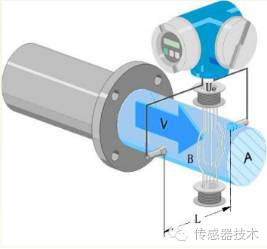
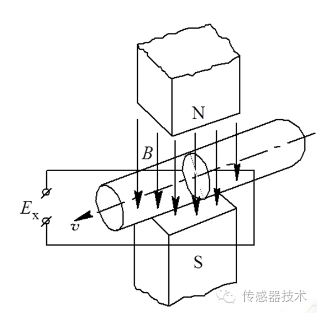
Conducting liquid in the magnetic field for cutting the magnetic lines of motion, the conductor in the conductor to produce an induced potential, the induced potential E is:
E = KBVD where:
K --- meter constant
B --- magnetic induction strength
V---measurement of the average flow velocity in the cross-section of the pipe
D --- measurement of the inner diameter of the pipe cross-section
The size of the induced potential is related to the magnetic induction strength, the size of the pipe diameter and the size of the fluid flow rate. Namely:
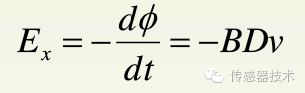
Volume flow rate qv versus fluid flow rate v:
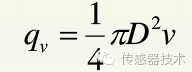
Available:
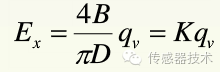
II. Volumetric Flow Sensors
Definition: Volumetric flow sensor, also known as fixed displacement flow sensor, referred to as PD flow sensor, in the flow meter in the highest accuracy of a class. Its mechanical measuring element to the fluid continuously divided into a single known volume part, according to the measurement chamber one by one repeatedly filled and discharged the volume part of the number of times the fluid to measure the total volume of fluid.
Principle: Volumetric flow measurement uses a small fixed volume to repeatedly measure the volume of fluid passing through the flow sensor. Therefore, inside the volumetric flowmeter sensor must have a space that constitutes a standard volume, which is referred to as the "metering space" or "metering chamber" of the volumetric flow sensor. This space consists of the inner wall of the meter housing and the rotating parts of the flow sensor. The principle of operation of a volumetric flow sensor is as follows: When a fluid passes through a flow sensor, a certain pressure difference is created between the inlet and outlet of the sensor. The rotating part of the flow sensor (referred to as the "rotor") rotates under this pressure difference and discharges the flow from the inlet to the outlet. In this process, the fluid fills the "metering space" of the flow sensor again and again, and is then continuously sent to the outlet. In a given flow sensor conditions, the volume of the measurement space is determined, as long as the measured number of rotor rotation, you can get through the flow sensor fluid volume of the cumulative value.
III. Vortex Flow Sensor
Definition: Vortex flow sensor is based on the Kamen vortex principle developed. In the fluid set up a triangular column vortex generator, the vortex generator from the vortex alternates between the two sides of the regular vortex, this vortex is known as the Carmen vortex.
Principle: A non-streamlinear vortex generator is placed in the fluid, so that the fluid is separated alternately on both sides of the generator, releasing two strings of regularly staggered vortices, and within a certain range of vortex separation frequency is proportional to the flow rate of the flow sensor. By measuring the frequency of the vortex, the flow rate of the fluid can be calculated according to the relevant formula.
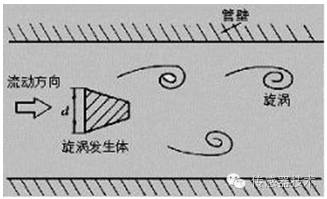
Vortex flow sensors are mainly used for flow measurement of industrial pipeline media fluids, such as gases, liquids, steam and many other media. It is characterized by small pressure loss, large range, high accuracy, and is almost independent of fluid density, pressure, temperature, viscosity and other parameters in the measurement of work volume flow. No moving mechanical parts, so high reliability and low maintenance. Instrument parameters can be stabilized for a long time.
IV. Turbine Flow Sensor
Definition: Turbine flow sensor is similar to impeller water meter, is a kind of velocity type flow sensor. The turbine impeller, propeller and other components placed in the fluid, the use of turbine speed and the average volume flow rate is proportional to the speed of the propeller speed is proportional to the principle of fluid velocity, the composition of the energy conversion device.
Principle: Turbine flow sensor is installed in the pipeline can be free to rotate the impeller, fluid flow through the impeller to make the impeller rotate, the higher the flow rate, the higher the flow velocity, then the greater the kinetic energy, the impeller speed is also higher. Measuring the rotational speed or frequency of the impeller will determine the flow rate and total amount of fluid flowing through the pipe.
Characteristics: Turbine flow sensor is a kind of velocity type instrument, which has the advantages of high accuracy, good repeatability, simple structure, few moving parts, high pressure resistance, wide measuring range, small volume, light weight, small pressure loss, easy maintenance, etc. It is used in closed pipeline to measure the volumetric flow rate and total amount of low-viscosity gas. It is widely used in petroleum, chemical, metallurgy, urban natural gas pipeline network and other industries.
V. Ultrasonic flow sensor
Definition: ultrasonic flow sensor is the use of piezoelectric materials made of lead titanate crystals, can be converted into acoustic energy components. Is through the detection of fluid flow on the ultrasonic beam (or ultrasonic pulse) to measure the role of volume flow meter.
Principle: When the ultrasonic beam propagation in the fluid, the fluid flow will make the propagation time changes slightly, and the change in propagation time is proportional to the flow rate of the liquid, which can be measured by the fluid flow rate, according to the pipeline caliber will be able to calculate the size of the flow rate.
Characteristics: The current industrial flow measurement prevails in large pipe diameter, large flow measurement difficulties, this is because the general flow sensor with the increase in the diameter of the measurement pipe will bring difficulties in manufacturing and transportation, cost increase, energy loss increase, installation inconvenience these shortcomings, it can be avoided. Because all types of ultrasonic flow sensors can be installed outside the pipe, non-contact flow measurement, instrumentation cost basically has nothing to do with the size of the measured pipe caliber, while other types of flow sensors with the increase in caliber, the cost of a substantial increase in the caliber of the larger ultrasonic flow sensors than the same function of other types of flow sensors, the more superior function-price ratio. Ultrasonic measuring instruments flow measurement accuracy is almost independent of the measured fluid temperature, pressure, viscosity, density and other parameters, and can be made into a non-contact and portable measuring instruments, so it can be solved by other types of instruments is difficult to measure the strong corrosive, non-conductive, radioactive and flammable and explosive media flow measurement problems.
VI. Differential pressure flow sensor
Definition:
Differential pressure flow sensor is installed in the pipeline according to the flow detection device generated by the differential pressure, known fluid conditions and detection and pipeline geometry to calculate the flow rate of the instrument.
Principle:
Fluid filled with pipeline, when it flows through the pipe throttle, the flow rate will be in the throttle at the formation of local contraction, thus increasing the flow rate, the static pressure is reduced, so in the throttle before and after the pressure difference is generated. The larger the flow rate, the greater the pressure difference, so that the pressure difference can be measured based on the size of the flow rate!
With the continuous development of flow sensors, more and more types of flow sensors in the gradual introduction, they each have their own advantages and shortcomings, the user in the selection of flow sensors, should be based on their own needs to choose the right sensor.