



The advent of variable frequency drives (VFDs) has revolutionized industrial automation control and motor energy efficiency. VFDs are virtually indispensable in industrial production, and even in daily life, they have become integral components in elevators and variable-frequency air conditioners. VFDs have permeated every corner of production and daily life. However, they have also introduced unprecedented challenges, with motor damage being one of the most prominent issues.
Many have already observed the phenomenon of VFDs damaging motors. For instance, a pump manufacturer recently faced frequent reports from customers about pump failures occurring within warranty periods. Previously, this manufacturer's products were known for their reliability. Investigation revealed that all the damaged pumps were driven by variable frequency drives.
Although the issue of VFD-induced motor damage is gaining attention, the underlying mechanisms remain unclear, and preventive measures are largely unknown. This article aims to address these uncertainties.
Damage to Motors Caused by VFDs
Damage to motors from VFDs manifests in two primary ways: stator winding damage and bearing damage, as illustrated in Figure 1. Such damage typically occurs within a timeframe ranging from several weeks to over a year. The specific duration depends on numerous factors, including the VFD brand, motor brand, motor power rating, VFD carrier frequency, cable length between the VFD and motor, and ambient temperature. Premature motor failure inflicts substantial economic losses on enterprises. These losses encompass not only repair and replacement costs but, more critically, the financial impact of unexpected production downtime. Therefore, when employing VFDs to drive motors, the issue of motor damage demands significant attention.
Differences Between Variable Frequency Drive and Line Frequency Drive
To understand why line frequency motors are more prone to damage under variable frequency drive conditions, one must first grasp the differences between the voltage supplied by a variable frequency drive and line frequency voltage. Then, one must understand how these differences adversely affect the motor.
To understand why motors are more prone to damage under VFD drive conditions compared to line-frequency operation, we must first examine the differences between the voltage supplied by a VFD and line-frequency voltage. We must then understand how these differences negatively impact the motor.
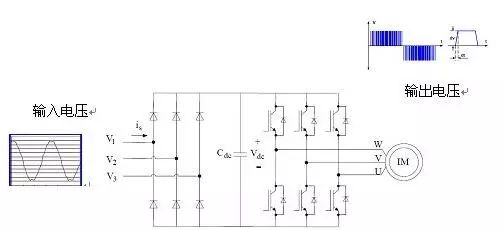
The basic structure of a variable frequency drive is shown in Figure 2, comprising two main sections: the rectifier circuit and the inverter circuit. The rectifier circuit forms a DC voltage output circuit using standard diodes and filter capacitors. The inverter circuit converts this DC voltage into a pulse-width modulated voltage waveform (PWM voltage). Consequently, the voltage waveform driving the motor from the VFD is a pulse waveform with varying pulse widths, not a sinusoidal voltage waveform. Driving the motor with this pulsed voltage is the fundamental cause of motor damage.
Mechanism of Inverter Damage to Motor Stator Windings
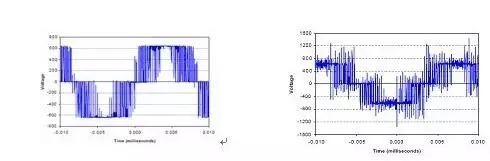
When pulse voltages propagate through cables, mismatched impedance between the cable and load causes reflections at the load end. These reflections result in superposition of incident and reflected waves, generating significantly higher voltages. Their amplitude can reach up to twice the DC bus voltage-approximately three times the inverter input voltage-as illustrated in Figure 3. Excessively high spike voltages applied to the motor stator windings cause voltage surges. Frequent overvoltage surges can lead to premature motor failure.
 The actual lifespan of a motor driven by a variable frequency drive after being subjected to voltage spikes depends on numerous factors, including temperature, contamination, vibration, voltage, carrier frequency, and the manufacturing process of the coil insulation.
The higher the carrier frequency of the frequency converter, the closer the output current waveform approaches a sine wave. This reduces the motor's operating temperature, thereby extending insulation lifespan. However, a higher carrier frequency means more spike voltages generated per second, resulting in more frequent impacts on the motor. Figure 4 illustrates how insulation lifespan varies with cable length and carrier frequency. The graph indicates that for a 200-foot cable, increasing the carrier frequency from 3 kHz to 12 kHz (a fourfold increase) reduces insulation life from approximately 80,000 hours to 20,000 hours (a fourfold decrease).
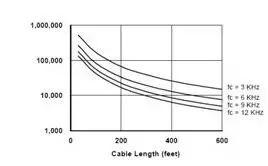
Effect of Carrier Frequency on Insulation
The higher the motor temperature, the shorter the insulation lifespan. As shown in Figure 5, when the temperature rises to 75°C, the motor's lifespan is reduced to only 50%. Motors driven by variable frequency drives (VFDs) experience significantly higher temperatures compared to those driven by utility frequency voltage, due to the PWM voltage containing a higher proportion of high-frequency components.
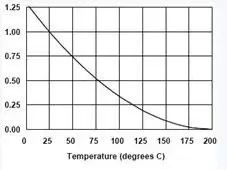
Mechanism of Variable Frequency Drive Damage to Motor Bearings
The cause of variable frequency drive damage to motor bearings is the flow of current through the bearings, which occurs in an intermittently connected state. Intermittently connected circuits generate arcs, and these arcs burn out the bearings.
Two primary causes induce current flow through AC motor bearings: first, induced voltage from internal electromagnetic field imbalance; second, high-frequency current pathways created by stray capacitance.
In an ideal AC induction motor, the internal magnetic field is symmetrical. When the currents in the three-phase windings are equal and phase-shifted by 120°, no voltage is induced on the motor shaft. However, when the PWM voltage output from the inverter causes magnetic field asymmetry within the motor, voltage is induced on the shaft. This voltage typically ranges from 10 to 30V, depending on the drive voltage-higher drive voltage results in higher shaft voltage. If this voltage exceeds the insulation strength of the lubricating oil within the bearing, an electrical path is formed. As the shaft rotates, the lubricating oil's insulation periodically interrupts the current flow. This process resembles the switching action of a mechanical switch, generating arcing that erodes the surfaces of the shaft, balls, and bearing races, forming pits. Without external vibration, minor pitting causes minimal impact. However, when combined with external vibration, it creates grooves that significantly impair motor operation.
Additionally, experiments indicate that the voltage on the shaft is also related to the fundamental frequency of the inverter's output voltage. The lower the fundamental frequency, the higher the voltage on the shaft, resulting in more severe bearing damage.
During the initial operation phase when lubricant temperature is low, current amplitudes range from 5 to 200 mA. Such low currents cause no bearing damage. However, after prolonged operation, as lubricant temperature rises, peak currents can reach 5 to 10 A. This induces arcing, forming micro-pits on bearing surfaces.
Protecting Motor Stator Windings
When cable lengths exceed 30 meters, modern variable frequency drives (VFDs) inevitably generate spike voltages at the motor terminals, shortening motor lifespan. Two approaches prevent motor damage: using motors with higher winding insulation breakdown strength (commonly called VFD-compatible motors) or implementing measures to reduce spike voltages. The former is suitable for new projects, while the latter is ideal for retrofitting existing motors.
Currently, four common motor protection methods are employed:
(1) Installing reactors at the inverter output: This is the most frequently used approach. However, note that while effective for shorter cables (under 30 meters), its performance may sometimes be suboptimal, as shown in Figure 6(c).
(2) Installing a dv/dt filter at the inverter output: This is suitable for cable lengths under 300 meters. Though slightly more expensive than reactors, it delivers significantly improved results, as shown in Figure 6(d).
(3) Installing a sine wave filter at the inverter output: This is the most ideal solution. By converting the PWM pulse voltage into a sine wave voltage, the motor operates under conditions identical to those of line frequency voltage. This approach completely resolves the spike voltage issue (spike voltages will not occur regardless of cable length).
(4) Installing a spike voltage absorber at the cable-motor interface: The drawbacks of the previous measures are that reactors or filters become bulky, heavy, and costly for high-power motors. Additionally, both reactors and filters cause voltage drops that reduce motor output torque. Using an inverter spike voltage absorber overcomes these limitations. The SVA surge voltage absorber developed by the 706 Institute of the Second Academy of CASIC employs advanced power electronics and intelligent control technology, making it an ideal solution for preventing motor damage. Furthermore, the SVA surge absorber also protects the motor bearings.