





Single-phase servo amplifiers (hereinafter referred to as "amplifiers") are designed to work in conjunction with various angular-travel, linear-travel, and multi-turn single-phase electric actuators. They are widely used in automatic control systems within industrial automation processes. These amplifiers represent an improvement over traditional models and offer the following distinct advantages compared to conventional Type II and Type III amplifiers:
1. By utilizing zero-crossing triggered solid-state relays as contactless electronic switches, the amplifier does not pollute the power grid, and its load capacity during operation is equivalent to that of manual operation with high-voltage power.
2. The new amplifier is equipped with indicator lights for actuator forward/reverse operation and amplifier power status. This facilitates the debugging and calibration of the amplifier and allows for continuous monitoring of the amplifier's-and indeed the entire system's-operational status once integrated into the system.
3. The use of dual voltage comparators enhances the amplifier's sensitivity and reduces the dead zone, thereby significantly improving the control performance of the actuator within the automatic control system. (h(f8s7p;y;d3T7V!F9^0s
4. The new amplifier replaces the three circuit boards found in traditional servo amplifiers with a single board, eliminating the need for eight heat sinks, eight rectifier diodes, and a metal base plate. Compared to traditional amplifiers, it weighs approximately half as much, while its structural integrity and vibration resistance have been enhanced. This facilitates assembly, debugging, and maintenance, while also improving the instrument's reliability.
The function of a servo amplifier is to combine multiple input signals with feedback signals and amplify them. Depending on the polarity of the combined signal, it outputs a corresponding signal to control the servo motor to rotate clockwise or counterclockwise. When the input signals and feedback signals are balanced, the servo motor stops rotating, and the output shaft of the actuator stabilizes at a specific position.
A servo amplifier assembly primarily consists of a preamplifier, a trigger circuit, a thyristor main circuit, and a power supply, as shown in the figure below.
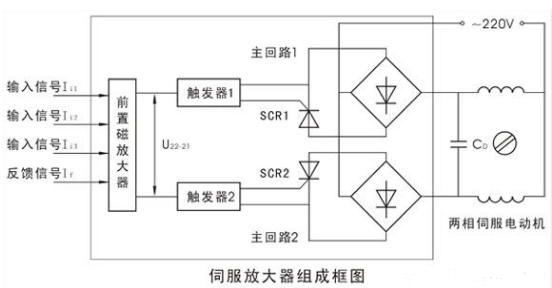
To accommodate the requirements of complex multi-parameter control, the servo amplifier is configured with three input signal channels and one position feedback signal channel. Consequently, it can simultaneously accept three input signals and one position feedback signal. In simple single-parameter control systems, only one of the input channels and the feedback channel are used.
In the servo amplifier, the pre-amplifier combines the three input signals and the feedback signal into a deviation signal, which is then amplified and output as voltage signal U22-21. This output voltage is simultaneously converted by trigger 1 (or 2) into a trigger pulse to control the conduction of the thyristors in main circuit 1 (or 2), thereby applying a 220 V AC power supply to the windings of the two-phase servo motor to drive it to rotate. When △1 > 0, U22-21 > 0, trigger 2 and main circuit 2 operate, causing the two-phase servo motor to rotate forward; when △1 < 0, trigger 1 and main circuit 1 operate, causing the two-phase servo motor to rotate backward; The circuit configurations and parameters of the two sets of triggers and the two sets of thyristor main circuits are identical. Therefore, when the input signal is balanced with the position feedback current If, the output of the pre-amplifier U22-21 ≈ 0, neither trigger outputs a trigger pulse, the thyristors in main circuits 1 and 2 turn off, the power supply to the two-phase servo motor is disconnected, and the motor stops rotating.
It can thus be seen that the servo amplifier functions as a three-position solid-state relay and possesses significant power amplification capability.