


In today's industrial settings, complex automation architectures and a wide variety of manufacturing technologies are prevalent throughout industrial systems, all connected via industrial networks. A stable network connection is critical to the normal operation of industrial systems.
Unlike deploying Ethernet in commercial or consumer environments, industrial Ethernet environments present additional physical and electromagnetic challenges. Industrial-grade Ethernet PHYs have extremely stringent requirements in terms of temperature tolerance, voltage surges, latency requirements, and network speed.
The impact of latency on industrial automation
In industrial Ethernet systems, there are many sources of delay. Some delays are caused by physical connections, typically wiring and PCB connections. Data also experiences delays as it passes through the PHY, MAC, switches, and other components in the network connection. Delay is also an important reference indicator when selecting a PHY.
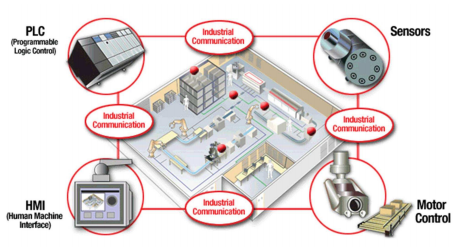 Industrial Automation Network Architecture, TI
Although the IEEE 802.3 series of standards continues to evolve, there is no explicit specification for the time it takes for a data packet to traverse the PHY. However, latency can directly impact real-time factory automation applications. Since latency is neither a defined value for Ethernet specified by the IEEE 802.3 standard nor an inherent synchronous or repeatable value of Ethernet, Therefore, the disconnect between Ethernet and factory automation applications must be addressed through the careful architecture of Ethernet physical layer devices (PHYs).
Regardless of network topology or industrial protocols, these protocols share a common goal: to provide precise control over different nodes on an industrial network. This can be achieved by time-stamping transmitted and received packets and using these time stamps to synchronize network time across network nodes. Network time is shared by the protocol within the packet data, and each node's timestamp unit marks that time. Any change in the timestamp reduces the system's accuracy. Longer delays also limit the frequency at which packets can use timestamps and restrict the number of nodes allowed in the network. Therefore, delays must be minimized as much as possible.
Industrial Ethernet PHY - Dela
For motion control applications in industrial automation that require precise control, cycle times typically need to be in the tens of microseconds. At these levels, the delay through each component in the network is critical. The delay control of the Ethernet physical layer (PHY) is a very critical limiting factor for cycle time.
In Ethernet standards such as 1000Base-T and 100Base-TX, PHYs with lower operational latency can improve cycle time. Lower latency can elevate cycle time to the same level as faster transmission rate Ethernet, effectively increasing network bandwidth. Currently, most industrial Ethernet applications operate on 100Base-TX Ethernet, but many applications are beginning to transition to 1000Base-T, which offers higher bandwidth. A PHY with lower latency effectively increases network bandwidth and also facilitates the transition of Ethernet to higher data rates.
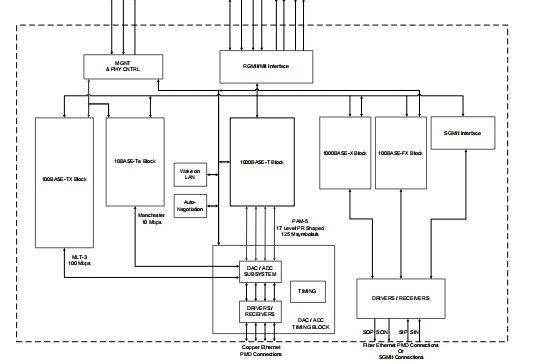 PHY internal design, TI
In Ethernet networks such as 1000Base-T and 100Base-TX, a PHY with lower operational latency can improve cycle time. Lower latency can increase cycle time to the same level as faster transmission rate Ethernet, which effectively increases network bandwidth. Currently, most industrial Ethernet applications operate on 100Base-TX Ethernet, but many applications are beginning to transition to 1000Base-T, which offers higher bandwidth. Lower latency PHYs effectively increase network bandwidth and also facilitate the transition of Ethernet to higher data rates.
Other Challenges for PHY in the Evolution of Industrial Ethernet
Temperature is difficult to control in industrial environments, and more stringent temperature conditions add to the complexity of PHY design. PHY must be able to perform at its rated performance across a wide temperature range. Generally, industrial Ethernet PHY should be able to operate in a temperature range of -40 to 85°C and withstand a maximum junction temperature of 125°C.
Power consumption is also a critical factor at all times, especially in gigabit PHYs, where power consumption can significantly impact the system's total power consumption. The power budget allocated to the Ethernet physical layer is limited, and each interconnected device requires two Ethernet physical layers, so power consumption must be sufficiently low to meet the connectivity requirements of the entire device. Some manufacturers opt for dual-power operation in addition to low-power PHYs to achieve even lower power consumption.
Summary
As the complexity of factory automation systems continues to grow, the demand for transmitting more data between nodes increases, making it increasingly important to maintain high-performance connectivity within factories. PHY hardware connections that are unaffected by harsh industrial environments are highly valuable for the implementation of industrial internet networks.