


Imagine a robotic arm that can bend and rotate, with each axis equipped with highly precise motor drivers, sensors, or machine vision, as if performing a symphony of motion. However, without a "conductor" to tell each component of the system when and how to execute their respective operations, the robotic arm might produce jarring clanging and metallic grinding sounds.
In previous articles on real-time control, we explored real-time control (RTC) instruments used for sensing, driving, and processing. To integrate them, we need the "conductor": real-time communication. In this article, we will use industrial 4.0 based on real-time communication and control as our starting point for discussion.
Factors driving the development of big data in the automation field
Due to the impact of the pandemic, factory operations without human intervention have become widely popular. The collection and appropriate distribution of big data (defined by the Oxford Dictionary as extremely large datasets that can reveal patterns, trends, and correlations through computational analysis, particularly those related to human behavior and interactions) can support digital twins, metering, service billing, and predictive maintenance. For example, having access to big data enables monitoring of robotic arm performance and system health, as well as data rates, temperature, humidity, vibration, and more, thereby enabling the development of AI models that can predict future performance and health based on big data (digital twins). To fully leverage these advantages, it is necessary to integrate information technology (IT) and operational technology (OT) to support Internet Protocol (IP) and RTC systems at the edge. Logically, this is referred to as IT and OT convergence.
In Ethernet, the network layer and transport layer of the Open Systems Interconnection (OSI) model support the Transmission Control Protocol/Internet Protocol (TCP/IP), so Ethernet inherently supports IPv4 (and IPv6). Additionally, it can reliably transmit the required amount of information, which is why industrial Ethernet is becoming a substantive communication standard in the field of industrial automation convergence. Since existing infrastructure typically uses two-wire protocols that do not support local TCP/IP, traditional fieldbuses are still used for communication with edge devices. Figure 1 illustrates the current communication methods in the industrial automation field.
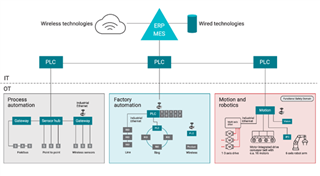 Figure 1: Current communication methods in the field of industrial automation
The way industrial communication is implemented is undergoing a transformation. Single-pair Ethernet (SPE) can maintain the existing two-wire system architecture while also supporting the faster speeds and numerous advantages of industrial Ethernet. Advanced field diagnostics support distributed and centralized monitoring and operation. Of course, SPE can reuse the existing two-wire infrastructure established by multiple existing fieldbuses, thereby simplifying convergence-driven upgrades and significantly reducing costs.
Understanding Ethernet
While Ethernet is open and ubiquitous in enterprise applications, it is currently not suitable for real-time applications because IT Ethernet frame transmission is "best effort" and unmanaged; errors are always undesirable. For real-time OT, errors can have severe consequences or even pose dangers. RTC systems require reliable communication as the system's "command center" to ensure the system operates as intended, thereby avoiding product failures or causing system damage or personal injury. Since IT Ethernet is typically used in enterprise or consumer environments, it rarely encounters environmental challenges. In contrast, RTC systems often operate in harsh environments.
The demand for robust, deterministic behavior (such as reliability across wide temperature ranges, noisy, and dirty environments) and higher data rates has driven the emergence of industrial Ethernet. Industrial Ethernet is deterministic and robust, providing additional bandwidth and inherent IP connectivity to fully leverage RTC systems.
Let's take a look at timing characteristics and how they apply to the Ethernet physical layer (PHY).
The Importance of Timing Characteristics
There are three key timing characteristics in RTC systems:
Delay. In this context, delay must be considered, such as propagation delay: the length of time from when data enters the system, subsystem, or subsystem component until it exits. For example, TI's DP83826E 10Mbps/100Mbps Ethernet PHY has a round-trip delay of 208ns. Lower delay can reduce cycle time or increase the number of nodes on the bus.
Determinism. If the arrival time of data varies significantly each time it passes through the system, then how low the delay is becomes irrelevant. This variation in arrival time is known as determinism. Lower jitter indicates better determinism. Low determinism means you need to build less margin into the system to accommodate varying delays. Figure 2 shows the delay (208ns) and determinism (±2ns) of the DP83826E. Real-time Ethernet protocols (such as EtherCAT) can leverage the low and deterministic latency characteristics of Ethernet PHY.
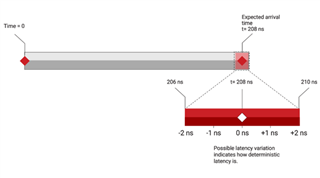 Figure 2: Delay and its determinism
Synchronization. Binding the timing of an entire system or several complete systems together also has certain advantages. In order to maximize efficiency and throughput while ensuring safe operation, different subsystems may need to know exactly when another subsystem performs a certain operation. All industrial Ethernet protocols support some form of synchronization. Time-Sensitive Networking (TSN) is an example of time synchronization for RTC systems. The Institute of Electrical and Electronics Engineers (IEEE) 1588v2, also known as the Precision Time Protocol (PTP), helps multiple devices maintain synchronization with each other. IEEE 802.1as, also known as Generalized PTP (gPTP), further enables synchronization for time-sensitive applications such as RTC.
Conclusion
Successful RTC and communication deployments are the cornerstone of Industry 4.0. However, it is not just about achieving Industry 4.0; with deterministic, synchronized, and low-latency communication PHYs and industrial Ethernet protocols, all instruments can be combined to play a beautiful symphony.