




(I) CAN bus characteristics
CAN is the abbreviation of Controller Area Network (CAN), which was developed by BOSCH, a German company famous for the development and production of automotive electronics, and eventually became an international standard (ISO11898). It is one of the most widely used field buses in the world. In North America and Western Europe, CAN bus protocol has become the standard bus for automotive computer control systems and embedded industrial control LANs, and has the J1939 protocol designed specifically for large trucks and heavy machinery vehicles with CAN as the underlying protocol. In recent years, its high reliability and good error detection capability have been emphasized, and it is widely used in automotive computer control systems and industrial environments with harsh ambient temperatures, strong electromagnetic radiation and high vibration.
Features:
Long transmission distance (up to 10Km) and fast transmission rate (up to 1MHz bps);
A single bus can connect up to 110 nodes, and the number of nodes can be easily expanded;
Multi-master structure, equal status of each node, convenient regional networking, high bus utilization;
High real-time, non-destructive bus arbitration technology, high priority nodes without delay;
Error CAN nodes will automatically shut down and cut off the connection with the bus, without affecting the bus communication;
The message is a short frame structure and hardware CRC checksum, the probability of interference is small, the data error rate is extremely low;
Automatically detect whether the message is sent successfully or not, and can be automatically retransmitted by hardware, so the transmission reliability is very high;
Hardware message filtering function, only receive the necessary information, reduce the burden on the cpu, simplify the software preparation;
(II) RS485 bus characteristics
RS-485 adopts half-duplex operation mode and supports multi-point data communication. rs-485 bus network topology generally adopts terminal matching bus type structure. That is, a bus is used to connect each node in series, and does not support ring or star network. rs-485 adopts balanced transmission and differential reception, so it has the ability to suppress common mode interference. Plus the bus transceiver has a high sensitivity, can detect voltages as low as 200mv, so the transmission signal can be restored beyond the kilometer. Some RS-485 transceivers modify the input impedance to allow up to eight times the number of nodes to be connected to the same bus.The most common application for RS-485 is communication within programmable logic controllers in industrial environments.
RS-485 electrical characteristics: the voltage difference between the two lines ranges from ± (2-6) V that the interface signal level is reduced, it is not easy to damage the interface circuit of the chip, and the level is compatible with the TTL level, it can be convenient to connect with TTL circuits;
The maximum data transmission rate of RS-485 is 10Mbps;
RS-485 interface is the use of balanced driver and differential receiver combination, anti-common-mode dry ability to enhance, that is, good anti-noise interference;
The maximum transmission distance of the RS-485 interface is standardized at 4000 ft, but in practice it can be up to 3000 m. The RS-485 interface allows the connection of up to 128 transceivers on the bus. The RS-485 interface allows up to 128 transceivers to be connected to the bus, i.e., it has multi-station capability, but only one transmitter can transmit on the RS-485 bus at any one time;
RS-485 interface has a good resistance to noise interference, long transmission distance and multi-station capability and other advantages make it the preferred serial interface;
RS485 interface composed of half-duplex network, generally only two connecting wires, the interface are shielded twisted pair transmission.
(III) CAN bus and RS485 bus applications
In the past, PC and smart device communication with the help of RS232, RS485, Ethernet and other methods, mainly depending on the device's interface specifications. But RS232, RS485 can only represent the communication of the physical media layer and link layer, if you want to achieve two-way access to data, you must write their own communication applications, but most of this program can not meet the ISO/OSI specifications, can only achieve a single function, for a single type of equipment, the program does not have the generality.
In the RS232 or RS485 devices into a network of devices, if the number of devices more than 2, it is necessary to use RS485 as a communication medium, RS485 network equipment to interoperate with the information only through the "main (Master)" device can be realized, the main device is usually a PC, and this device This master device is usually a PC, and this kind of device only allows the existence of a master device in the network, and the rest are all from (Slave) devices. Fieldbus technology is based on the ISO/OSI model, with a complete software support system to solve the bus control, conflict detection, link maintenance and other issues. Fieldbus devices automatically form a network, no master/slave devices or allow the existence of multiple masters. At the same level, products of different manufacturers can be interchanged, and the devices are interoperable with each other.
Nowadays, there are many bus formats, what are the characteristics of CAN compared to other buses? First of all, compare the familiar 485 bus, 485 bus is just a level standard, not a new protocol, and 232 is almost the same, of course, so that is not very appropriate, but it helps you understand.
(IV) CAN bus PK RS485 bus
CAN (Controller Area Network) belongs to the fieldbus category, it is an effective support for distributed control or real-time control of the serial communication network. Compared with the current RS-485 distributed control system based on the R line, the distributed control system based on CAN bus has obvious superiority in the following aspects:
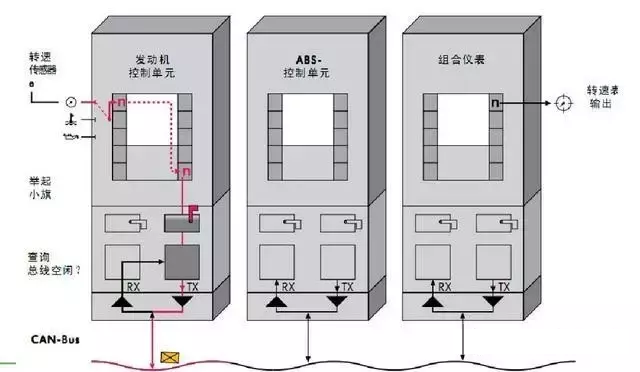
(1) CAN controller works in a multi-master mode, each node in the network can be based on the bus access priority (depending on the message identifier) using a lossless structure of the bit-by-bit arbitration method of competing to send data to the bus, and the CAN protocol abolished the station address encoding, and instead of encoding the communication data, which allows different nodes to receive the same data at the same time, these features make the CAN bus constitute the These features make the data communication between the nodes of the CAN bus network real-time, and it is easy to form a redundant structure to improve the reliability of the system and the flexibility of the system. The use of RS-485 can only constitute a master-slave structure system, and the communication method can only be carried out in the form of polling by the master station, so the real-time and reliability of the system are poor.
(2) The CAN bus is connected to the physical bus through the two outputs CANH and CANL of the CAN controller interface chip 82C250, and the status of the CANH terminal can only be high or suspended, and the CANL terminal can only be low or suspended. This ensures that there will be no phenomenon like in the RS-485 network, when there is an error in the system and there are multiple nodes sending data to the bus at the same time, resulting in the bus presenting a short circuit, thus damaging some nodes. And CAN node in the case of serious errors with automatic shutdown output function, in order to make the bus on the other nodes of the operation is not affected, so as to ensure that there will be no phenomenon in the network, due to individual nodes have problems, making the bus in the "deadlock" state.
(3) CAN has a perfect communication protocol, can be realized by the CAN controller chip and its interface chip, which greatly reduces the difficulty of system development, shorten the development cycle, these are only only electrical protocols RS-485 can not be compared.