





Brush motors and brushless motors, as the two predominant motor types in modern industrial and consumer electronics, have wiring methods that directly impact equipment efficiency, stability, and lifespan. This article systematically analyzes the wiring principles, operational steps, and common pitfalls for both motor types, providing professional guidance tailored to practical application scenarios.
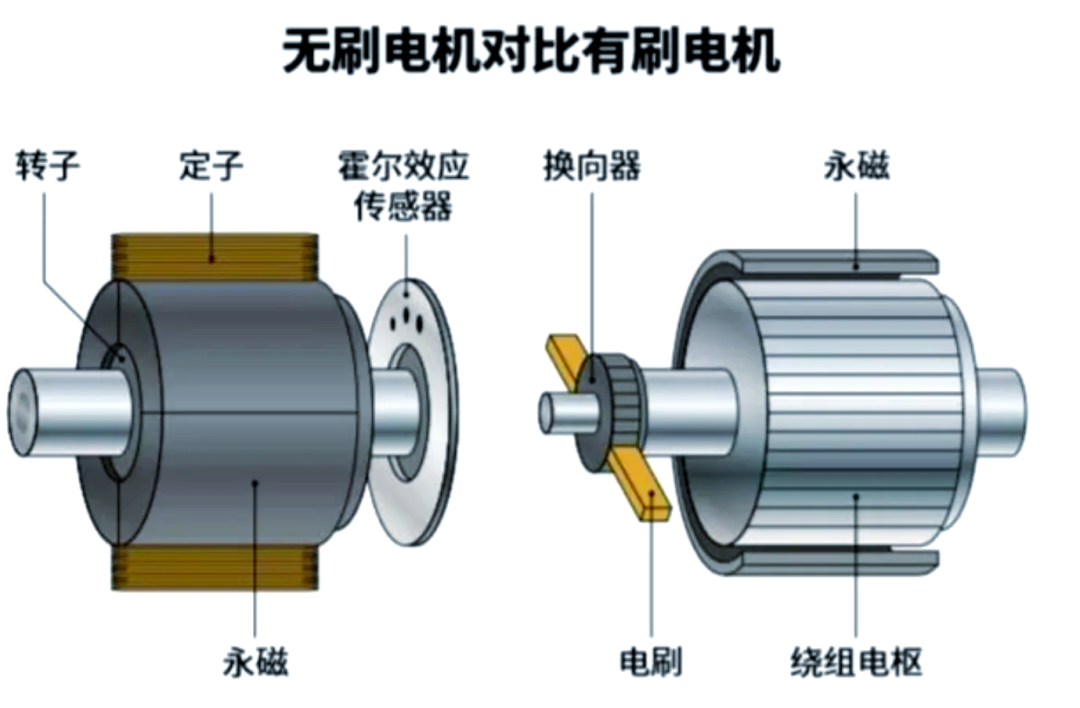
I. Brush Motor Wiring Principles and Practical Application
Brush motors utilize mechanical commutators (carbon brushes) to switch current direction. The core of wiring lies in correctly connecting the stator windings to the rotor armature. The typical wiring steps for a two-wire DC brush motor are as follows:
1. Power Polarity Identification: Connect the red wire to the positive terminal (+) of the power source and the black wire to the negative terminal (-). If the motor rotates in the opposite direction, simply swap the two terminals to reverse the rotation.
2. External Speed Controller Connection: When adjusting speed, connect the PWM speed controller in series between the power supply positive terminal and the motor. Ensure the controller's rated current matches the motor's power rating. For example, a 12V/5A brushed motor requires a speed control module with a continuous current rating ≥6A.
3. Protective Circuit Installation: It is recommended to connect a reverse diode (e.g., 1N4007) in parallel at the power supply end to absorb back EMF generated during armature de-energization, preventing driver circuit breakdown.
Common Misconceptions:
● Directly connecting high-power motors to low-capacity power supplies intensifies carbon brush sparking and shortens lifespan.
● Neglecting grounding, causing electromagnetic interference. Correct practice: Connect the motor's metal housing to the equipment ground via a yellow-green strip wire.
II. Brushless Motor Wiring Analysis
Brushless motors (BLDC) employ electronic commutation, requiring controllers to sequence power to three-phase windings. Using a common three-phase brushless motor as an example:
1. Phase Matching: Connect the motor's UVW phase wires to the corresponding controller ports. If rotation is incorrect, simply swap any two phase wires (e.g., U-V). Some high-end controllers support software phase adjustment, eliminating manual rewiring.
2. Hall Sensor Wiring: For BLDC motors with Hall feedback, match all five signal wires (red/black for power, yellow/green/blue for signals) to the controller. Use a multimeter to verify Hall sensor power supply voltage (typically 5V) for circuit continuity.
3. Controller Configuration:
● Power Input: 48V controllers require matching 48V lithium battery packs. Do not connect power sources exceeding 20% of the rated voltage.
● Signal Interface: Speed control signal wire (usually white) accepts 0-5V analog voltage or PWM signals. Some models support USB parameter programming.
Critical Precautions:
● Phase Loss Protection: Incorrect three-phase wiring causes motor vibration or winding burnout. Verify balanced waveforms across all phases with an oscilloscope before powering on.
● Sensor Calibration: Perform Hall sensor zero-point calibration during initial operation (e.g., power on for 5 seconds with motor stationary). Refer to controller manual for specifics.
III. Application Scenario Comparison and Selection Recommendations
1. Applications for Brushed Motors:
● Low-cost requirements: Ideal for children's toys and household fans, leveraging their simple structure and controller-free operation.
● Instantaneous overload scenarios: During crane start/stop transitions, brushed motors utilize carbon brushes to buffer current surges.
2. Advantages of Brushless Motors:
● High-precision control: Drone ESCs achieve millisecond-level response via 400Hz refresh rates.
● Long-cycle operation: Industrial robotic arms using brushless solutions eliminate carbon brush replacement maintenance, with lifespans exceeding 20,000 hours.
IV. Advanced Debugging Techniques
1. Oscilloscope Diagnostics:
●Brushed Motors: Monitor power supply ripple. If peak-to-peak exceeds 10% of rated voltage, add an LC filter circuit.
●Brushless Motors: Capture back-EMF waveforms. Adjust controller PID parameters if phase delay exceeds 15°.
2. Thermal Management Solutions:
●Brushed Motors: Install heat sinks (e.g., 3mm thick aluminum alloy) at brush contacts. Operating temperature must ≤85°C.
●Brushless Motors: If winding temperature rise exceeds 60K, inspect for increased eddy current losses due to wiring errors.
V. Safety Specifications and Standards
● Insulation Testing: After all wiring is complete, measure the insulation resistance between conductors and ground using a 500V megohmmeter. A resistance value >2MΩ is acceptable.
● Dynamic Monitoring: Install current transformers to monitor phase currents in real time. Immediately shut down and investigate if abnormal fluctuations exceed 15%.
The systematic wiring approach outlined above maximizes the performance advantages of both motor types. For complex applications (e.g., electric vehicle drive systems), electromagnetic field optimization using simulation tools like ANSYS Maxwell is recommended to achieve dual improvements in energy efficiency and reliability.