

What is a water level controller?
A water level controller is a sensor that measures the position of a liquid, also known as a water level sensor. It can convert the height of the liquid into an electrical signal output, so as to control the height of the water level. Water level controller is widely used in a variety of industrial detection and control, especially in the need to automatically replenish or stop the water into the occasion, such as industrial boilers, civil buildings with pools and so on.
There are various types of water level controllers, including but not limited to reed switch level controllers, float magnetic switch level controllers, electrode level controllers, pressure level controllers and so on. Reed switch level controller consists of reed switch and permanent magnet, suitable for water level control or water level alarm of open containers such as water tanks, water towers and pools in industrial and civil buildings. Float magnetic switch level controller, on the other hand, controls the water level through the rise and fall of the float switch.
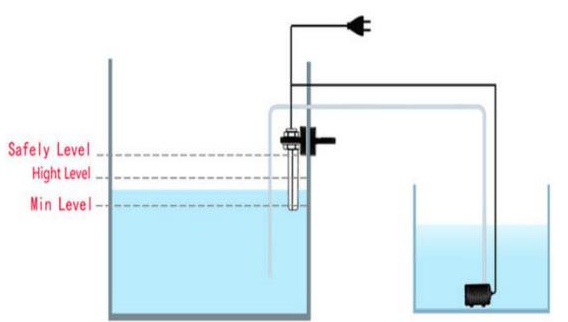
Water tower level controller is a special kind of water level controller, which is mainly used for water level control of water tower. When the water level of the water tower drops to the lower limit level, the water tower water level controller will start the pump to pump the water into the water tower; when the water level of the water tower rises to the upper limit level, the water tower water level controller will turn off the pump and stop pumping water. This approach enables fully automated water level control without manual intervention.
In addition, the water level controller can also be used with a motor protector to protect the pump motor, preventing motor damage caused by too low or too high a water level. At the same time, the water level controller also has a current sensing function, which can ensure stable operation and strong anti-interference ability.
Overall, the water level controller is an important piece of industrial equipment that ensures that the liquid is kept at a predetermined level in the equipment or container, prevents the equipment from being damaged due to the water level being too high or too low, and improves the stability and safety of the equipment.
The working principle of water level controller
Water level controller is used to monitor the position of the liquid switch, the controller is connected to the pump at one end, one end is connected to the power supply, when the liquid is below the detection point position, the sensor detects no water, according to the principle of the output of a signal, connected to the pump switch to open the automatic addition of water. When the liquid level is higher than a certain detection point, the sensor sends out a signal, the switch connected to the power supply will be forced to close to stop adding water. Double liquid level detection protection to prevent overflowing tank.
The principle of the water level controller is to detect the water level through the sensor probe, when the water level reaches a certain position, the internal chip of the sensor outputs high and low level signals, so as to realize the control of the liquid level. The device has low power consumption, small size, good waterproof performance, and very convenient installation and maintenance.
Next, I'm going to share some water level controller circuit diagrams with you, as well as briefly analyze how they work.
Water level controller circuit diagram share
1.the use of 8051 microcontroller water level controller circuit diagram
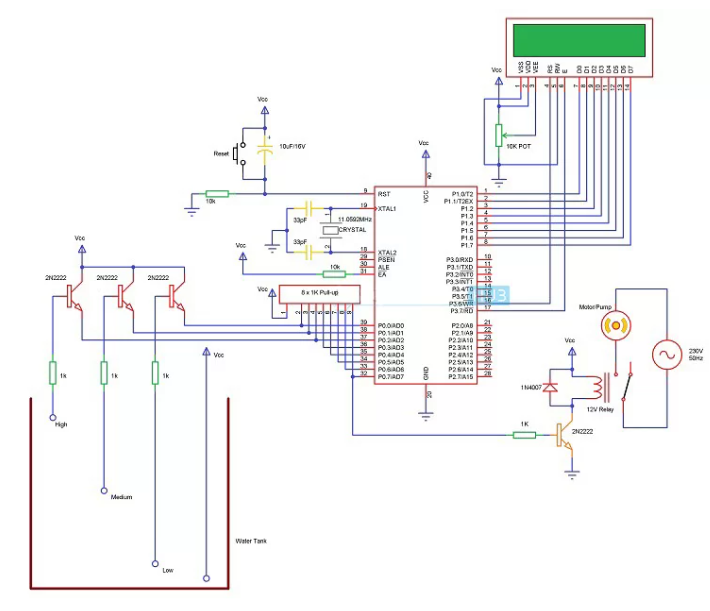
This is a water level controller circuit diagram using an 8051 microcontroller. The circuit diagram operates on the principle of "water conductivity". It uses four wires immersed in the tank to detect and display the changing water level. The microcontroller interprets the data from these wires, displays the water level on the LCD screen and controls the motor accordingly.
When the water tank becomes empty, the LCD screen will display the word "LOW" to signal the motor to start running automatically. When the water level reaches the midpoint, the LCD will display "HALF" and the motor will continue to run.
Once the tank reaches full capacity, the LCD will display "FULL" which will cause the motor to deactivate. The motor will then restart when the water level in the tank falls below a specific threshold.
2.Water level controller circuit diagram using 8051 microcontroller
This is a circuit diagram of a water level controller using an 8051 microcontroller. The circuit diagram works by inserting a positive voltage supply probe into the bottom of the tank. The probes for detecting 1/4, 1/2, 3/4 and FULL levels are located one by one above the bottom positive probe and are equally spaced. Let us consider the topmost probe, representing the FULL level. The other end is connected to the base of transistor Q4 through resistor R16. When the water level reaches its maximum value, current flows into the base of transistor Q4, causing it to conduct and resulting in a drop in collector voltage.
The collector of Q4 is connected to P2.4. A low voltage at P2.4 indicates that the top tank is empty. When the water level falls below the full water level probe, the base of Q2 opens, turning it off. As a result, the collector voltage at P2.4 rises sharply, indicating that the tank is not yet full. The remaining sensor probes (3/4, 1/2, 1/4) operate in a similar manner, and the microcontroller determines the current level by scanning port pins P2.4, P2.5, P2.6, and P2. 7. If all of these port pins are high (indicating that all sensor probes are on), the tank is empty.
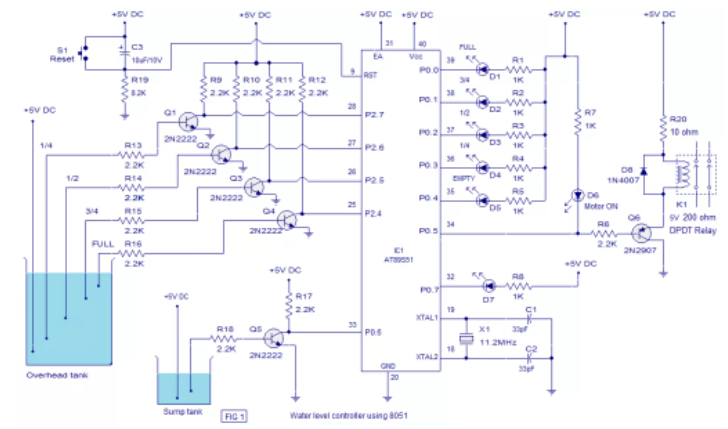
The pump is controlled by port pin P0.5. When pumping begins, the controller sets P0.5 to a low state, activating transistor Q6, which in turn triggers relay K1, turning the pump on. At the same time, LED D6 illuminates to indicate that the motor is running. LED D7 is used as a low-sump indicator. If the water level in the sump tank falls below a specific level, the controller lowers P0.7, causing LED D7 to light.
3. Contact water level controller circuit diagram
This is a simple circuit to control a water pump. When the water level in the high level tank exceeds the required level, the pump automatically shuts off and stops the pumping process, thus preventing the water from overflowing. It uses a relay to cut off the power to the pump.
The circuit uses CMOS IC CD 4001 / 4011 to drive the relay. Its input gate 1 is used to connect a probe to detect the water level. One probe is connected to gate 1 of the IC and the other probe is grounded. When probe A connected to gate 1 of the IC is suspended, the input of gate 1 remains high, output pin 4 goes high and the relay driver transistor conducts. The relay will be activated. The power supply to the water pump is connected through the common terminal of the relay and the normally open contact, and when the relay is engaged, the water pump operates. The LED indicates the relay operating status. When the water level rises and makes contact with probes A and B, the IC output goes low and the relay is de-energized, stopping the pumping.
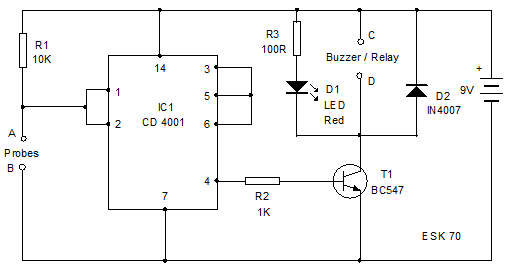
Initially, when A and B are not connected, i.e., when the water level is low, the input pin1 of IC is logic high, and according to the or non-gate truth table, the output of pin3 is logic low. Since pin 3 is shorted to pins 5 and 6, the inputs to the other or non gates will be logic low. This will provide a logic high signal to the corresponding output pin 4. When current flows through the resistor to the base of the transistor, it begins to conduct and acts as a closure switch. The relay connected to the collector of the transistor is energized, a normally open contact is connected to the common contact, and the pump is supplied with mains power and begins to operate.
Now, when the level of water in the tank rises, probes A and B are connected through the water, current flows through them (as water is a conductor) and pins 1 and 2 are connected to the negative supply of the battery through A and B. The output pins 1 and 2 are connected to the negative supply of the battery.
As a result, output pin 3 is at a logic high, causing the input pin of the other or non-gate to go logic high, and thus the corresponding output pin 4 to go logic low. Due to lack of bias current, the transistor cuts off, the relay cuts off accordingly, and power to the tank is cut off.
4. based on the NE555 water level controller circuit diagram
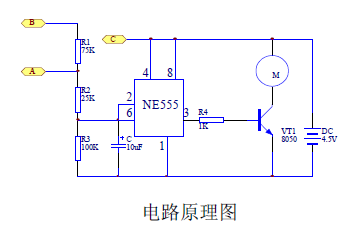
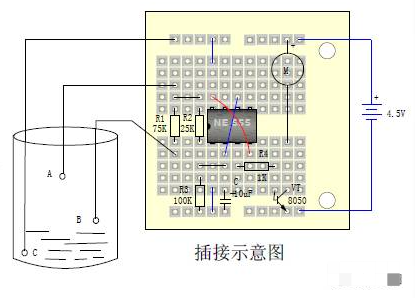
Water level controller circuit schematic and plug diagram shown in the attached figure. In the figure, the 555 constitutes a Schmitt trigger to complete the water level control function.
The working principle of the circuit diagram is A, B, C in the attached figure are three detection points. When the water level rises to point A, the pump stops, the water level is lower than point B, the pump works, automatically adding water to the pool.
Point C is at the bottom of the pool, which is connected to the power supply VDD, when the water level is lower than the point B, 555 ②, ⑥ foot voltage is 0, ③ foot output high level, VT1 conductive, the relay is engaged, the pump works.
When the water level reaches point B, points C and B are short-circuited under the action of water, so that ②, ⑥ pin voltage is equal to R3/(R3+R2+R1)*VDD, equal to 1/2VDD (2.25V). This voltage is greater than ② foot (1/3) VDD, less than ⑥ foot (2/3) VDD, ③ foot to maintain a high level unchanged, continue to add water.
When the water level reaches point A, points C, B and A are shorted so that the voltage at pins ② and ⑥ is equal to R3/(R3+R2) * VDD, which is equal to (3.6V). This voltage is greater than ⑥ pin (2/3) VDD, ③ pin output low level, VT1 cutoff, the relay is disconnected, so that the pump stops working.