


As professionals in industrial control, you are likely familiar with the Modbus communication protocol. It is arguably the most widely used communication protocol in the field of industrial automation. Its openness, scalability, and standardization have made it a universal industrial standard.
I believe the advantages of the Modbus protocol go without saying. The purpose of this article is primarily to discuss the drawbacks of the Modbus protocol.
Everything has two sides, and every protocol has its shortcomings. The fact that Modbus has drawbacks does not mean it is a bad protocol; I hope everyone will view this rationally.
1. Limitations on the Amount of Data That Can Be Read
The following diagram illustrates the data format for Modbus RTU protocol function code 03:
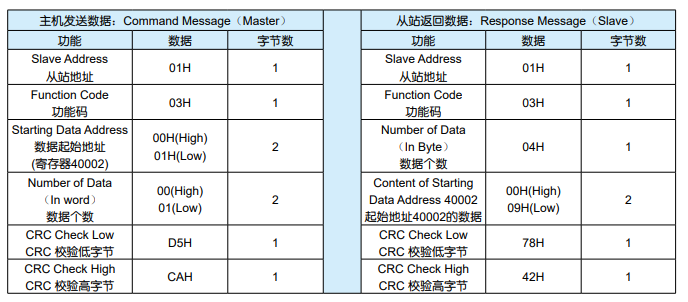
As shown in the figure, the data count (byte count) returned by the slave station is only one byte.
Since the byte count occupies only one byte, when reading input/hold registers, a maximum of 127 registers can be read at a time. In applications with very large data volumes, multiple reads are required to retrieve all the data, which inevitably reduces communication efficiency.
2. Lack of Support for Writing to Individual Register Bits
Among the eight commonly used Modbus function codes, there is no specific function for writing to individual bits within a register. Therefore, when we need to set or clear a specific bit in a register, the process becomes quite cumbersome.
There are generally two approaches to handling this:
First approach: We must first read the value of the register, then manipulate a specific bit of that value, and finally write the modified value back. This requires two round-trips to complete and, from a certain perspective, is not secure.
The second approach: We can treat a single bit as a separate register, where writing a 1 represents True and writing a 0 represents False. This method can be accomplished in a single interaction, but it wastes a significant amount of memory space.
The Modbus protocol was created in 1979 and is now used in tens of thousands of devices. I believe its inventors were certainly aware of these issues, but were unable to implement a unified solution.
Perhaps one day the Modbus protocol will be able to resolve these two issues...
Some might argue that the Modbus protocol has security vulnerabilities. However, as a protocol designed for industrial field applications, its primary purpose is to facilitate data exchange. In an offline environment, there is no harm if there is no attack.