




Today, autonomous and self-powered sensors are applied across diverse fields such as the Internet of Things (IoT), industrial automation, smart cities, and structural health monitoring (SHM). Within this framework, academic research has pioneered sustainable and circular solutions to meet the power demands of miniature electronic devices.
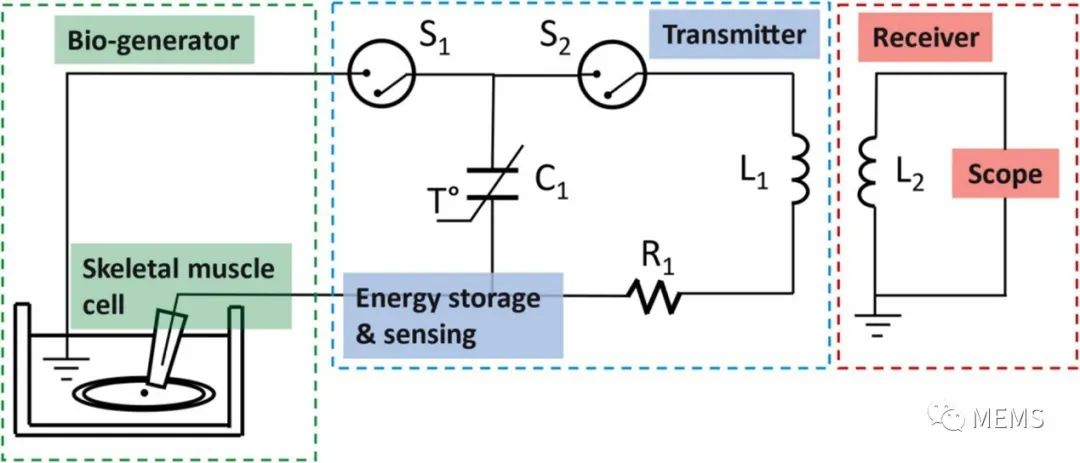
According to MEMS Consulting, researchers at the University of Perugia, Italy, have recently proposed a novel method for remote temperature measurement of biological cells and their surroundings. This approach utilizes electrical energy harvested from a single flounder muscle fiber. An optimized RLC circuit is embedded within the cell, where the capacitor serves as both an energy storage unit and a temperature sensor, leveraging its inherent thermal sensitivity. Experimental data confirmed that the developed system can wirelessly transmit temperature using energy harvested from the cell membrane and operates within the biologically relevant range (30°C to 50°C). This self-powered temperature sensor holds potential for enhancing biomedical sensing and non-invasive remote temperature monitoring. The research findings were published in the journal Nano Energy under the title "Self-Powered Temperature Sensors Harnessing Membrane Potential of Living Cells."
In this work, researchers considered that muscle fibers can maximize the membrane potential difference, as their resting potential can reach -90 mV. They explored utilizing the membrane potential of sole muscle fibers to assess the feasibility of implementing self-powered biosensor technology. Preliminary LTspice simulations were employed to design a wireless communication system capable of measuring the biological parameter of interest-temperature. To this end, researchers modeled and optimized an RLC circuit whose oscillation frequency varies with cellular temperature. This enabled the fabrication and testing of temperature sensors directly powered by sole muscle fibers under diverse experimental conditions, allowing evaluation of their overall efficiency and reliability.
Bioelectric Generator and Energy Harvesting Circuit
Through the researchers' experimental setup, variations in capacitor C1 can be harnessed to utilize the damped oscillation frequency at different temperatures. Since skeletal muscle fibers are present throughout the mammalian body, the researchers' method enables a self-powered temperature sensor to be implanted anywhere in the human body. This facilitates monitoring and understanding of intracellular temperature fluctuations, which may hold significant implications for various biological processes-such as the proliferation of malignant breast tumors-or for integrating bio-robots for targeted drug delivery.

Experimental Setup
Researchers also conducted experimental tests on energy generated by biological cells. They isolated flounder muscle from mice and inserted an intracellular electrode into a single fiber, demonstrating the feasibility of directly harvesting electrical energy from the cell membrane. During testing, they collected a voltage of -60 mV and 2 µJ of electrical energy, which was stored in a 1 mF capacitor and ultimately used to power a passive sensing device. The researchers demonstrated that skeletal muscle performed even better than the oocytes used in previous studies.
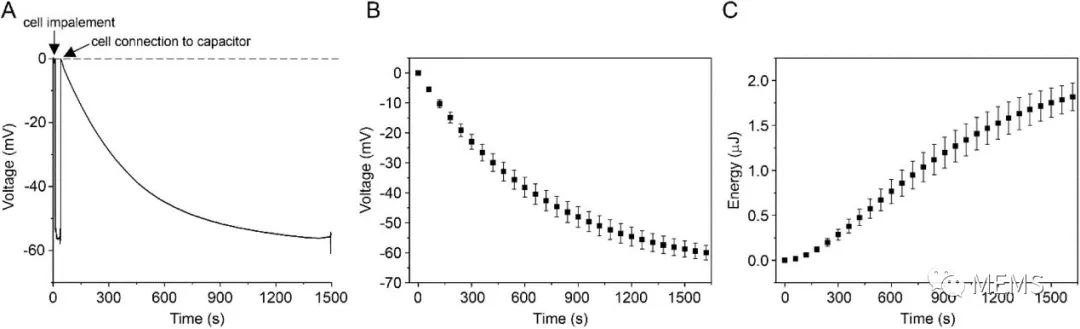
Charging a capacitor via flounder muscle fibers
Researchers compared experimental results with an RLC circuit model, revealing good agreement between measured data and theoretical predictions. However, the low voltage harvested from the fibers may pose challenges for implementing low-power electronic interfaces for wireless communication. Nevertheless, the autonomous temperature sensor proposed in this study utilizes a specifically selected storage capacitor connected to the bio-energy generator and can communicate with an external receiver at close range (10 mm).
This temperature sensor, once calibrated, transmits temperature data at a 160 Hz bandwidth across the range from room temperature to biologically relevant temperatures (30°C to 50°C). Future miniaturization could enable higher-frequency temperature sensing, but this requires carefully designing the electronic circuit's energy efficiency to minimize parasitic resistances and further energy dissipation.
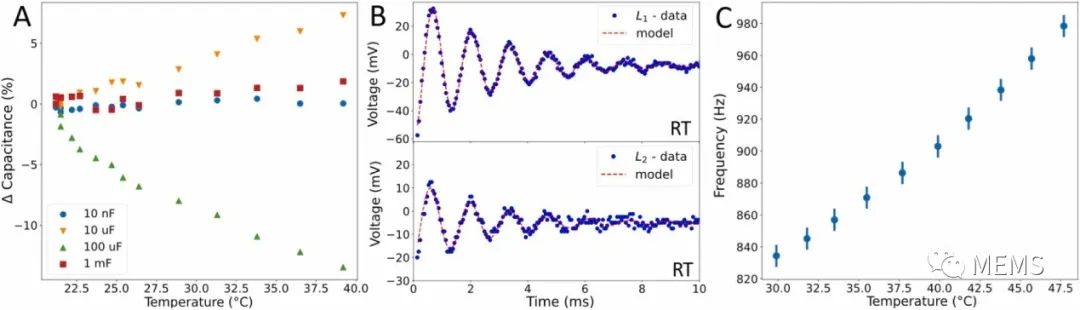
Temperature Sensor Characteristics
In summary, researchers have highlighted the potential of biological cells as energy sources for small-scale bio-embedded applications. By harnessing the functionalities of living cells-particularly animal cells (muscle fibers)-chemical energy can be converted into electrical energy, enabling the development of self-powered bio-embedded sensors. Compared to rechargeable batteries and kinetic energy harvesting technologies, this solution offers distinct advantages, paving the way for future integration of bio-embedded electronics into biological systems. This technology holds promise for establishing a class of bio-autonomous sensors capable of directly interacting with biological cells within living organisms. Further research and development in this field will contribute to advancements in energy harvesting techniques and the evolution of bio-embedded electronics.