




MPC Control
Model predictive control (MPC) has evolved from its origins as a heuristic control algorithm applied in industrial processes in the 1970s into a new academic discipline with rich theoretical and practical content.
Predictive control addresses control problems with optimization requirements. Over the past 30 years, the success of predictive control in complex industrial processes has fully demonstrated its enormous potential for handling complex constrained optimization control problems.
MPC control is a real-time closed-loop optimization control method. The primary advantage of this algorithm is its iterative online operation, which continuously obtains the current optimal control quantities. Additionally, it can establish objective functions to satisfy multiple constraints such as vehicle actuators, skid, and dynamics.
However, its tracking performance is highly sensitive to the accuracy of the predictive model. Furthermore, due to the high computational requirements of nonlinear model predictive control, it is unsuitable for high-speed driving environments.
Currently, many researchers have linearized nonlinear vehicle models, but this only ensures tracking accuracy within the linear regions of the vehicle and tires.
MPC controllers, also known as rolling-time domain controllers, consider the nonlinear dynamic model of the control system and predict the system's output behavior over a future time interval. By solving the constrained optimal control problem, the system minimizes tracking error over the future time interval, making this method robust.
Model predictive control algorithms have the basic features of predictive modeling, rolling optimization, and feedback correction. Traditional research methods often ignore or simplify kinematic and dynamic constraints, yet such constraints significantly impact control performance.
Model predictive control methods can explicitly incorporate vehicle kinematic and dynamic constraints into the optimization objective function.
By leveraging the rolling optimization and feedback correction features of MPC, the impact of closed-loop system time delays can be effectively reduced or even eliminated. Additionally, future trajectory information provided by the planning process can be utilized to optimize motion control, thereby enhancing control performance.
Wang Weiran et al. designed an adaptive predictive control method based on Laguerre functions.
This method consists of two parts: an adaptive MPC module for precise trajectory tracking, and a Laguerre function module for significantly reducing computation.
In the adaptive MPC module, a recursive least squares algorithm is introduced to identify the model parameters of the system, thereby improving the system's accuracy and robustness. However, when the AUV operates in complex environments, this method may result in a significant increase in computational load.
Therefore, in the Laguerre function, the reconstruction of the controller input variables is introduced to reduce the matrix order of the objective function. The results show that this method demonstrates excellent performance in terms of dynamics, interference resistance, and robustness when tracking AUV trajectories with reduced computational load.
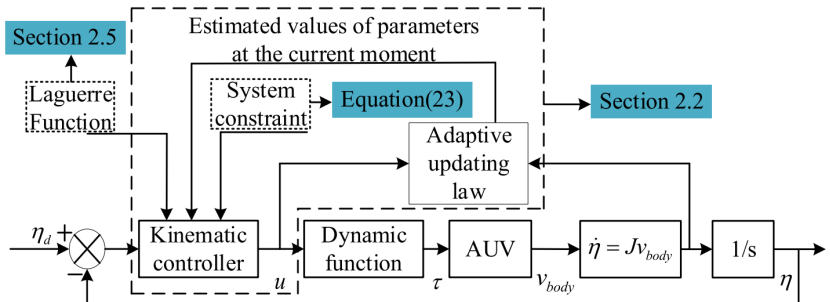 Adaptive MPC Block Diagram
Paden summarized pure tracking algorithms, front wheel feedback control, rear wheel feedback control, Lyapunov function-based control, output feedback linearization control, and MOC control in terms of stability, time complexity, model usage, and assumptions.
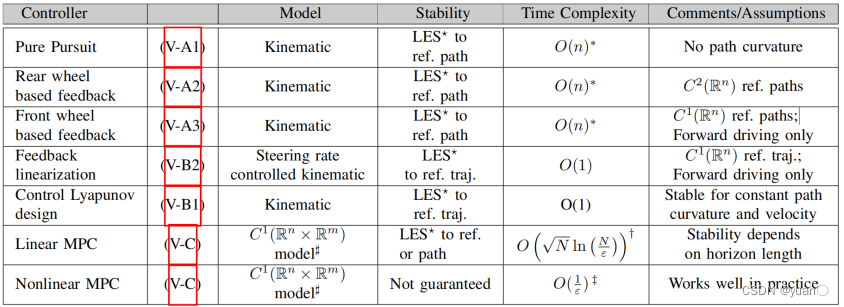 Summary of various controllers Legend*: Local exponential stability (LES)