


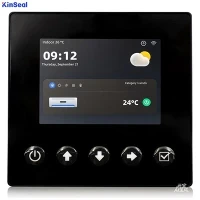


HMI Human Machine Interface, HMI is the abbreviation of Human Machine Interface, "Human Machine Interface", also called Human Machine Interface, is the medium of interaction and information exchange. HMI is a digital device that connects programmable controllers (PLC), inverters, DC speed controllers, meters and other industrial control equipment, using the display to show, through the input unit (such as touch screen, keyboard, mouse, etc.) to write the work parameters or input operating commands, to achieve the information interaction between man and machine. This report counts the touchscreen human-machine interface (HMI) market.
Global Touch Screen Human Machine Interface (HMI) Overall Size and Development Trend Analysis
Human-computer interface is a medium for interaction and information exchange between equipment systems and users, which is used to realize the conversion between the internal form of information and the form acceptable to human beings.
Usually used to connect programmable logic controllers, special controllers, inverters and other industrial automation control products, the use of display units (such as LCD modules) to display real-time information such as the operating status of machinery and equipment; in the human-computer interface can be used to input units (such as touch screens, keyboards, etc.) to write operating parameters or input operating commands, thereby realizing the interaction between human and equipment information is a standard configuration of various types of industrial automation production equipment. It is the standard configuration of various industrial automation production equipment. Mainly used in logistics equipment, medical equipment, industrial robots, food machinery, clothing machinery, textile machinery, rail transportation equipment, packaging machinery, plastic machinery, electronic manufacturing equipment, printing machinery and other fields.
Recently, with the booming development of Industrial Internet of Things (IoT), HMI has begun to become an intelligent gateway for machine connection, playing an increasingly important role. As an important part of BBK's M-IoT machine IoT solution, BBK's IoT HMI has been welcomed by more and more customers.
Global Touchscreen Human Machine Interface (HMI) Market Size and Trends (2016-2027) & ($Million)

In 2020, the global Touchscreen Human Machine Interface (HMI) market size reached 1665.68 million USD, and is expected to reach 3019.95 million USD in 2027, with a compound annual growth rate (CAGR) of 9.1%.
At the regional level, the Chinese market has changed rapidly in the past few years, with a market size of $291.21 million in 2020, accounting for about 17% of the world, and is expected to reach $649.89 million in 2027, when the global share will be more than 21%.
China's industrial automation technology is mainly through the combination of China's equipment manufacturing industry application requirements, the introduction of international advanced technology, digestion and absorption, and re-innovation on the basis of gradual development. China's industrial automation technology development history is relatively short, the R & D foundation is relatively weak, the maturity of the technology compared with the international advanced technology there is still a certain gap. However, in recent years, the level of China's industrial automation technology has been rapidly improving, and the gap between products and technology and international advanced technology has been narrowing. The application and popularization of modern industrial automation technology will significantly improve the overall production efficiency of society, and at the same time accelerate the optimization and upgrading of traditional industrial structure. With the continuous development of control engineering, ergonomics, computer software, embedded software, electronics, power electronics, electrical machinery, mechatronics, network communications and other disciplines, intelligent, miniaturized, networked, platform, integrated will become the main direction of industrial automation technology development. Among them, the industrial human-machine interface is gradually developing in the direction of intelligence and networking, and the increase of interfaces, wireless communication, intelligent analysis and other functions as well as the enhancement of processing speed is the future direction of technological development. Servo system with the new power semiconductor devices, high-performance digital signal processor and servo-specific modules are widely used, servo drive software algorithms continue to progress, high-speed, high-precision, high-performance, high-efficiency, integrated, networked, modular design and so on has become the direction of technological development of the servo system.
The industry generally believes that the transformation and upgrading of the traditional industry's intelligence, digitization, and informatization is the main driving force behind the growth of the human-machine interface market. Human-machine interface has a significant role in converting the form of information, providing system control, and promoting human-computer communication. As the main force of information interaction in the field of automation, it not only improves the efficiency and quality of production, but also enhances the user's experience.
However, although the demand and prospects for human-machine interface is very considerable, but from the global development point of view, China's industry market still has certain problems. Europe and the United States and other countries began to develop human-machine interfaces as early as the 1980s, and China only started after 2000, so there is a gap in product technology, performance, stability, etc., and the market is monopolized by companies in Europe, the United States, Japan and other regions. In other words, due to the differences in technology, products and brand influence, although China has the world's largest demand market for human-machine interfaces, it has never been the world's largest human-machine interface sales market. This means that China's human-machine interface development is still at the low end, and the structure of domestic business development and industry chain deviation is obvious, which is not conducive to the long-term development of the domestic market in the future. The good news is that the strong support of the current domestic industrial policy, the release of demand brought about by the increase in labor costs, as well as the expansion of product applications under the trend of intelligent transformation, has brought favorable opportunities for the development of China's human-machine interface. Under this opportunity, China's enterprises focus on product and technology, accelerate independent research and development and innovation development, is constantly narrowing the relevant gap with foreign enterprises.
Currently the world's major manufacturers including Siemens, Schneider, Advantech, Mitsubishi Electric and ABB, etc., the share of major manufacturers in 2020 accounted for more than 35%. The global touch screen human-machine interface (HMI) market is relatively decentralized, the industry is expected to become more competitive in the next few years, especially in the Chinese market.
Touch screen human-machine interface (HMI) development trend
The overall outlook is promising
The Chinese government will stabilize growth as the top priority of economic work in the next period of time, and also pointed out for the first time that China's economic operation will show an "L"-shaped trend, and accordingly introduced a series of policy measures. Many of these policy measures are unprecedented, such as removing production capacity, removing inventories, removing leverage, lowering costs, and replenishing short boards. This shows that the decision makers have accurate judgment on the current trend of China's economic operation and adequate risk estimation. Therefore, in the light of China's economic fundamentals and development prospects, the overall outlook for the future is promising.
Strong demand and rapid growth in developing countries
The epidemic will gradually be brought under control with the concerted efforts of mankind, and the increasing adoption of human-machine interface technology in emerging economies is expected to drive the overall market in the coming years.
Rapidly evolving technology
The latest generation of HMI products incorporates and builds on the best features of previous generations of HMIs and operator interface terminals by incorporating proven commercial technologies at the same time. New technology benefits include: open source, affordable configurations, ease of use, integrated screens and flexible ports, web and cloud-based connectivity, mobile devices and more.