


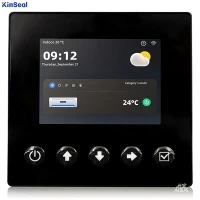


Manufacturers and automation companies often don't agree on whether it's more logical to implement single-touch panels or multi-touch technology. Multi-touch panels for industrial use have been available for many years and offer operators more functionality, including the ability to zoom, switch and navigate with 3D HMI software. While "newer" usually means more expensive, this is not always the case with HMI hardware. Depending on the manufacturer's needs, multi-touch panels are often less expensive than single-touch panels when factors such as screen size, build costs and processor performance are taken into account.
Multi-touch panel operation does not become obsolete quickly, which can reduce costs. It is possible to deploy panels that support multi-touch but operate in single-touch mode so that they can be upgraded to newer multi-touch software in the future. Since no additional hardware upgrades are required, it is relatively easy to upgrade deployed HMI systems to multi-touch software.
Multi-touch panels can provide machine operators with functionality improvements and efficiency gains, including: the ability to visually locate status notifications for important devices; toggle navigation through multiple menu screens; graphical representations across machine lines; and additional safety features such as two-handed or two-finger touches to activate certain operating modes.
Similar interface features have been used on smartphones and tablets for years. With advances in multi-touch software and smartphone and tablet functionality, machine control, and visualization, applications are also available on mobile HMI software that supports HTML5, which allows HMI screens to be automatically converted to tablet or smartphone size. Previously, the screen needed to be reprogrammed if you wanted to display it on a different size device.
With web-based HMI screens, HMIs displayed on machines can be displayed on mobile devices. The increasing use of multi-touch panels in industrial applications means that mobile devices, which are typically used for checking work emails or for general business purposes, can offer more functionality in terms of machine monitoring and control. Over the years, multi-touch enabled panels and software packages have proven to be just as reliable as traditional HMI systems and are gaining higher market share in the production floor monitoring arena.
High-quality industrial displays can have lifecycles of ten years or more. Choosing a single-touch panel over a multi-touch panel for short-term gain could cause a lot of inconvenience to users in the future. The further development of multi-touch and web-based HMI software may cause some confusion when deciding whether to stay with an existing system with fewer features or upgrade a single-touch panel that is still working properly. A better strategy is to deploy multi-touch panels and set them to single-touch mode until the application requires the full functionality of the HMI.
Another trend is to reduce the overall equipment and machine footprint. It is important to consider whether there is a real need to install space-saving tablet PCs in order to eliminate standalone industrial computers (IPCs) in control cabinets. Choosing a multi-touch tablet PC may be the right strategy, but it may not be suitable for all applications. The tablet should have enough processing power, random access memory (RAM) and on-board diagnostic tools to provide proper performance for the application.
The advantage of passive multi-touch panels and standalone IPC units is that the panel will last for years, even if the IPC is upgraded to a more powerful model. If a passive panel is damaged, the replacement process is relatively easy. Passive panels, as well as flat panels with integrated CPUs, can be fully enclosed units mounted on arms or poles, eliminating the need to cut holes in a separate HMI enclosure.
A strategy to reduce panel wiring is to use single-cable connection technology. Using simple, low-cost hardware adapters, IPC can send digital video interface signals, USB 2.0 signals, and power to panels up to 100 meters away. This saves more space on the production floor and provides some flexibility for future HMI hardware upgrades.
PC-based open platforms are ideal for HMI integration. PC-based controllers can run HMI software just as easily as PLCs and motion control projects. Considering vertical communications, IPCs and tablets are well suited for Open Platform Communications Unified Architecture (OPC UA) communications. This builds in secure and encrypted data transfer for cloud and edge computing solutions.
System security is typically implemented in software and networks, but the new HMI hardware prevents unauthorized field applications and errors. An example is the use of radio frequency identification (RFID) chips installed in employee access cards or key cards. HMIs configured with RFID readers can authorize user access based on job responsibilities. As a result, employees can only use some of the machine functions via the HMI, depending on their position and responsibilities. As a more efficient and effective security guard, RFID eliminates the need to manually enter user names and passwords.
Choosing multi-touch HMI hardware and ensuring that the tablets provide sufficient processing power over time is a smart strategy. Deploying standardized multi-touch panels can prepare a plant for future advancements.