




An automation system consists of devices capable of receiving input (sensors, HMIs, etc.), a computing system (processor), and manipulators (actuators) that perform the actual work. The most important part of the three is the computing or control system. It can be divided into two types: open-loop and closed-loop (feedback) control.
Open-loop control is a system in which the controller sends signals to the actuator to obtain a desired response. The signals sent are controlled only by the program initially fed to the controller. In closed-loop systems, feedback signals are involved. The feedback signal is generated by a sensor, which directly or indirectly measures the response from the actuator. This feedback signal is processed by the controller to compare the actual output with the desired output. The controller then makes the necessary adjustments to the signal sent to the actuator. The cycle is repeated until the correct response is obtained.
The input component can be a human-machine interface or a sensor.
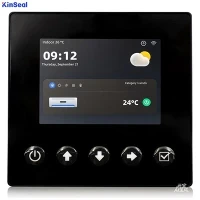
The HMI is where the human operator communicates with the controller. This is where variables or commands are entered to modify the desired output.
Sensors are used to measure the output using different physical or electromagnetic properties (e.g., pressure, temperature, magnetic, radiation, etc.). The measured physical properties are converted into electronic signals that the controller can read and use.
The actuator is the part that produces the action. The actuator consists of a driver as well as a joint and linkage assembly. The actuator provides the force or torque required to move the connecting rods connected through the joints. The actuator can be considered as electric, hydraulic or pneumatic. Electric actuators are motors or solenoids that convert electrical energy into mechanical output. Hydraulic and pneumatic systems operate using fluid pressure compressed against a piston, cylinder, vane or blade. These systems can also be considered electrically powered in their most basic concepts because the fluid is controlled by the opening and closing of a solenoid valve.
Links can move relative to each other depending on the degrees of freedom allowed by the joint. Degrees of freedom are defined as the allowable movement of a link in a three-dimensional axis. There are six degrees of freedom, three for translation (up and down, left and right, forward and backward) and three for rotation (pitch, yaw and roll). For simplicity, most joints allow only one or two degrees of freedom because creating a highly movable arm is difficult, expensive and impractical.