





Connected devices with advanced sensing and control functions are becoming increasingly common in industrial applications, giving rise to the concept of industrial interconnection during their interconnection. Whether wired or wireless, improving automation efficiency has become a top priority. The high density of sensing and control devices naturally leads to increased interconnection. Although industrial wireless networks can address some interconnection challenges to a certain extent, they typically require some form of physical connection, and wireless networks are not suitable for all industrial environments.
The Rise of Single-Pair Ethernet (SPE) in Industrial Scenarios
In the interconnection mentioned above, an Ethernet connection may require multiple wires for fast 100 Mbps Ethernet or even Gbps Ethernet. Drawbacks such as complexity, high cost, and the inability to ensure timely exchange of information collected by sensors do not meet the expectations of industrial interconnection.
Single-pair Ethernet technology is a connection technology that can achieve a speed of 1 Gb/s over short distances and enable two-way communication. Initially, this connection technology was widely used in automotive applications. According to the IEEE 802.3 transmission standard, single-pair Ethernet technology has been integrated into new-generation vehicles, replacing CAN and other bus systems. This technology can unify control, communication, and various safety functions to operate over Ethernet, which precisely meets the needs of industrial automation interconnection.
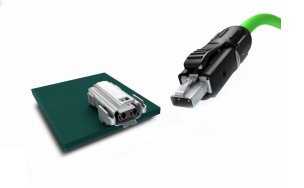
The most direct driving factor for introducing single-pair Ethernet in industrial scenarios is to meet the demand for efficient two-way communication in applications. The 1 Gb/s connection speed enables real-time secure connections from devices to infrastructure and from devices to the cloud. Beyond its cost and ease of use, the enhancement of sensor data analysis and the acceleration of error response alone make it highly attractive.
What Are the Advantages of Single-Pair Ethernet?
First, there is no need to compare single-pair Ethernet with wireless connections, which lack universality in industrial scenarios. When compared with other wired connections, single-pair Ethernet provides Power over Data Line (PoDL) in the same compact interface, using only two cables to transmit both data and power. Traditional wired connections use four cables. Fewer cables mean lower costs and greater freedom for mechanical equipment. From a more critical perspective, does reducing the copper (Cu) content in cables also mean achieving faster transmission with less energy? In this regard, the cost-benefit analysis of single-pair Ethernet is undoubtedly favorable.
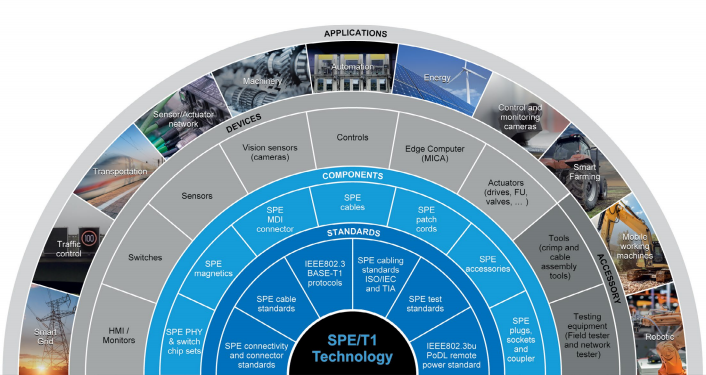 SPE Technology, SPE Alliance
As mentioned, single-pair Ethernet can reach a speed of 1 Gb/s over short distances, with a cable length of up to 1000 meters at a transmission speed of 10 MB/s, using a bandwidth of 600 MHz for data communication. Its communication advantages are obvious and need no further elaboration. It is worth noting that one terminal of a single-pair Ethernet connection is used for 1 Gbps/600 MHz data transmission, and the other supports power transmission with a current of up to 8A. This mixed connection of data and power must be physically shielded and separated to avoid interference between power and data signals.
Overall, this technology reduces the overall size of connectors and minimizes the workload at many terminals. Single-pair Ethernet brings Ethernet down to the sensor-actuator level and directly connects sensors and actuators to automation systems or the cloud, providing significant assistance to industrial interconnection.
The PoDL Challenge of Single-Pair Ethernet
The earlier mention of Power over Data Line (PoDL) in compact interfaces also addresses the inefficiency of long-distance power transmission. Currently, standard single-pair Ethernet data connections can reach 50W, and mixed power-data connections can deliver up to 400W at 48V. Here arises an issue: high power levels may cause PoDL to deviate from standards. Most electrical devices can accept a 10% voltage drop, while PoDL allows a maximum of 20%. In power tests on PoDL harnesses, a 40-meter cable length can bring the power close to 200W under this condition, and when the cable is shorter than 20 meters, the high power level reaches 400W. To avoid PoDL deviating from standards, this maximum value is typically not used.
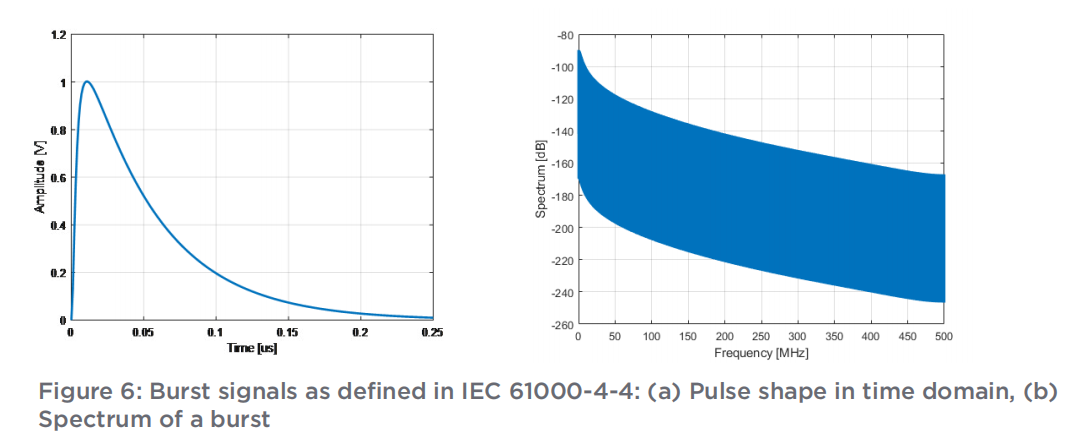
Using PoDL combines data and power cables into the same wire. Although this setup enables simultaneous transmission of data and power, it has a drawback: it imposes strict requirements on noise and the rate of change in power levels, as otherwise, data transmission will be affected. Therefore, using good filter circuits to suppress such noise is particularly important in industrial environments, especially for noise generated in the lower megahertz range (see the figure below).
Summary
Single-pair Ethernet presents an opportunity for protocol standardization in the entire industrial network. Why? Considering the huge number of sensors and actuators in industrial equipment, while Ethernet is a standard for many industrial networks, the industrial reality is filled with various systems and a multitude of traditional gateways. The role of single-pair Ethernet in bridging Ethernet with other systems has attracted more industry attention than its performance advantages alone.