


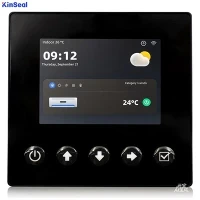


Board control and PLC (Programmable Logic Controller) control are two common types of industrial automation control. While there are some similarities in certain areas, they are significantly different in many ways. The differences between board control and PLC control will be explored in detail below.
1. Definition and Usage:
Board control usually refers to the use of circuit boards or hardware devices to control and monitor equipment or systems through signal acquisition and output control. Board control is commonly used in applications that require high-precision and real-time control, such as industrial robots, medical equipment, and communications equipment.
PLC control refers to the use of programmable logic controllers (PLCs) to accomplish control and monitoring tasks.PLCs are specialized digital computers with strong processing power and programmability.PLCs are widely used in automation control fields, such as factory automation, machinery control, and power system control.
2. Programming method:
Board control is usually programmed using embedded system programming or Hardware Description Language (HDL). Embedded system programming is mainly used to realize the control logic by writing the underlying drivers and control algorithms. Hardware description languages are commonly used to design and verify hardware circuits.
PLC controls are programmed using specific programming languages (e.g., LD, FBD, LAD, SFC, etc.). These programming languages are designed and optimized for the characteristics of PLC control logic, making PLC programming more intuitive and easier to understand.
3. Real-time performance:
Board controls typically have high real-time performance and can be controlled and monitored with very short response times. This is because the board control connects directly to the hardware device and performs data acquisition and output control through the hardware interface. It is not dependent on external communication and transmission processes, and therefore can provide control and feedback to the device in real time.
The real-time performance of PLC control is relatively low.PLC systems are usually connected to external devices and require data acquisition and transmission through communication interfaces. This makes the real-time performance of PLC control affected by communication delays and calculation speeds, with relatively long response times.
4. Flexibility and Scalability:
Board control is less flexible and scalable. Once the hardware devices are finalized, board controls are often difficult to change or upgrade. If it is necessary to modify the control algorithm or add new functions, it is usually necessary to redesign the hardware circuit or replace the control device.
PLC control has better flexibility and scalability.PLC system usually consists of a mainframe and various modules, which can be selected and combined according to the needs of various modules. By reprogramming the control logic, modification of the control strategy and expansion of functions can be easily realized.
5. Troubleshooting and Maintenance:
Board controls usually rely on specialized technicians for troubleshooting and maintenance. Due to the complexity of the hardware circuits, once a failure occurs, in-depth analysis and overhaul of the hardware circuits is required.
PLC control has better troubleshooting and maintenance performance.PLC systems usually have automatic diagnostic functions that can quickly detect and locate faults. In addition, PLCs are also easy to use, allowing maintenance personnel to quickly understand and familiarize themselves with the control logic for troubleshooting and maintenance.
In summary, there are significant differences between board control and PLC control in terms of definition and purpose, programming methods, real-time performance, flexibility and scalability, troubleshooting and maintenance.