





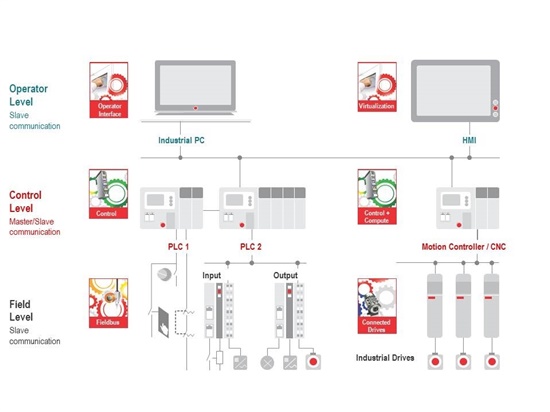
Factory automation systems for Industry 4.0 typically comprise three tiers of equipment to enable real-time communication and control:
At the field level, I/O modules, actuators, and drives manage physical operations within the factory;
At the control level, programmable logic controllers (PLCs) or computer numerical control (CNC) systems are responsible for gathering information from the field level and issuing commands to the field.
At the operator level, human-machine interface (HMI) devices communicate with operators, who can simultaneously issue commands.
Each level requires optimized hardware and software solutions to address its unique design challenges. Among these, challenges at the control level are particularly difficult to resolve.
As the number of nodes supported by a single controller continues to increase, designers of control-level devices face specific challenges beyond the common industrial automation design concerns such as energy consumption, extended power supply lifespan, and reliability requirements. Supporting more nodes means fewer controllers are needed across the entire plant solution, creating a more cost-effective automation solution. Alternatively, these additional nodes can be deployed throughout the plant to achieve higher levels of automation. However, as the number of supported nodes grows, processor performance must scale accordingly while maintaining sufficiently low power consumption to avoid increasing package size. Furthermore, most PLCs are designed without fans, making power dissipation a critical design consideration.
Since PLCs and CNCs simultaneously control numerous nodes or functions within a factory, the real-time nature of their operations is critical. For a solution to achieve precise timing, two components are essential: a real-time operating system (RTOS) and flexible, time-aware peripherals for industrial communication. The RTOS is employed in these devices to manage decision-making and control latency, ensuring compliance with critical timing requirements. Commercial RTOS have been widely adopted in industrial control for years, while interest in RT Linux® solutions continues to grow. These solutions deliver the time-sensitivity and decision-making capabilities required for industrial automation applications while leveraging the full advantages of the large Linux open-source community.
For the communication peripheral portion of real-time solutions, the primary requirement is supporting industrial fieldbus protocols through a method that achieves low latency and short protocol cycle times, even when increasing the number of nodes. This becomes a more complex challenge when multiple fieldbus standards must be supported within a single design. Multi-protocol support is essential to ensure end products are compatible with multiple standards-such as EtherCAT, PROFINET, and Ethernet/IP-that may already be deployed within a factory. Achieving multi-protocol support via hardware (ASIC) is complex, as each protocol may require its own dedicated ASIC, necessitating distinct board designs for every supported fieldbus. A programmable approach simplifies this challenge. In these approaches, fieldbus protocol changes can be implemented through software or firmware updates alone.
To facilitate this real-time communication solution efficiently, controllers require extensive peripheral interfaces. This is because they must communicate across multiple layers: with fieldbus networks within the factory, backplanes connecting I/O, actuators, drives, or other controllers, and servers performing factory diagnostics via data acquisition protocols like OPC UA. All this necessitates a large number of peripheral interfaces, particularly Ethernet interfaces. Additionally, a flexible and programmable communication solution is required.
The TMDXIDK5728 Industrial Development Kit (IDK) for the Sitara™ AM572x processor is now available for evaluating control-level factory automation solutions. The AM572x dual-core ARM® Cortex®-A15 processor is ideally suited for industrial applications due to its support for industrial temperature ranges, an extended lifespan of up to 100,000 hours, real-time software support, and extensive peripherals-including dual PRU-ICSS (Processor Real-Time Unit-Industrial Communication Subsystem) for programmable industrial communications. The TMDXIDK5728 provides four Ethernet ports, with two potentially sourced from a gigabit switch and the other two potentially sourced from the PRU-ICSS (default configuration), or all four ports sourced from the PRU-ICSS. The TMDXIDK5728 enables evaluation of TI's latest solutions for industrial fieldbus protocols based on the AM57x, delivered through the PRU-ICSS-INDUSTRIAL-SW within the Processor-SDK-RTOS. Additionally, the TMDXIDK5728 can run the Processor-SDK-Linux-RT software package, which provides an optimized RT Preempt patch for TI's mainline Linux kernel to enable development of real-time industrial automation applications.