





In industrial automation and power systems, three-phase AC motors are one of the most common power sources. To enable forward and reverse control of the motor, a reliable forward-reverse interlock circuit must be designed.
Compared with single-phase induction motors, three-phase induction motors offer better operational performance and result in savings in various materials. Based on the structure of the rotor, three-phase induction motors can be classified into two types: squirrel-cage and wound-rotor. Squirrel-cage induction motors feature a simple structure, reliable operation, light weight, and low cost, making them widely used; their main drawback is the difficulty in speed control. Like the stator, the rotor of a wound-rotor three-phase induction motor is equipped with three-phase windings and is connected to an external rheostat via slip rings and brushes. Adjusting the rheostat's resistance improves the motor's starting performance and allows for regulation of its speed.
A three-phase AC motor consists of major components such as the stator, rotor, and bearings. When three-phase AC current is applied to the stator windings, a rotating magnetic field is generated. This magnetic field interacts with the conductors in the rotor, producing electromagnetic torque that causes the motor to rotate.
Next, we will provide a detailed explanation of the analysis method for the forward-reverse interlock circuit of a three-phase AC motor:
1. Forward-Reverse Principle:
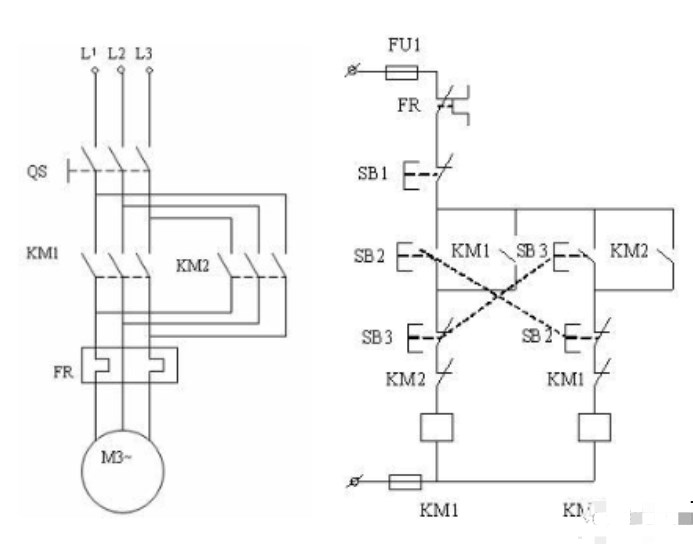
The direction of rotation of a three-phase AC motor depends on the sequence of the currents in the stator windings. To change the motor's direction of rotation, simply reverse the sequence of the currents in any two phases of the stator windings. This can be achieved by using contactors (relays), which switch the sequence of the power supply lines, thereby changing the direction of the rotating magnetic field.
2. Interlock Circuit Design:
To ensure the safe and reliable operation of the motor's forward and reverse rotation, an interlock circuit must be designed. The core of the interlock circuit involves using two contactors, with each contactor controlling one direction of rotation (forward or reverse).
Only one contactor can be closed at any given time to prevent simultaneous operation in both forward and reverse directions, which could cause a power supply short circuit or damage the motor.
3. Control Circuit Design:
The control circuit typically includes pushbuttons (Start, Stop, Forward, Reverse), indicator lights, and protective components (such as overload protection switches and phase failure protectors). During design, it is essential to ensure coordination between the control circuit and the main circuit, as well as the correct selection and arrangement of all control components.
4. Safety Measures:
When designing a forward-reverse interlock circuit, the safety of personnel and equipment must be taken into account. In addition to the interlock function, safety measures such as emergency stop buttons, electrical isolation devices, and mechanical interlock devices should also be included.
5. Circuit Analysis:
When performing circuit analysis, it is necessary to establish correct logical connections for the auxiliary contacts of contactors, as well as the normally open and normally closed contacts of pushbuttons. Ensure that the operating sequence and time settings for components such as time relays and intermediate relays in the forward/reverse control circuit are correct. Additionally, parameters such as voltage, current, and power within the circuit should be analyzed to ensure stable operation and long-term reliability.
In summary, the design of a forward-reverse interlock circuit for a three-phase AC motor is a comprehensive engineering task involving multiple fields, including motor science, electrical control technology, and safety standards. By gaining a thorough understanding of the motor's operating principles and the key design considerations for control circuits, engineers can design forward-reverse interlock circuits that are both safe and efficient. With the continuous advancement of power electronics and automatic control technologies, we can look forward to more innovative solutions being applied to the control of three-phase AC motors in the future.