


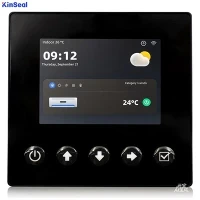


Human Machine Interfaces (HMIs) are particularly important in the digital transformation process.HMIs are now under full software control and can be configured and customized for specific users, roles or machine states. This new flexibility offers great scope for a concise and efficient user experience.
A human-machine interface (HMI) integration framework refers to a software framework for building, designing, managing, and deploying HMIs that helps developers and system administrators quickly create, adapt, and maintain HMI interfaces to improve productivity and user experience. The following are common HMI integration frameworks:
1. Qt: Qt is a cross-platform GUI application framework that provides highly customizable interface design tools that behave similarly across platforms, making it easy for developers to perform cross-platform development.
2. JavaFX: JavaFX is a Java language to build a rich graphical user interface (GUI) application technology , which provides a rich library of graphical and multimedia components , support for near real-time animation effects and concurrency model .
3. NET: The Microsoft .NET Framework is a cross-platform application framework that supports multiple programming languages and development environments, and provides a rich library of GUI controls and data access components that can help developers quickly build and distribute applications.
4. Web technologies: Web technologies (such as HTML, CSS, JavaScript, etc.) are used to realize interactive HMI interfaces, often using front-end frameworks (such as React, Angular, Vue, etc.) to simplify the development and management of Web interfaces.
5. LabVIEW: LabVIEW is a system design software for data acquisition, control, test and monitoring, which provides a large number of HMI components and function libraries, support for a variety of standards and protocols, can be used to build a variety of complex systems.
6. Unity: Unity is a cross-platform game engine and development tools for game and virtual reality (VR) development, which provides a rich game engine and 3D modeling tools, support for a variety of human-computer interaction, such as gestures, head tracking, voice recognition, etc., can be used for the development of games, VR educational applications.
7. Electron: Electron is a use of JavaScript, HTML and CSS and other Web development technologies to build desktop applications development framework, which can use the Node.js environment to access the operating system's APIs, developers can use Electron to build a cross-platform applications with native application experience.
8. Android Things: Android Things is an operating system and application development platform for Internet of Things (IoT) devices, with built-in Google Play services, developers can use programming languages such as Java and Kotlin to build HMI-based smart devices, smart homes and other IoT applications.
9. Dlib: Dlib is a C++ library for machine learning and computer vision, which contains a rich variety of computer vision and machine learning algorithms as well as facial detection, tracking and other professional visual positioning libraries, which can be used to build a colorful HMI human-computer interaction.
The above are some of the more popular HMI integration framework, they can help developers quickly build a colorful and efficient graphical interface to meet the needs of different scenarios.