




Analog and digital sensors offer long-term stability, precision, and reliability.
Motion control and industrial automation systems present numerous challenges for design engineers. For instance, they must contend with excessive dirt and dust found in factory settings. Additionally, conveyor belts and pick-and-place systems may experience high vibration or impact force peaks, threatening the stability of circuit sensors. The selected magnetic sensing system must possess outstanding durability to ensure long-term accuracy and reliability within the application.
During project planning, design engineers should conduct a thorough review of the environmental, mechanical, electrical, and magnetic parameters of industrial applications. Engineers should analyze the entire magnetic circuit of industrial applications-including sensors and magnetic actuators. Considering all critical factors, engineers may recommend powerful custom sensors to meet the unique requirements of industrial automation systems.
This article discusses how to select highly accurate and reliable sensors for industrial automation applications. After defining and describing the advantages of several analog and digital sensors, it provides examples of industrial applications utilizing these devices.
Analog Rotary and Linear Hall Effect Sensors Deliver Stability and Accuracy
Analog sensors enable end users to obtain instant feedback on magnet position within industrial automation systems. Historically, analog Hall effect sensors measured magnetic flux density and were highly susceptible to application temperature values. Recent advancements in analog Hall effect technology enable Hall effect chips to measure the angle of the flux field rather than the traditional amplitude, significantly reducing sensitivity to temperature variations. Today, Hall effect sensors deliver highly stable analog outputs across extensive temperature ranges.
The following Hall effect sensors are well-suited for custom analog sensing applications:
Rotary Hall Effect Sensors Employing no moving parts, these semiconductor-based sensors integrate Hall Effect sensing elements with circuitry to deliver analog output signals corresponding to changes in rotating magnetic fields. Rotary Hall Effect Sensors offer two output options: analog or Pulse Width Modulation (PWM). The device is programmable, allowing engineers to associate specific output voltages or PWM values with precise rotational degrees.
Multiple programming points can be set for up to 360 degrees of rotation. Each programming point represents a voltage or PWM output value corresponding to a specific magnetic field angle. This generates a high-precision, high-resolution ratio measurement output signal relative to the degree of rotation.
Advantages:
- Does not experience resistance value changes or mechanical wear like mechanical rotary or resistive film rotary devices
- Provides exceptional stability at normal operating temperatures up to +105°C
- Delivers 0-360° rotation accuracy with 0.5-4.5 VDC output or 10-90% PWM duty cycle
Applications:
Replaces resistive film and mechanical potentiometer devices prone to wear and oxidation issues that cause signal loss in control units.
Motion control applications include measuring the angle of flap valves in fluids and precisely controlling flow rates
Detecting the position of rotary switches in control circuits
Linear Hall Effect Sensor
Linear Hall Effect sensors measure linear magnetic field movement rather than rotation. This sensor can be programmed for a set output voltage that is proportional to a given travel distance. (Its output options are identical to those of rotary Hall Effect sensors.) Using a single Hall Effect chip, this sensor measures the linear movement and relative magnetic flux angle of a magnetic actuator, with a maximum travel of 30 mm. This results in a proportional output signal relative to the precise movement of the sensor.
Advantages:
The sensor and actuator can be placed within the application's final installation area (including all magnetic influences from the surrounding environment);
This mounting position allows engineers to optimize the application's output signal, as any shunting, mechanical tolerances of the magnetic field, or stacking tolerances will be incorporated into the programmed output signal to correspond with the direction of magnetic flux when the magnet rotates.
Applications:
Used as a liquid level sensor for monitoring fluid levels; the sensor detects the position of a moving float equipped with a magnet
Provides extremely precise position tolerances for automated pick-and-place systems
Reed switches and Hall effect sensors deliver highly reliable digital sensing
Industrial automation users prefer digital outputs when verifying whether an object (e.g., elevator doors) is in the correct position. The following digital sensors offer exceptional reliability in customized magnetic sensing applications:
Reed Switch
The contacts of a reed switch are made of precious metal and sealed within a glass tube. This electrical switch operates without requiring any external power source.

Advantages:
Resistant to moisture and other environmental hazards, ensuring reliable operation for millions of cycles.
Applications:
Microprocessor-controlled logic-level electrical loads
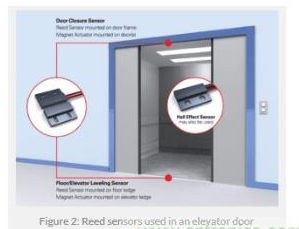
Digital on/off applications, such as door closure or position detection systems in industrial/motion control markets (as they can switch AC or DC loads); examples include freight or passenger elevator doors using reed switches for door closure detection, see Figure 2.
Digital Hall Effect Sensors
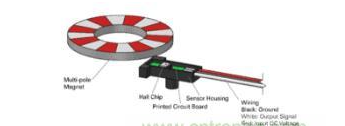
These sensors integrate Hall effect sensing elements with circuitry to provide digital on/off output signals corresponding to magnetic field changes, without requiring any moving parts. The active circuitry of Hall effect devices always consumes a small amount of current.
Advantages:
Provides high reliability
Programmable to activate within specified magnetic field tolerances to meet precise sensing requirements
Applications:
Limited to industrial and motion control applications involving low DC voltage and current values.
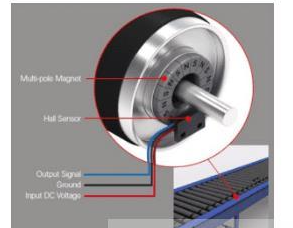
Widely used in high-speed sensing applications, such as rotational speed sensing on conveyors. For an example of a Hall-effect speed sensor detecting rotation of a 16-pole ring magnet, see Figure 4.
Conclusion
Industrial automation and motion control environments present numerous environmental hazards. Designing a magnetic circuit that integrates robust magnetic sensors is key to delivering precise, reliable industrial automation solutions. For certain industrial applications, a customized magnetic sensor may be required to achieve long-term reliability. Reed switches and Hall effect sensors are well-suited for digital applications demanding exceptional reliability, such as elevator door closure detection systems. Rotational and linear Hall effect sensors enhance the stability and accuracy of customized analog applications, including fluid flow monitoring and automated pick-and-place systems.