




Controls
Complex automation systems are easier to understand when broken down into multiple parts. To better communicate on the plant floor, plant personnel refer to machine components by level. In automation, control components and systems are those that send data signals to field-level devices that, in turn, complete an action or return information. Logic components or software in a control system, or PLC components are designed to scan inputs, scan codes, and set outputs from field devices based on pre-programmed instructions.
Industrial controllers are designed to receive inputs and transmit pre-programmed commands to field-level devices. There are two types of controls - continuous and discrete.
For continuous control, parameters and variables are analog and continuous. Analog signals are variable and have more than one state, not just "on" and "off", but in between. For discrete control, binary digital signals are used. The digital signal is either "on" (binary 1) or "off" (binary 2).
Because both continuous and discrete I/O controls are used in today's automation to control multiple machine functions, many control systems are designed to communicate in both signal types with the aid of conversion circuits or components.
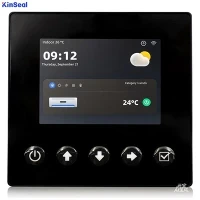
Human Machine Interface (HMI)
An HMI is a programmable machine interface. The device allows the operator to connect directly to the machine system to monitor inputs and outputs and to exercise control.
Programmable Logic Controller (PLC)
PLCs are most commonly used in automation where manual inputs are limited and advanced interfaces are not required. These early control devices were typically programmed using ladder logic and were designed to be user-friendly. If you understand hard-wired relay logic, you will feel comfortable programming this device. Programming can be done from your PC via serial or USB connection.
Fieldbus Inputs and Outputs
A fieldbus consists of a series of networked field devices that communicate serially over a 31.25kHz bus. On a fieldbus system, devices can use a pair of wires to pass data between each other and the host control system. With fieldbus, your data is not limited to measured variables, but also includes diagnostic data, status messages, and alarms.
Industrial Safety Products
Increased automation on the factory floor has created new safety challenges and opportunities. Challenges include keeping workers away from moving parts and being able to stop machines immediately in an emergency. Using the same components found in automation, manufacturers have designed high-tech safety equipment to fill needs and gaps.
Safety light curtains
Safety light curtains provide protection for automated machinery by sensing the light beam through a photoelectric presence. If the beam is destroyed, a stop signal is sent to the machine control.
Emergency Stop Buttons
Electromechanical Emergency Stop Switches (Emergency Stop Buttons) are not your typical pushbutton switch. The Emergency Stop Pushbutton is designed as an easily recognizable red button on a yellow background and has an easy-to-use mushroom shape. It is connected directly to the normally closed contacts of the hazardous load, so the stop is instantaneous.
Connector Cables and Harnesses
Machine components rely on cables for power distribution and communication transmission. Cables are designed to connect equipment and conduct without radio frequency interference (RFI) and electromagnetic interference (EMI). Connectors are plugs at each end of a cable. Conductors are enclosed wires. The shielding prevents interference. Cables can be custom-designed to meet the geometric and electrical specifications of the machine. The number of cables required to accomplish all the work within a machine may often need to be configured as an assembly or harness. A variety of cable management systems are available to solve the problem of messy cable tangles.
Machine Communication
Today, automated machines are being built that contain a wide variety of components capable of interconnecting. Connectivity has become a primary consideration when designing machines. Network communications are transmitted from one component to another or from one system to another via analog and/or digital signals or other industrial communication protocols. Through wireless or wired connections, machine communications follow standardized communication protocols.
Just as you have a street address, machine PCs, PLCs, and other intelligent control devices have a Network Interface Card (NIC) and an Internet Protocol (IP) address with a unique Machine Access Code (MAC).
There are two main communication protocols available for building:
- User Datagram Protocol (UDP)
- Transmission Control Protocol (TCP)
The key word here is "built on". Devices have different protocols added to them depending on their specific function. Network protocols enable devices to recognize, connect, and share information.