


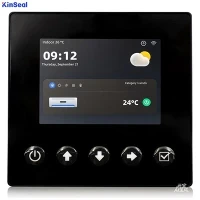


Programmable Logic Controller (PLC) is a digital computer with programmable control functions. It is a computer system specially designed for industrial control system, which is used to control industrial situations such as production lines, machines and equipment and industrial automation equipment. By writing different programs, PLC can control different machines or equipments to operate according to the pre-set programs.PLC has good reliability, stability and expandability, and is widely used in manufacturing, chemical industry, energy, transportation and other fields.
The working principle of programmable controller
Programmable controller (PLC) principle of operation is based on the monitoring of input signals and control of output signals. PLC receives input signals (such as sensor signals), based on the preset program and logic instructions, arithmetic, judgment, and control of the state of the output signals (such as control of the motor start-stop, light switch, etc.). Adjustment of the control process.
The PLC uses digital signals rather than analog signals for control, which gives it greater reliability, accuracy, and speed, and allows multiple input/output points to be monitored and controlled simultaneously. It also has an embedded operating system and communication interface, so it can communicate and transfer data to each other, as well as network with other automation equipment (e.g., sensors, actuators, computers, etc.).
Structural Components of Programmable Controllers
Programmable controller (PLC) is usually composed of the following components:
1. Central Processing Unit (CPU): responsible for receiving input signals, executing programs and controlling output signals, it is the core component of PLC.
2. Input/Output (I/O) module: responsible for converting signals from external sensors and actuators into digital signals for processing by the CPU.
3. Memory module: responsible for storing programs, data, monitoring information, etc.
4. Programming device: responsible for writing and modifying programs, usually using specialized programming software and programmers.
5. Communication module: responsible for communicating with other devices, such as communicating with other PLCs, communicating with upper computer, etc.
6. Power module: responsible for providing power for the whole PLC system.
The above are common PLC components, there may be some differences between different models of PLC.
The main role of the programmable controller
Programmable controller (PLC) is a computerized control device used to control industrial automation systems.PLC can receive input signals from various sensors and actuators, perform logic processing, and realize the control of industrial automation systems by controlling the output signals of actuators.
The role of PLC includes:
1. control the production process: PLC can control the equipment in the industrial automation system, such as machine tools, automated production lines, etc., to achieve precise production and processing process control.
2. monitoring sensor signals: PLC can monitor the signals from various sensors, such as temperature, humidity, pressure, etc., real-time feedback equipment status, and the corresponding control.
3. data acquisition and processing: PLC can collect and process data from various devices in the industrial automation system, and transfer the data to the upper computer or cloud platform to realize remote control and data analysis.
4. automation control: PLC can realize automation control through various control logics and algorithms, such as automatic adjustment of temperature, flow, etc.
5. System integration: PLC can integrate various control devices and systems, such as machine vision, robotics, etc., to realize a complete automation control system.
Functional characteristics of programmable controllers
The functional characteristics of programmable controllers (PLC) are as follows:
1. Programmability: The most important feature of PLC is program control, which allows users to realize the functions of automation control system through programming.
2. Expandability: PLC has a good scalability, according to the user's needs, through the expansion of I / O modules and other ways to flexibly expand the system.
3. Reliability: PLC system has high reliability, suitable for long-term operation in harsh environments.
4. Efficient: PLC's hardware and software systems are designed for efficient operation and response speed, suitable for real-time control.
5. Easy maintenance: PLC hardware and software system design makes it easy to maintain and upgrade, reducing equipment downtime and improving productivity.