


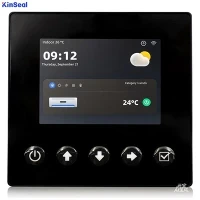


A Programmable Logic Controller (PLC) is a digital computer used to control industrial automated production lines, machines and processes. It can accept digital and analog input signals, perform logical operations according to pre-written programs, and output digital and analog signals to control the execution equipment and achieve automated industrial control.
PLC works on the principle that it will receive input signals, such as sensors, switches, buttons, etc., and then, according to the logic of the pre-written program, it processes the input signals and outputs control signals to control the execution equipment, such as motors and valves. The program is represented in a way similar to a logic diagram, and the program is written by the programmer in a specific programming language.PLC is mainly composed of a CPU, I/O system, memory and communication interface.The CPU controls the internal calculations of the PLC and communicates and controls the external devices.PLC operation and modification of program logs are usually accomplished by programming software on a PC, and the PLC and the PC are connected by serial or Ethernet. The PLC and the PC communicate with each other via serial port or Ethernet.
Functional Characteristics of Programmable Logic Controllers
Programmable Logic Controller (PLC) is an electronic system used to automate and control production and manufacturing processes.The functional characteristics of PLC are as follows:
1. Programmability: the main function of PLC is to program the production process according to the user's needs.PLC can perform different logical operations based on different input signals (e.g., sensor feedback, keystroke inputs, etc.).
2. Reliability: PLC is highly reliable and can be operated in harsh environments. PLC has a strong anti-interference capability and can withstand disturbances such as electrical noise and transients.
3. Flexibility: PLC software can be updated and changed at any time, the user can be modified and adjusted as needed in the production process to meet different needs.
4. Easy maintenance: PLC has a strong self-diagnosis and error checking function, users can detect and solve problems in time to ensure the operation of equipment and production continuity.
5. Openness: PLC system has openness, can be integrated with other equipment and systems to form an automation system, to achieve intelligent control and management of the entire production process.
6. Safety: PLC can be integrated with safety functions, such as safety switches, safety gates, etc., to ensure that the equipment achieves maximum safety and security during operation.
7. Input / output function module is complete: One of the biggest advantages of PLC, is for different field signals (such as DC or AC, switching, digital or analog, voltage or current, etc.), there are corresponding templates can be directly connected to the industrial field devices (such as buttons, switches, sensing current transmitters, motor starters or control valves, etc.), and through the bus and the main board of the CPU connection.
8. Convenient installation: compared with computer systems, PLC installation does not require a special room, nor do they need strict shielding measures. Use only the detection device and the actuator and PLC I / O interface terminals are correctly connected, it can work normally.
9. Fast operation: Due to PLC control in different PLC systems, the number and configuration of these components may vary. However, these basic components form the core part of a programmable logic controller, enabling it to perform a variety of automation control tasks.
Structural Components of Programmable Logic Controllers
The structural composition of the programmable logic controller (PLC) includes the following parts:
1. Central processor: responsible for various tasks such as data processing, communication and storage of the PLC system.
2. Input/output module: used to convert external signals (input signals) into digital signals that can be processed by the PLC system, and to convert digital signals from the PLC system into control signals (output signals) for output to external devices.
3. Power supply module: used to provide the power supply of the PLC system, to provide a stable power supply for the entire PLC system.
4. Programming means: used to write PLC programs, including programming software and programming devices. Among the programming devices are handheld terminals, program downloaders, etc.
5. Communication module: used for communication and data exchange between PLC system and other devices and control systems.
6. Expandable module: used to expand the PLC system's input/output points, CPU speed, storage capacity and other system functions to meet the needs of different industrial application scenarios.
Application areas of programmable logic controllers
Programmable Logic Controllers (PLCs) are widely used in the field of industrial automation and are an important part of automated control systems. The following are some of the application areas of PLCs:
1. Industrial automation: PLCs are usually the core component for controlling and monitoring equipment in automation systems such as large factories, production lines and robots.
2. Building automation: PLCs can be used in building automation to control lighting, air conditioning, security systems and motorized roller shutters.
3. Transportation: PLCs can be used in transportation systems, such as controlling signal lights, access control systems, and so on.
4. Agricultural automation: PLCs can be used in controlling the climate of greenhouses, rolling shutters, sprinkler systems, etc.
5. Medical equipment: PLC can be used in the automatic control and monitoring of X-ray machines, medical filters, respirators, etc.
6. Petrochemical and mining: PLCs are widely used in the chemical and mining industries, for example, to handle chemical reactions, control injection systems, etc.
7. Aerospace: PLCs are used in the aerospace field for automation tasks in avionics and control systems, such as autopilot, autopilot, and autonavigation.
In conclusion, PLC has become a core component of modern industrial and automated control systems and is widely used in many different fields.