




One of the things that seems to happen over and over again in our industry is the emergence of a new product area that makes a big splash in engineering and then languishes in a dark, dry corner for years. This technology sounds too good to be true! We could use it to revolutionize our products. Then the technology withered and languished for a few years, with some companies offering some new versions. But it never really made it to the big time. After a few years, it finally became a very viable method and was used everywhere.
This happens a lot because the product doesn't really live up to the expectations generated by the hype. Or, there may be so many competing versions that no one is quite sure which way to turn. Then the technology matures and works well, and you see it everywhere.
In my opinion, this is the case with power line communications ( PLC ). A few years ago, PLC seemed to be the solution to many communications problems. But then it disappeared, and now it seems to have finally taken a big step forward. It's being used in utility smart grid and meter reading applications, home automation, and many other areas we'll discuss later. Of course, its biggest advantage is that it doesn't require new wiring. And, PLCs can be used over fairly long distances.
In fact, sending data over power lines was considered a neat thing a long time ago. The concept of sending communication signals over the same pair of wires used for power distribution dates back to a 1924 patent for "carrier transmission over electric circuits". PLCs for voice telephony began in the early 1900s and became common in Europe and the United States by the late 1920s.
Power line communication methods are now categorized as broadband and narrowband. Broadband is used to send high-speed data around the home, such as Ethernet, while narrowband works at a more leisurely pace and is used for utility meter reading, industrial command and control, home automation, and many lighting control applications.
To be sure, PLCs operate in harsh environments. Not only do untwisted power cords work like antennas, but there are always multiple circuits in an industrial environment or at home where communication signals may have to be transmitted to the main circuit panel and then find their way to the destination receiver. Each circuit from the main panel has multiple taps, creating a very complex impedance and noise environment to send RF signals. Power lines are often an extremely difficult and noisy communications medium, characterized by several unpredictable forms of intense interference.
Broadband PLC
Broadband systems are particularly difficult to cope with and generate interference.The HomePlug AV was introduced in 2005 and is now a mainstay of broadband PLCs, with adapters available at physical rates of 200Mbps, 500Mbps, and now more than 1Gbps.While the theoretical maximum for a HomePlug connection may be 200Mbps, the actual speeds of most connections are around 30Mbps to 50Mbps-which is still sufficient most of the time for random video playback from the router to the TV, as long as it's reliable and consistent.HomePlug passes the IEEE 1901 specification, which ensures interoperability.
NarrowbandProgrammableControllers
But today we want to talk about narrowband powerline communications.
Communication over long-distance power lines (AC and high-voltage DC) is an important part of the grid infrastructure. Automated utility meter readouts are now the norm in most places. Home automation for lighting, HVAC and appliances is an important and growing area of use. All of these areas use narrowband PLCs. Designers of industrial control systems are utilizing this technology. Other rapidly emerging applications include the control of street lights, vending machines, solar panels and electric vehicle charging.
Communication technologies for the use of power lines have evolved. Initial deployments include variations of basic single-carrier frequency shift keying (FSK) and phase shift keying (PSK) modulation. These technologies were limited in their ability to reliably cope with harsh powerline environments and, as a result, early PLC systems encountered problems.
There are currently two main standards for narrowband: G3 and PRIME. typically, the G3 (or similar IEEE P1901.2) standard focuses more on robustness. For industrial applications, you have to be sure that the data will arrive, maybe not at the highest speed, but it does. g3 offers 20.36Kbps, 34.76Kbps, and 46Kbps (with encoding) data rates, Forward Error Correction (FEC), and compatibility with 6LoWPAN/IPv6. g3 is available in the european cenelec-A or -B bands ( G3 operates on the CENELEC-A or -B bands (20Kbps-40Kbps) in Europe and can be used across the entire FCC band, providing data rates up to 400Kbps in the US. It provides Layer 2 128-bit AES encryption for data security.
OFDM solves this problem
G3 and PRIME utilize Orthogonal Frequency Division Multiplexing (OFDM), a technique for transmitting large amounts of digital data over noisy channels. It combines many slower data rate carriers to create an overall higher data rate. A set of carrier frequencies or channels is automatically selected to stay away from interference. Multiple sub-signals are transmitted simultaneously at different (orthogonal) frequencies. Each data subcarrier is modulated using PSK or QAM. This, together with error correction, ensures that data can be received without error in very noisy environments.
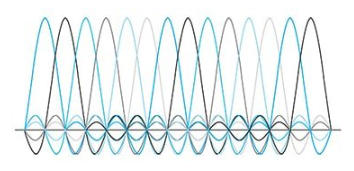
Spectrum of multiple constant amplitude OFDM subcarriers.
The trick to making OFDM a practical transmission system is to connect the subcarrier modulation rate to the subcarriers. By setting the subcarrier spacing to the reciprocal of the symbol rate, the peaks and zeros are perfectly aligned so that at any subcarrier frequency, the subcarriers are orthogonal and there is no interference between them.
Narrowband PLC Controller ICs for Industrial Controls
A number of chip vendors produce controllers that support the PRIME, G3, and IEEE 1901.2 standards.OFDM and error correction technologies make narrowband PLCs well suited for industrial control systems in typically electrically noisy environments. These technologies do use some fairly heavy math functions and require some serious computing power. Today, this is not a big deal, but make sure that the controller chip you choose has the horsepower to handle your particular environment.
An example of a narrow-band PLC controller IC is Maxim 's ZENO MAX79356, which uses two pipelined 32-bit RISCprocessors. The chip is G3-PLC certified, and its programmability ensures that it can handle standard revisions and national changes.
The MAX79356 consumes a maximum of only 80.6 mW of power in listen mode, and the IC includes a complete analog front end ( AFE ) with an AES-CCM encryption engine for high security. The device is available in a 48-pin LQFP package and operates over the -40° to 85°C temperature range.