





With the rapid development of electronics, computers, communications, fault diagnosis, redundancy checking and graphic display technology, the level of industrial automation is also increasing. However, in the production process, the quality of the product by the interference of multiple factors and make the advantages of the automation level inferior. pid control theory has emerged since then.
Automatic control systems can be divided into open-loop control systems and closed-loop control systems. A control system includes controllers, sensors, transmitters, actuators, input and output interfaces using PID control to achieve the pressure, temperature, flow, level controllers, programmable controllers that can realize the PID control function (PLC), as well as PC systems that can be realized PID control and so on.
PID control
In engineering practice, the most widely used regulator control law for proportional, integral, differential control, referred to as PID control, also known as PID regulation. It has become one of the main technologies of industrial control for its simple structure, good stability, reliable operation and easy adjustment.
When the structure and parameters of the controlled object can not be completely mastered, or do not have access to accurate mathematical models, control theory of other technologies is difficult to use, the structure and parameters of the system controller must rely on experience and field debugging to determine, when the application of PID control technology is most convenient.
PID control, PI and PD control in practice, PID controller is based on the system's error, the use of proportional, integral, differential calculation of the control volume for control. The most ideal control when the proportional-integral-derivative control law, which combines the strengths of the three: both proportional role in a timely and rapid, but also the role of the integration of the elimination of the residual difference in the ability to differentiate the role of the override control function.
The links of PID control
1, proportional (P) control
Proportional control is one of the simplest control methods. The output of its controller is proportional to the input error signal. There is a steady state error in the system output when only proportional control is available. The output signal of the controller is proportional to the deviation signal, that is to say, as long as there is a deviation, the output of the controller will immediately change in proportion to the deviation, so the response speed of P regulation is very fast.
P regulation can reflect the changes in the system in time, but can not completely eliminate the deviation of the system, therefore, if only P regulation is used in the actual control process, the system will produce residuals, K p increase can make the system deviation is reduced, but in fact, if K - D is too large will lead to system instability.
2, integral (I) control
In integral control, the output of the controller is proportional to the integral of the input error signal. For an automatic control system, if there is a steady state error after entering the steady state, the control system is said to have a steady state error or simply a differential system.
In order to eliminate the steady state error, an "integral term" must be introduced into the controller. The integral term integrates the error depending on the time, and increases as the time increases. Thus, even if the error is small, the integral term increases with time, and it drives the output of the controller to increase so that the steady state error is further reduced until it is close to zero.
The proportional + integral (PI) controller, therefore, allows the system to enter steady state with almost no steady state error. The size of the integral time determines the strength of the integral effect, the larger the integral time, the weaker the integral effect, resulting in an increase in the amount of system overshoot; the stronger the integral effect, on the contrary, is prone to cause system oscillation.
3, differential (D) control
In differential control, the output of the controller and the input error signal differential (i.e., the rate of change of the error) is proportional to the relationship. Automatic control system to overcome the error in the regulation process may be oscillating or even destabilization. The reason for this is due to the presence of a large inertia component (link) or a hysteresis component, which has the effect of suppressing the error, and whose changes always lag behind the changes in the error.
The solution is to make the change in the suppression of error "ahead", i.e., when the error is close to zero, the suppression of error should be zero. That is to say, in the controller only the introduction of "proportional" term is often not enough, the role of the proportional term is only to amplify the magnitude of the error, and the need to increase the "differential term", which can predict the trend of error changes, so that the controller with a proportional + differential, will be able to make the control of error suppression ahead of time. In this way, the controller with proportional + differential, can be made in advance to inhibit the control of the error is equal to zero, or even negative, thus avoiding the serious overshooting of the controlled quantity.
Therefore, for the controlled object with large inertia or hysteresis, the proportional+differential (PD) controller can improve the dynamic characteristics of the system in the regulation process.D The main function of the regulation is to reduce the amount of overshooting, to control the oscillation of the controlled object's output, and to shorten the response time of the system, which improves the dynamic characteristics of the system. However, too large a T D will reduce the ability to suppress interference signals.
4, PID control
The most ideal control when the proportional-integral-differential control law, which sets the length of the three: both proportional role in a timely and rapid, but also the integral role of the elimination of the residual difference in the ability to have the differential role of the control function ahead of time.
When the deviation savings appear, differential can immediately and greatly action, inhibit the deviation of this leap: proportional at the same time play a role in eliminating deviations, so that the deviation amplitude is reduced, because the proportional role is persistent and play a major role in the control law, so that the system is more stable: and the integral role of the residual difference slowly overcome. As long as the three roles of the control parameters are properly selected, you can give full play to the advantages of the three control laws, to get a more ideal control effect.
Therefore, as long as the three roles can be reasonably matched, you can achieve fast and accurate and smooth regulation performance, to obtain excellent control results, which is the charm of PID regulation.
5, parameterization
PID controller parameterization is the core of the control system design. It is based on the characteristics of the process to be controlled to determine the scale factor of the PID controller, the integral time and the size of the differential time.
PID controller parameter setting methods, summarized in two categories: one is the theoretical calculation of the setting method. It is mainly based on the mathematical model of the system, after theoretical calculations to determine the controller parameters. Calculated data obtained by this method may not be used directly, but also through the actual engineering adjustments and modifications. The second is the engineering calibration method, which mainly relies on engineering experience, directly in the control system test, and the method is simple, easy to grasp, in engineering practice is widely used.
PID controller parameters of the engineering tuning method, mainly critical ratio method, response curve method and attenuation method. The two methods have their own characteristics, the common point is through the test, and then in accordance with the engineering experience of the formula for the controller parameters to be adjusted. But no matter which method is used to obtain the controller parameters, need to be in the actual operation of the final adjustment and improvement. The critical ratio method is generally used. Using this method for the PID controller parameter tuning steps are as follows:
(1) First pre-select a short enough sampling period for the system to work;
(2) Add only the proportional control link until a critical oscillation occurs in the step response of the system to the input, and note down the proportional amplification factor and the critical oscillation period at this time;
(3) Under a certain degree of control through the formula to obtain the parameters of the PID controller.
In the actual commissioning, can only be roughly set an empirical value first, and then modified according to the regulation effect.
For the temperature system: P (%) 20 - 60, I (points) 3 - 10, D (points) 0.5 - 3
For flow system: P (%) 40--100, I (min) 0.1--1
For pressure systems: P (%) 30--70, I (min) 0.4--3
For liquid level systems: P (%) 20--80, I (min) 1-5
Doesn't it sound a little hard to understand? Let's ask Ming to explain it to us.
Ming has been given a task: there is a water tank leaking, and the rate of leakage is variable, but the water surface is required to maintain the height of the water surface at a certain position, once the water surface is found to be lower than the required position, you have to add water to the water tank.
The beginning of Xiaoming with a dipper to add water, faucet from the tank has a distance of more than ten meters, often have to run several times to add enough water, so Xiaoming and changed to use a bucket to add a bucket, a plus is a bucket, run fewer times, plus the speed of the water is also fast, but several times will be given to the tank to add the overflow of the accidentally wet a few times, Xiaoming and brainstorming, I don't use a dipper and not a bucket, the old man with a basin, several times down, found that it is just right, do not have to run too many times, and will not let the water overflow. I found that it was just right, I didn't have to run too many times, and I didn't let the water overflow. This checking time is called the sampling period.
At the beginning of Xiaoming with a dipper to add water, faucet from the water tank has a distance of more than ten meters, often have to run several times to add enough water, so Xiaoming and then changed to use a bucket to add a bucket, a plus is a bucket, run fewer times, the speed of water is also faster, but several times will be given to the tank to add the overflow of the accidentally wet a few times, Xiaoming and brainstorming, I don't use a dipper and don't need to barrels, the old man with a basin, several times, found that it is just right, do not have to run too many times, also won't let the water overflow. I don't need to run too many times, and I don't want the water to overflow. The size of this tool for adding water is called the proportionality coefficient.
Xiaoming also found that although the water would not overflow, sometimes it would be higher than the required position, and there was still the danger of wetting his shoes. He came up with a way to install a funnel on the water tank, each time you add water is not poured directly into the tank, but poured into the funnel to let it slowly add. This overflow problem solved, but the speed of adding water and slow, and sometimes can not catch up with the speed of the leak. So he tried to change the funnel of different sizes and diameters to control the speed of adding water, and finally found a satisfactory funnel. The time of the funnel is called the integral time.
Xiaoming finally breathed a sigh of relief, but the requirements of the task suddenly strict, the timeliness of the water level control requirements greatly improved, once the water level is too low, you must immediately add the water to the required position, and can not be too much higher, or do not pay the wages. Xiaoming again difficult! So he opened his brain, finally let it think of a way, often put a pot of spare water at the side, once the water level is found to be low, not through the funnel is a pot of water down, so that the timeliness is guaranteed, but the water level will sometimes be much higher. He also asked for the location of the surface of the water above a point will be chiseled a hole in the water, and then connect a pipe to the bottom of the spare bucket so that more water will leak out from the top of the hole. The speed at which this water leaks out is called differential time.
The story of Ming's experiment is a step-by-step independent, but the actual water tools, funnel caliber, the size of the overflow hole at the same time will affect the speed of water, the size of the water level overshoot, do the back of the experiment, often have to modify the change the results of the previous experiment.
People with PID control with a kettle to the cup of water printed with a scale of half a cup of water after the stop
Set value: half-cup scale of the water cup;
Actual value: the actual amount of water in the water cup;
Output values: the amount of water poured out of the kettle and the amount of water scooped out of the cup;
Measurement: human eyes (equivalent to sensors)
Execution object: human
Positive execution: pouring
Counter-execution: scooping
1P proportional control, that is, people see the amount of water in the cup does not reach half a cup of water cup scale, according to a certain amount of water from the kettle in the king of the cup of water poured or the amount of water in the cup of water over the scale, with a certain amount of water from the cup of water scooped out, this one action may result in less than a half a cup or more than a half a cup on the stop.
Note: P proportional control is one of the simplest control methods. The output of its controller is proportional to the input error signal. Steady-state error exists in the system output when only proportional control is available.
2PI integral control, that is, according to a certain amount of water into the water cup, if you find that the amount of water in the cup does not have a scale, you keep pouring, and then found that the amount of water is more than half a cup, the water scooped from the cup to the outside, and then repeatedly not enough to pour the water, and more scooped until the amount of water reaches the scale.
Note: In integral I control, the output of the controller is proportional to the integral of the input error signal. For an automatic control system, if there is a steady state error after entering the steady state, the control system is said to have a steady state error or simply System with Steady-state Error (System with Steady-state Error). In order to eliminate the steady state error, an "integral term" must be introduced into the controller. The integral term integrates the error depending on the time and increases with time. Thus, even if the error is small, the integral term increases with time, and it drives the output of the controller to increase so that the steady state error is further reduced until it equals zero. The proportional + integral (PI) controller, therefore, allows the system to enter steady state with no steady state error.
3PID differential control, that is, the human eye looking at the cup of water and the distance from the scale, when the gap is very large, the kettle with a large amount of water to be poured, when people see the amount of water is close to the scale, reduce the kettle's output of water, and slowly approaching the scale, until it stops in the cup of the scale. If the water stops at the exact position of the scale, there is no static differential control; if it stops near the scale, there is static differential control.
Note: In differential control D, the output of the controller is proportional to the differential of the input error signal (i.e., the rate of change of the error).
In engineering practice, the most widely used regulator control law for proportional, integral, differential control, referred to as PID control, also known as PID regulation.PID controller has been introduced nearly 70 years of history, it is simple structure, good stability, reliable, easy to adjust and has become one of the main technologies of industrial control.
When the structure and parameters of the controlled object can not be completely mastered, or do not have access to accurate mathematical models, control theory of other technologies is difficult to use, the structure and parameters of the system controller must rely on experience and field debugging to determine, when the application of PID control technology is the most convenient.
PID controller
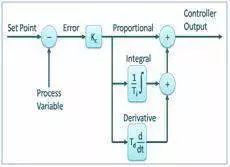
PID controllers are widely used in industrial process control. About 95% of closed-loop operations in industrial automation use PID controllers. The controller is combined in such a way that it generates a control signal. As a feedback controller, it delivers the control output to the desired level. Before the invention of microprocessors, analog electronics implemented PID control. But today all PID controllers are handled by microprocessors. Programmable logic controllers also have built-in PID controller instructions.
By using a low-cost simple switching controller, only two control states are possible, such as full on or full off. It is used for limited control applications where these two control states are sufficient to control the target. However, the oscillatory nature of this control limits its use and is therefore being replaced by PID controllers.
PID controllers maintain the output such that there is zero error between the process variable and the setpoint/desired output through closed-loop operation.PID uses three basic control behaviors, which are explained below.
P-controller:
The proportional or P-controller gives an output proportional to the current error e(t). It compares the desired or set value with the actual or feedback process value. The error obtained is multiplied by the proportionality constant to get the output. If the error value is zero, this controller output is zero.
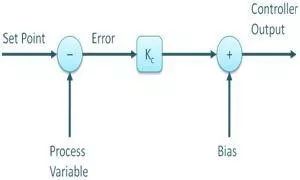
This controller needs to be biased or manually reset when used on its own. This is because it never reaches a steady state. It provides stable operation but always maintains the steady state error. As the proportionality constant Kc increases, the response speed increases.
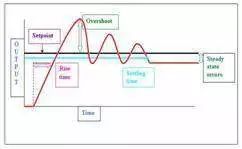
I-controller
Since the p-controller always has a deviation between the process variable and the set point, the I-controller is needed, which provides the necessary action to eliminate the steady state error. It integrates the error for a period of time until the error value reaches zero. It maintains the value of zero error for the final control unit.
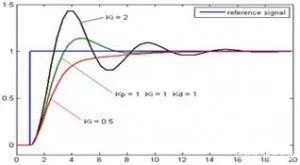
When a negative error occurs, the integral control reduces its output. It limits the speed of response and affects the stability of the system. The speed of response is increased by decreasing the integral gain Ki.
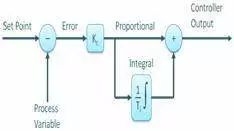
In the above figure, the steady state error decreases as the gain of the I controller decreases. For the most part, PI controllers are especially useful in situations where a high speed response is not required.
When a PI controller is used, the I-controller output is limited to a degree that overcomes the integral saturation, where the integral output is nudged even when the zero error state is increased due to the condition of nonlinearity in said plant.
d-controller
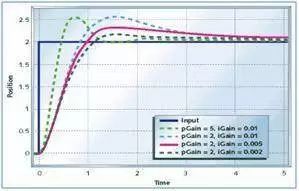
I-controller does not have the ability to predict wrong future behavior. So it reacts normally once the set point is changed. d-controller overcomes this problem by predicting erroneous future behavior. Its output depends on the rate of change of error with respect to time, multiplied by a differential constant. It provides startup to the output which increases the system response.
In the above figure, the D controller has more response than the PI controller and the build-up time of the output is reduced. It improves the stability of the system by compensating the phase lag caused by the I controller. Increasing the differential gain will improve the response.
Role of the PID controller
Role of proportional regulation
Proportional response to the deviation of the system, once the system has deviated, proportional regulation immediately produces regulation to reduce the deviation. Large proportionality can speed up the adjustment and reduce the error, but too large a proportion makes the stability of the system decline, and even cause system instability.
Integral regulation
It makes the system eliminate the steady state error and improves the degree of non-difference. Because there is an error, the integral regulation is carried out until there is no difference, the integral regulation stops, and the integral regulation outputs a constant value. The strength of the integral effect depends on the integral time constant Ti, the smaller Ti is, the stronger the integral effect is. On the contrary, if Ti is large, the integral effect is weak, and the addition of integral regulation can make the system stability decline, and the dynamic response becomes slower.
Differential regulation
Differential action reflects the rate of change of the system deviation signal, with predictability, can foresee the trend of deviation changes, so it can produce ahead of the control role in the deviation has not been formed before, has been eliminated by the differential regulation. Differential action on the noise interference has an amplifying effect, so too strong plus differential regulation, the system is not good for anti-interference.
PID control application development direction
In the production process in order to improve product quality, increase production, saving raw materials, production management and production process is always in the optimal working condition. Therefore, a method of optimal control is produced, which is called adaptive control. In this type of control, the system is required to be able to automatically adjust the system according to the changes in the measured parameters, the environment and the cost of raw materials, so that the system is always in an optimal state. Adaptive control consists of three components: performance estimation (discrimination), decision making and modification. It is the development direction of microcomputer control system. However, because the control law is difficult to grasp, so the promotion of some difficult to solve the problem. Into the adaptive pid control comes with some intelligent features, like living creatures can adapt to changes in external conditions. There is also a self-learning system, it is more intelligent.