




Introduction: In the field of industrial automation, programmable logic controller (PLC) as automatic control to become the basis of most automation system equipment, but also to the industrial control has brought unprecedented extraordinary changes. Industrial control systems using PLCs have unrivaled advantages over traditional relay-based industrial control systems in terms of operation, control, efficiency and accuracy. Although the relay control devices used in industrial control systems will not be completely eliminated, but due to the emergence of PLC has changed the design thinking of industrial control designers.
I. Disadvantages of control relays
Today relays are used in all areas of home and industrial control. They are more reliable than their predecessors. However, this is also accompanied by a number of problems. For example, the vast majority of control relays are subjected to long-term wear and fatigue working conditions and are easily damaged. Moreover, the contacts of relays are prone to arcing and can even fuse together to produce misoperation, causing serious consequences. Furthermore, for a specific use of equipment equipped with hundreds of relays, its control box will be large and bulky. Under full load operation, large relays will generate a lot of heat and noise, and also consume a lot of power. And the relay control system must be manually wired, installed, if there is a simple change, but also need to spend a lot of time and manpower and material resources to reform, installation and commissioning.
II. the advantages of programmable controllers, features and functions
Programmable controller is known for its small size and powerful functions, it can not only easily complete the sequential logic, motion control, timing control, counting control, numerical operations, data processing and other functions, and can be established through the input and output interfaces with various types of digital and analog production machinery, thereby realizing the automatic control of the production process. Especially now, due to the arrival of the information, network era, expanding the functions of PLC, so that it has a strong networking communication capabilities, and thus more widely used in many industries.
1,Sequence control
Sequence control is the most basic and widely used area of PLC. The so-called sequence control, is in accordance with the order of the process, under the action of the control signal, so that the production process of each actuator automatically in accordance with the sequence of action. Because it also has the advantages of flexible programming design, high speed, high reliability, low cost, easy maintenance, etc., it can completely replace the traditional relay contactor control system in realizing single-machine control, multi-machine group control, and production process control. It is mainly based on the operation of the button, limit switches and other on-site to give the command signal and sensor signals, control mechanical moving parts to carry out the corresponding operation, so as to achieve the automated production line control. Typical applications in the control of automatic elevators, pipelines on the automatic opening and closing of the electromagnetic logging, belt conveyor sequence start. For example, my plant's raw material mixing system is the use of PLC sequence control function.
2, closed-loop process control
In the past, the analog quantity for process control are composed of hardware circuits PID analog regulator to achieve open and closed-loop control. And now can be completely PLC control system, the choice of analog control module, its function is completed by the software, the accuracy of the system is determined by the number of bits, not affected by the components, and therefore more reliable, easy to realize the complex control and advanced control methods, you can simultaneously control multiple control loops and multiple control parameters. For example, temperature, flow, pressure, speed, etc. in the production process.
3, motion position control
PLC can support the control and management of CNC machine tools, in the machining industry, programmable controllers and computer numerical control (CNC) integrated together to complete the motion position control of the machine tool, its function is to accept the input device input machining information, processed and calculated, issued the appropriate pulse to the drive device, through the stepper motor or servo motor, so that the machine tool according to the predetermined track movement to complete the Self-control of multi-axis servo motors. At present, it is used for controlling centerless grinding, stamping, segmental punching of complex parts, rolling and touching applications.
4, Monitoring and management of production process
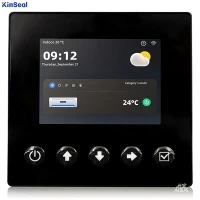
PLC can be connected to the display terminal and printer and other peripherals through the communication interface. Display as a human-machine interface (HMI) is a microprocessor chip containing intelligent equipment, it can be combined with the PLC to replace the numerous control buttons on the control cabinet, selector switches, signal indicators, and production process simulation screen and the electrical control cabinet a large number of intermediate relays and terminal rows. All operations can be carried out on the operating elements on the display screen.PLC can conveniently and quickly collect and process the data in the production process, and can display the parameters to be displayed in binary, decimal, hexadecimal, ASCII characters and so on. On the display screen, the color change of the icon reacts to the operation status of the field equipment, such as the opening and closing of the valve, the starting and stopping of the motor, the status of the position switch, etc. The PID loop control reflects the change of the quantity in the process of production with the data, bar graphs, and other comprehensive methods, and the operator can adjust the parameters through the parameter setting, and can search for the data record of any moment through the data query, and save the relevant production data through the printing. The operator can find the data record at any moment through the data query and save the related production data through printing, which is convenient for the future production management and analysis of process parameters.
5, Network Characteristics
PLC can realize the communication and networking requirements between multiple PLCs or between multiple PLCs and a computer, so as to form a multi-level distributed control system and a factory automation network.
(1) Through the communication module, the upper computer and the corresponding software to realize the long-distance monitoring of the control system.
(2) Connecting with the remote client computer through modem and public telephone network, so that the administrator can monitor the control system at a distance through the telephone line.
Conclusion
As a kind of universal industrial controller, programmable controller can be used in all industrial fields. At present, domestic and foreign programmable controllers have been widely and successfully applied to machinery, metallurgy, petroleum, chemical industry, textile, transportation, electric power, military and other fields, and has achieved considerable technical and economic benefits. And it also represents the world's advanced level of today's electrical control technology, it has been with CNC technology, CAD / CAM technology, industrial robotics technology and listed as the four pillars of industrial automation technology.