

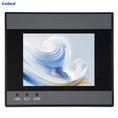
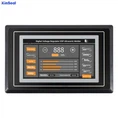


Industrial controllers are electronic devices used in industrial automation. By receiving sensor signals, executing control algorithms, and outputting control commands, they achieve automated control and management of industrial production processes. Industrial controllers are widely applied in mechanical manufacturing, chemical engineering, power generation, metallurgy, transportation, construction, and other fields, serving as one of the key devices for realizing industrial automation and smart manufacturing.
I. Principles of Industrial Controllers
The fundamental principle of industrial controllers is to utilize computer technology and control theory for real-time monitoring and control of industrial production processes. At its core lies the control algorithm, which processes input signals to generate output signals, enabling precise control over production processes.
- Input Signal Processing: Industrial controllers acquire various parameters from production processes-such as temperature, pressure, flow rate, and speed-via sensors and other devices. These parameters are termed input signals.
- Control Algorithms: Industrial controllers employ built-in or externally integrated control algorithms. Based on input signals and predefined control objectives, these algorithms calculate optimal control strategies.
- Output Signal Generation: Following the algorithmic calculations, the controller generates corresponding output signals-such as motor start/stop commands or speed adjustments.
- Control Execution: Output signals are transmitted to actuators (e.g., motor drivers, valve controllers) to influence production equipment, thereby implementing process control.
II. Classification of Industrial Controllers
Based on functionality, structure, and application domains, industrial controllers can be categorized as follows:
- Programmable Logic Controllers (PLCs): Controllers with programmable capabilities, widely used in industrial automation.
- Microcontroller-Based Controllers: Controllers based on microcontrollers, characterized by compact size, low cost, and flexible functionality.
- Embedded Controllers: Controllers integrating control algorithms and hardware, characterized by high integration and customization.
- Distributed Controllers: Systems composed of multiple controllers enabling distributed control of large-scale production processes.
- Fieldbus Controllers: Controllers based on fieldbus technology, facilitating high-speed communication and data exchange between devices.
III. Components of Industrial Controllers
Industrial controllers primarily consist of the following components:
- Central Processing Unit (CPU): The core component of the controller, responsible for executing control algorithms and processing data.
- Memory: Used to store control programs, data, parameters, and other information.
- Input/Output Interfaces: Used to connect devices such as sensors and actuators, enabling signal input and output.
- Communication Interfaces: Used for data exchange and communication with other controllers or computer systems.
- Power Supply Module: Provides stable power to the controller.
- Human-Machine Interface (HMI): Displays control information and operational interfaces, facilitating user monitoring and operation.
IV. Application Technologies of Industrial Controllers
- Control Algorithms: Industrial controllers employ various control algorithms, such as PID control, fuzzy control, and neural network control, to accommodate diverse control requirements.
- Communication Technologies: Industrial controllers utilize multiple communication technologies, including Modbus, Profibus, and EtherCAT, to enable high-speed communication and data exchange between devices.
- Fault Diagnosis: Industrial controllers feature fault diagnosis capabilities, enabling real-time monitoring of equipment status to promptly detect and address malfunctions.
- Data Acquisition and Processing: Industrial controllers perform data acquisition and processing, capturing various parameters during production in real time for subsequent analysis and handling.
- Human-Machine Interaction: Industrial controllers incorporate human-machine interaction functions, allowing users to interact via touchscreens, keyboards, and other devices to monitor and control production processes.
V. Development Trends of Industrial Controllers
- Intelligentization: With the advancement of artificial intelligence technology, industrial controllers will become increasingly intelligent, capable of achieving adaptive control, predictive control, and other functions.
- Integration: Industrial controllers will integrate more closely with other devices and systems, enabling highly integrated industrial automation solutions.
- Networking: Industrial controllers will increasingly rely on network communication technologies to enable high-speed communication and data exchange between devices.
- Customization: As industrial production demands diversify, industrial controllers will prioritize customized designs to meet the needs of different industries and application scenarios.
- Green Technology: Industrial controllers will emphasize energy efficiency and environmental protection, adopting low-power designs and energy-saving technologies to reduce energy consumption and emissions during production processes.
VI. Conclusion
As pivotal equipment in industrial automation and smart manufacturing, industrial controllers continue to evolve in their principles, classifications, components, and application technologies. Driven by technological advancements and shifting market demands, industrial controllers will progress toward greater intelligence, integration, networking, customization, and environmental sustainability, delivering enhanced convenience and efficiency to industrial production.