


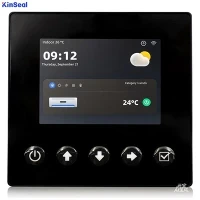


I. Concept of robot control system
A robotic control system is a management system with its own goals and functions consisting of a control subject, a control object and a control medium. A control system implies through which any interested or changeable quantity within a machine, mechanism or other device can be maintained and changed in a desired manner. A control system is also implemented to bring the controlled object to a predetermined desired state. The control system makes the controlled object tend to a certain desired stable state.
II. Functional requirements of the robot control system
1,Memory function: store the order of operation, movement path, movement mode, movement speed and information related to the production process.
2, teaching function: offline programming, online teaching, indirect teaching. Online demonstration includes two kinds of demonstration box and guide demonstration.
3,Contact function with peripheral equipment: input and output interface, communication interface, network interface, synchronization interface.
4, coordinate setting function: joint, absolute, tool, user-defined four kinds of coordinate system.
5,Human-machine interface: demonstration box, operation panel, display.
6,Sensor interface: position detection, vision, touch, force, etc..
7, position servo function: robot multi-axis linkage, motion control, speed and acceleration control, dynamic compensation.
8,Failure diagnosis and safety protection function: system status monitoring during operation, safety protection and fault self-diagnosis under fault condition.
III, the main types of robot control system
The task of the control system is to control the robot's actuator to complete the movement and function according to the robot's operation instruction program, and the signals returned from the sensor feedback. If the robot does not have information feedback characteristics, it is an open-loop control system; if it has information feedback characteristics, it is a closed-loop control system.
According to the control principle can be divided into program control system, adaptive control system and artificial intelligence control system.
According to the form of control movement can be divided into point control and trajectory control.
IV, industrial robot control system composition
1,Control computer: the dispatching and commanding center of the control system.
2, teaching box: teaching robot trajectory and parameter setting, as well as all human-computer interaction operations, with its own independent CPU and storage unit, and the main computer to serial communication to achieve information interaction.
3,Operation panel: It consists of various operation buttons and status indicator lights, and it only accomplishes the basic function operation.
4,Hard disk and floppy disk storage: the peripheral memory for storing the working program of the robot.
5, digital and analog input and output: a variety of state and control command input or output.
6, printer interface: record the need to output a variety of information.
7, the sensor interface: for the automatic detection of information to achieve smooth control of the robot, generally for the force, touch and vision sensors.
8, axis controller: complete the robot joints position, speed and acceleration control.
9, auxiliary equipment control: used with the robot with the control of auxiliary equipment, such as hand claw variators and so on.
10 communication interface: realize the robot and other equipment information exchange, generally serial interface, parallel interface, etc..
11, network interface
(1) Ethernet interface: through the Ethernet to achieve several or a single robot direct PC communication, data transfer rate of up to 10Mbit / s, can be directly on the PC with the windows library function for application programming, support for TCP / IP communication protocols, through the Ethernet interface will be loaded with data and programs into each robot controller.
(2) Fieldbus interface: support for a variety of popular fieldbus specifications, such as Devicenet, ABRemoteI/O, Interbus-s, profibus-DP, M-NET and so on.
V. Robot control system structure
Centralized control system
Realize all control functions with one computer, simple structure, low cost, but poor real-time, difficult to expand.
The PC-based centralized control system makes full use of the openness of PC resources, and can achieve a good openness: a variety of control cards, sensor devices, etc. can be integrated into the control system through the standard PCI slot or through the standard serial port, parallel port.
The advantages of the centralized control system are: lower hardware costs, easy to collect and analyze information, easy to realize the optimal control of the system, better integrity and coordination, PC-based system hardware expansion is more convenient.
The disadvantages are also obvious: the lack of flexibility in system control, control hazards are easy to centralize, once the failure occurs, its impact on a wide range of serious consequences; due to the high real-time requirements of the robot, when the system carries out a large number of data calculations, it will reduce the system real-time, the system's responsiveness to multi-tasking will also be in conflict with the system's real-time; in addition, the system connects to complexity, which will reduce the reliability of the system.
Master-slave control mode
Master and slave processors are used to realize all control functions of the system. The master CPU realizes management, coordinate transformation, trajectory generation and system self-diagnosis, etc.: the slave CPU realizes the motion control of all joints. Its composition block diagram, as shown in Figure.
Master-slave control mode system real-time is better, suitable for high-precision, high-speed control, but its system scalability is poor, maintenance difficulties.
Decentralized control mode
According to the nature of the system and the way the system control is divided into several modules, each module has a different control task and control strategy, and the relationship between the modes can be master-slave or equal. This way of real-time is good, easy to realize high-speed, high-precision control, easy to expand, intelligent control can be realized, is the current popular way.
The main idea is "decentralized control, centralized management", that is, the system of its overall objectives and tasks can be integrated coordination and distribution, and through the coordination of sub-systems to complete the control task, the entire system in the functional, logical and physical aspects are decentralized, so it is also known as a centralized control system or decentralized control system.
In this structure, the subsystems are composed of controllers and different controlled objects or devices, and the subsystems communicate with each other through networks and so on. The distributed control structure provides an open, real-time, and accurate robot control system. Two levels of control are often used in distributed systems.
Two-level distributed control system
Usually consists of an upper machine, a lower machine and a network. The upper machine can carry out different trajectory planning and control algorithms, while the lower machine carries out the research and implementation of interpolation subdivision and control optimization. The upper and lower machines work in coordination with each other via a communication bus, which here can be in the form of RS-232, RS-485, EEE-488, and USB buses.
Nowadays, the development of Ethernet and fieldbus technology provides faster, stable and effective communication services for robots. Especially the fieldbus, which is applied to the production site, in the microcomputerization of measurement and control equipment between the realization of bidirectional multi-node digital communication, thus forming a new type of network-integrated fully distributed control system - fieldbus control system.
The advantages of the distributed control system are: good system flexibility, reduced risk of the control system, the use of multi-processor decentralized control, which is conducive to the parallel execution of the system functions, improve the processing efficiency of the system, shorten the response time.
Robot control system classification
1, the program control system: to each degree of freedom to impose a certain regularity of the control role, the robot can achieve the required spatial trajectory.
2, adaptive control system: when the external conditions change, in order to ensure that the required quality or in order to improve the quality of control with the accumulation of experience on their own, the process is based on the state of the operating machine and servo error observation, and then adjust the parameters of the nonlinear model, until the error disappears. The structure and parameters of such a system can change automatically with time and conditions.
3,Artificial intelligence system: It is impossible to prepare the motion program beforehand, but requires the control role to be determined in real time according to the obtained information about the surrounding state during the motion.
4, point-based control system: the robot is required to accurately control the position of the end-effector, and has nothing to do with the path.
5,Continuous trajectory control system: requires the robot to move according to the trajectory and speed taught.
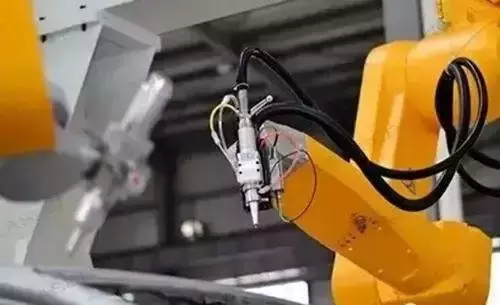
6. Control bus: international standard bus control system. Use international standard bus as the control system control bus, such as VME, MULTI-bus, STD-bus, PC-bus.
7,Customized bus control system: The manufacturer defines its own use of the bus as the control system bus.
8,Programming method: physical setting programming system. Setting fixed limit switches by the operator to realize the program operation of starting and stopping, which can only be used for simple picking up and placing operations.
9,Online programming: through the human teaching to complete the operation of the information memory process programming methods, including direct teaching simulation teaching and teaching box teaching.
10, offline programming: not on the actual operation of the robot direct teaching, but away from the actual operating environment, teaching program, through the use of advanced robotics, programming language, remote offline generation of the robot's operating trajectory.