





Introduction
Industrial control is a core component of industrial production. Programmable Logic Controllers (PLCs) serve as key devices in industrial automation control, widely applied across various sectors of the national economy including industry, transportation, and municipal services. PLCs are industrial control devices developed by integrating microelectronics, computer technology, automatic control, and communication technologies into sequential controllers. Their purpose is to replace relays, execute logic, timing, counting, and other sequential control functions, thereby establishing flexible programmable control systems [1]. Traditional PLC industrial control software is tightly coupled with hardware, and foreign products dominate the market share, presenting issues such as high costs and insufficient scalability.
1. Evolutionary Trends in Industrial Control Systems
As control science converges with computing, information, and communications disciplines, control theory evolves from classical feedback control and modern control toward data-driven intelligent control. Control systems progress from single-point control and networked control to distributed cloud-based control. Through the innovative integration of Information and Communications Technology (ICT) with Operational Technology (OT), traditional industrial control systems are gradually evolving into new industrial control systems. These new systems feature interconnectedness, scalability, and data-driven decision-making, manifested in two major trends:
(1) Transition from Closed, Isolated Specialized Control Architectures to Open, Decoupled General-Purpose Control Architectures
With the emergence and advancement of technologies like 5G and edge computing, the traditional five-layer ISA-95 industrial control architecture is shifting toward a three-layer "end-edge-cloud" structure. Among these, the evolution of the control layer PLC has become a focal point across the industry. Technologically, industrial control tasks are migrating from embedded specialized devices to cloud-edge general-purpose devices with real-time data processing capabilities. Operationally, soft real-time tasks like logic control are increasingly centralized at the edge or cloud, while hard real-time tasks such as motion control remain executed on field-side devices.
(2) Transition from Single-Task Processing to Distributed Multi-Task Collaboration
Traditional PLCs employ sequential processing for tasks. However, expanding control scales increase task volume and diversity, widen priority differences between tasks, and heighten collaboration requirements. Particularly with the introduction of big data and artificial intelligence technologies, efficient collaboration between traditional control tasks and data-driven IT tasks necessitates a shift from single-node processing to multi-node collaborative processing in traditional control systems.
2.5G Cloud-Based PLC Technical Development Pathways
Driven by ICT advancements-particularly network technologies like 5G-5G cloud-based PLCs have emerged as a key solution to traditional PLC limitations. Based on the deployment location of PLC control tasks, current 5G cloud-based PLCs follow three primary technical development pathways:
(1) Field-level cloud-based PLC: Control tasks are deployed on industrial gateways, suitable for medium-to-high-speed control scenarios at the field level. It supports industrial control cycles of 1–5 ms and above, offers high reliability, and has low deployment costs.
(2) Edge-level cloud-based PLC: Control tasks are deployed on indoor base band processing units (BBU), user plane functions (UPF), or multi-access edge computing (MEC) platforms. Suitable for workshop or factory-level centralized control scenarios with medium-to-low speeds, supporting industrial control cycles of 20 ms and above with low deployment costs.
(3) Wide-area cloud-based PLC: Control tasks are deployed on central cloud servers, suitable for low-speed collaborative control scenarios at the factory level. Enhanced with fiber optics and deterministic networking technologies, end-to-end latency can be reduced to 5 ms, but deployment costs are higher.
Current 5G cloud-based PLC technology faces challenges including inconsistent architectures, lack of edge-end collaboration support, and inability to orchestrate PLC applications. Particularly, 5G networks serving industrial control encounter delays, jitter, and reliability issues. To address these, this paper proposes a 5G virtualized PLC technical architecture. Through "end-edge-cloud" collaboration, it achieves three unifications: unified runtime environment, unified deployment scheduling, and unified development and operations portal.
3. Technical Architecture of 5G Virtualized PLC
3.1 Typical Characteristics of Virtualized PLC
Virtualization technology is a resource management technique that creates an abstraction layer on computer hardware using software. This divides the hardware resources of a single computer into multiple virtual machines, enhancing resource utilization efficiency and security. Widely adopted in cloud computing, virtualization technology continues to evolve and mature, expanding its application across diverse domains and hardware architectures.
Virtualization PLC (vPLC) creates a virtualized runtime environment, decoupling PLC control tasks from physical hardware. This enables deployment of PLC tasks across various network element devices. vPLC exhibits three key characteristics:
(1) PLC Software-Hardware Decoupling: Traditional PLCs employ embedded hardware and real-time operating systems with tight software-hardware coupling. vPLC introduces a PLC runtime environment that handles task loading, execution, and scheduling, thereby decoupling PLC tasks from the real-time operating system.
(2) Virtual PLC Execution: Virtualization technology enables deployment and operation of heterogeneous operating systems on general-purpose hardware. The PLC runtime environment runs on a virtual operating system, decoupling PLC tasks from underlying hardware.
(3) PLC Orchestration and Scheduling: At its core, vPLC functions as a PLC software service. It can be orchestrated and deployed within "edge-cloud" systems and dynamically scheduled during runtime, offering flexibility and scalability markedly distinct from traditional PLCs.
Compared to traditional PLCs, vPLC enhances system flexibility and scalability, reduces equipment and operational costs, and greatly facilitates production line upgrades and redesigns.
3.2 Virtualized PLC Provides a Unified Technical Foundation for 5G Industrial Control Systems
Centered on vPLC, the 5G industrial control system aims to deliver an open Control-as-a-Service (CaaS) architecture. PLC control functions can be deployed ubiquitously and flexibly reused, enabling plug-and-play device control across heterogeneous networks. The system's architecture is designed around the "end-edge-cloud" collaboration concept, comprising operational, service, and development layers.
(1) Runtime Layer: Based on real-time virtualization technology, it provides a unified real-time runtime environment for vPLC on general-purpose hardware. Virtualization supports mixed deployment of real-time and non-real-time operating systems, enabling dynamic scaling of vPLC.
(2) Service Layer: Responsible for deploying vPLC across different physical nodes while managing their lifecycle, achieving unified deployment and scheduling of PLC industrial control services.
(3) Development Layer: Provides PLC application development environments, compilation, and debugging tools, offering a unified development and operations portal for 5G industrial control systems.
The 5G industrial control system boasts multiple technical advantages. First, it provides a unified architecture for three distinct cloud-based PLC technologies. On one hand, it supports migrating control centers from the field to the edge or central cloud, freeing PLC control from constraints imposed by field environments and enabling centralized deployment. On the other hand, edge-side vPLC ensures low-latency control of field devices, supporting various high-real-time applications including motion control. Second, deploying vPLC across diverse 5G network elements delivers integrated capabilities of "connectivity + computing power + PLC functionality" for industrial control. This creates a new, flattened industrial control system, breaking the monopoly of traditional industrial control ecosystems. Third, leveraging a universal software/hardware architecture reduces industrial control costs, accelerating the maturation of "software-defined industry."
4 Key Technologies of 5G Virtualized PLC
4.1 Real-Time Virtualization
PLC tasks run as operating system processes in cycles according to industrial control cycles. Each cycle must ensure the PLC process receives external inputs and obtains CPU processing time. The real-time capability of the operating system is critical for delivering reliable PLC control services. Real-time virtualization technology enables the co-deployment of real-time and non-real-time computational tasks on general-purpose hardware through software/hardware virtualization. It supports consolidating computational tasks from multiple embedded devices onto a single general-purpose device. While ensuring real-time performance, this technology leverages the universal operating system's strong hardware adaptability and rich application capabilities. It offers advantages such as reduced device cost, size, and power consumption, while achieving compatibility across heterogeneous device ecosystems.
Currently, the industry employs various virtualization techniques, primarily categorized as hardware partitioning, full virtualization, paravirtualization, and operating system virtualization. Among these, the following three approaches are most suitable for real-time virtualization adaptation:
(1) Hardware Partitioning: Divides underlying hardware resources into independent partitions, each running its own operating system. Hardware partitioning offers excellent real-time performance, approaching bare-metal levels, but lacks resource sharing capabilities, suffers from limited scalability, and exhibits low resource utilization. Notably, peripheral I/O requires pre-partitioning and cannot be reused, increasing technical complexity.
(2) Real-time Linux Containers: Modify Linux from a time-sharing system to a real-time system using methods like Preemption Patch or Xenomai. Then, leverage lightweight container virtualization for resource isolation, creating a real-time, virtualized runtime environment for PLCs. This approach fully utilizes Linux's mature software and hardware ecosystem, reducing PLC software porting costs. Although containers have low operational overhead, the modified Linux kernel's real-time performance remains inferior to dedicated real-time operating systems (RTOS), leading to jitter and glitches in scenarios like servo motion control.
(3) Microkernel Virtualization: Deploys RTOS and general-purpose operating systems (GPOS) in a hybrid configuration using a microkernel as a Type-1 hypervisor. Microkernels offer simplified functionality, lower overhead, and enhanced security compared to monolithic kernels, enabling both hardware virtualization and high real-time performance. This technology is actively developing in industrial, automotive infotainment, and robotics sectors, though challenges include an immature technical ecosystem and complex hardware adaptation.
5G industrial control systems can select different real-time virtualization approaches based on network elements and application scenarios. For edge and cloud-based vPLCs, real-time Linux container technology is the preferred choice. On one hand, Linux real-time modification incurs low overhead and facilitates easy deployment. On the other hand, container orchestration scheduling and redundancy backup technologies are mature, posing low risks. Considering the high real-time requirements of edge-side vPLC and the need for edge-side collaboration, edge-side vPLC should prioritize real-time Linux containers or microkernel virtualization solutions.
4.2 5G Deterministic Networks
5G industrial control systems impose two primary requirements on network connectivity. First is ultra-low latency air interface capability. In scenarios like industrial motion control, inter-controller communication, and high-speed logic control, short control cycles (1–5 ms) and stringent reliability requirements (>99.9999%) demand high wireless air interface performance for data transmission across layers vertically and systems horizontally. Second, deterministic data transmission in heterogeneous network environments. Uncertainty in network-induced latency is a critical factor affecting control system stability. Existing network linear-jump system modeling can compensate for unstable random delays but still struggles to meet real-time control performance demands.
A deterministic network provides users with guaranteed quality of service (QoS), featuring flexible switching between deterministic and non-deterministic services and autonomous control over QoS tiers. Typical deterministic network technologies are shown in Table 1. Overall, deterministic networking represents the primary path for realizing 5G industrial control systems. 5G Deterministic Networking (5GDN) employs high-precision clock synchronization, traffic shaping, and resource reservation techniques on top of 5G network slicing to deliver deterministic bandwidth, deterministic latency, and 99.9999% connection reliability. This creates a predictable, plannable, verifiable wireless network with deterministic capabilities, offering a "differentiated + deterministic" service experience [5]. When integrated with field networks and edge computing technologies, 5G Deterministic Networking enables end-to-end deterministic control.
4.3 "End-Edge-Cloud" Collaborative Orchestration
Through real-time virtualization, traditional PLC hardware devices are transformed into hardware-decoupled PLC software services. Within the 5G cloud-edge-end architecture, flexible deployment of PLC software services is required, necessitating a unified vPLC orchestration and scheduling platform.
vPLC orchestration and scheduling supports deploying vPLC as containers or virtual machines on network elements such as 5G industrial gateways, 5G industrial base stations, 5G industrial UPFs, and MEC. Orchestration methods include two types: interconnection between computing chips and I/O chips (Controller to IO, C2IO) and interconnection between computing chips (Controller to Controller, C2C). C2IO refers to PLC-to-IO communication, encompassing both master PLC-to-IO and slave PLC-to-IO scenarios. C2C denotes PLC-to-PLC communication, primarily involving master PLC control over slave PLCs. In typical scenarios, the cloud hosts production control systems, industrial software, and enterprise information management systems. The edge primarily deploys master PLCs responsible for interfacing with cloud systems. These master PLCs generate C2C control commands and distribute them to slave PLCs deployed at the edge. Edge-side slave PLCs primarily handle C2IO communication, receiving control commands from the edge master PLC to manage field-side I/O devices.
Unlike orchestration systems like Kubernetes or Kubevirt, vPLC demands high real-time performance and reliability. Standard container or virtual machine orchestration struggles to meet the stringent cycle requirements of industrial control. vPLC orchestration and scheduling necessitates sacrificing some scalability to achieve superior real-time performance and reliability. Among these, vPLC redundant hot standby constitutes a core component of the orchestration and scheduling framework. 5G vPLC Orchestration and Scheduling Model
5. 5G Virtual PLC Implementation
5.1 Test Scenario and Solution
To advance the deep integration of 5G and industrial applications, China Mobile has collaborated with industry partners to conduct technical trials of 5G vPLC. This technology has been validated and deployed across more than ten industrial enterprises. Taking a typical client as an example, China Mobile deployed a 5G network within the client's production workshop to provide network services for Automated Guided Vehicle (AGV) material handling. Based on material type, the business platform plans distinct AGV movement paths, guiding vehicles between automated storage systems and different production segments.
To address these requirements, the 5G industrial control system employs a "Master vPLC-Slave vPLC" edge-cooperative architecture (see Figure 4). At the edge, the master vPLC is deployed on the UPF to centralize PLC deployment. It receives task instructions from the Manufacturing Execution System (MES), encapsulates them into control commands, and sends these to the slave vPLCs carried by the AGVs. Simultaneously, it receives feedback from the slave vPLCs during execution. At the field level, the slave vPLC is deployed on a 5G industrial control gateway, achieving a "two-in-one" replacement for both the PLC and the 5G Data Terminal Unit (DTU). On one hand, the slave vPLC receives control commands from the master vPLC and uses sensors to control the AGV's drive system, enabling precise movement and positioning. On the other hand, when the AGV reaches its destination, the slave vPLC feeds back the task execution results to the master vPLC, reporting the task completion status.
5.2 System Development
Real-time container technology is employed to deploy vPLC on both the 5G UPF and industrial gateways, transforming them into a 5G Industrial UPF and a 5G Industrial Control Gateway. Key configurations are detailed in Table 2.
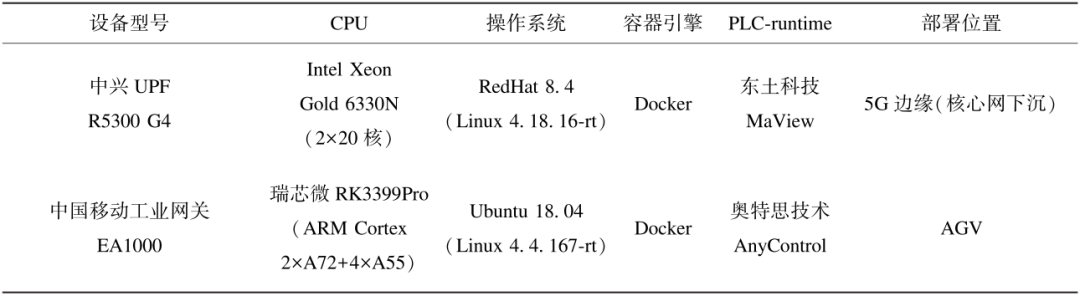
The system architecture shown in Figure 5 comprises a 5G industrial UPF, 5G industrial control gateway, and orchestration platform. The primary R&D efforts are as follows.
(1) Linux Kernel Modification
First, the original UPF and gateway kernels were modified into real-time kernels by integrating the Preempt-RT patch. The modified kernel versions are Linux 4.18.16-rt and Linux 4.4.167-rt. Under high load conditions, the maximum process handling latency was reduced from 8 ms to 500 μs. Second, CPU resource isolation was configured to assign real-time tasks to dedicated CPU cores, reducing task-switching overhead and further lowering maximum process processing latency jitter below 300 μs. Third, an interrupt routing mechanism was designed to redirect peripheral interrupt responses to other CPU cores for processing, minimizing interference with real-time task execution. Through these Linux kernel modifications, maximum process processing latency jitter was reduced to below 100 μs.
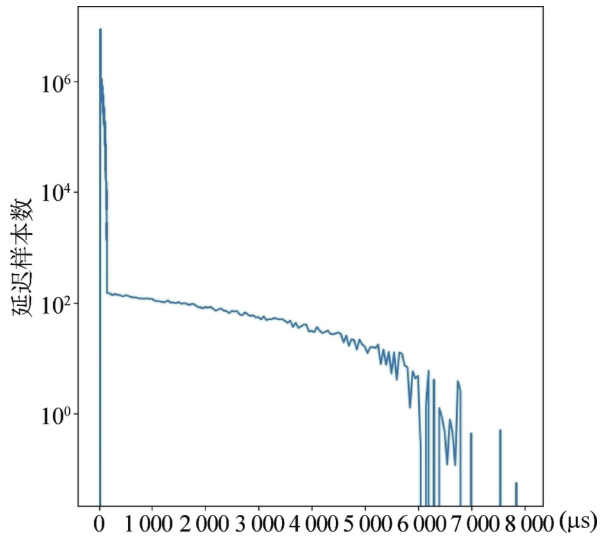 Process Handling Latency Before Linux Kernel Modification
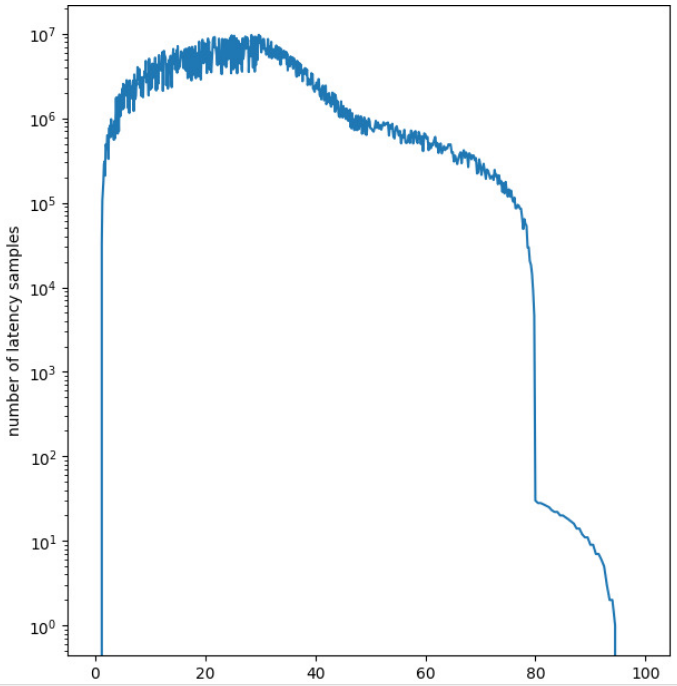 Processing Latency After Linux Kernel Modification
(2) PLC-runtime Containerization
To support dynamic PLC expansion, a containerized virtual runtime environment must be established for PLC-runtime. First, build the PLC container image based on Alpine Linux, primarily integrating PLC-runtime with 32/64-bit dynamic link libraries. Currently, the system supports two domestic PLC-runtime variants. Next, create container volumes corresponding to vPLC instances to persist data generated during PLC container operation. Third, PLC containers require access to host peripheral resources during operation. For interfaces like RS232/485 and CAN, access is achieved through device file mapping. For IP network interfaces, access is enabled via port mapping, primarily mapping ports such as the PLC program download interface and external bus service ports (e.g., Modbus TCP slave service ports).
(3) vPLC Orchestration
To support unified orchestration across UPF and gateways while reducing gateway resource overhead, a lightweight orchestration system was developed using a B/S architecture. Users perform frontend operations via browsers, while the backend comprises management and orchestration modules for PLC container orchestration and deployment. The management module, deployed on servers, primarily provides web access, container image downloads, and PLC container configuration/monitoring. The orchestration module is deployed on both the UPF and gateways, primarily offering container image pulling, container environment configuration, and runtime management. The management and orchestration modules communicate via HTTP. Taking container runtime monitoring as an example, the orchestration module periodically communicates with the local Docker service through the Docker Client to retrieve container status information, which is then reported to the management module. When the management module detects abnormal status, it initiates exception handling.
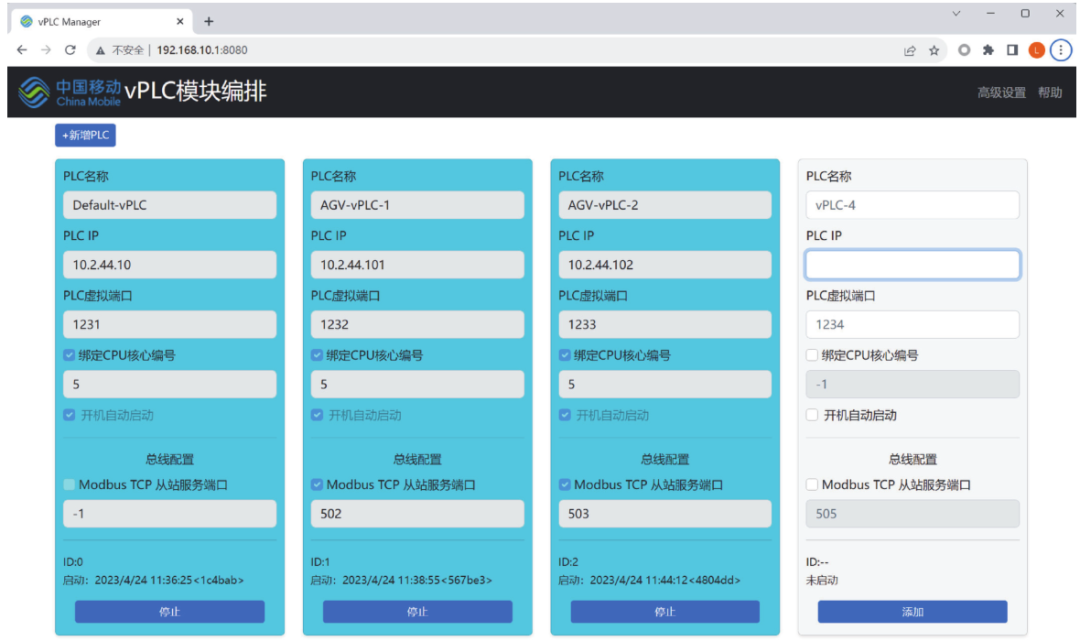 Virtual PLC Orchestration System Interface
5.3 Test Results
Following the field deployment of the 5G Industrial UPF and 5G Industrial Control Gateway, Modbus TCP communication was configured between the master vPLC and slave vPLC, as well as between the slave vPLC and I/O. The slave vPLC's industrial control cycle was set to 5 ms, while the master vPLC's cycle was configured at 20 ms. Each master vPLC control cycle included one communication instance with the slave vPLC. Following extended operational testing (14 days), AGV scheduling functioned reliably without shutdowns or route deviation failures. The master vPLC exhibited an average execution time of 457 μs, a maximum execution time of 599 μs, and maximum jitter of 532 μs (see Figure 9). Industrial control typically requires latency jitter to remain within 10%–15% of the control cycle. Based on these measurements, the master-slave vPLC edge-cooperative architecture in 5G industrial control systems can support control cycles of 5 ms or longer, meeting the performance requirements for medium-to-high-speed industrial control. Given that current 5G interface air latency remains above 5 ms, the edge-cooperative solution combines the advantages of centralized deployment with support for medium-to-high-speed control, compared to single-deployment edge-side vPLC schemes.
The cost of traditional PLC solutions includes equipment expenses such as master PLCs, slave PLCs, and 5G DTUs. The 5G industrial control system solution encompasses costs for 5G industrial UPF software licensing and 5G industrial control gateways. Compared to traditional PLC solutions, the 5G industrial control system solution achieves a significant reduction of over 50% in equipment procurement costs. Additionally, the 5G industrial control system supports unified orchestration. PLC application deployment, updates, and operations/maintenance can be centralized and performed remotely, offering flexible scalability and reducing O&M time by over 80%.
In summary, the 5G industrial control system delivers PLC industrial control services via software upgrades on 5G network elements without requiring hardware modifications or disrupting existing UPF/gateway operations. It supports medium-to-high-speed industrial control and offers advantages including diverse application scenarios, cost reduction, ease of maintenance, and scalability.
6 Conclusion
With the advent of the Fourth Industrial Revolution, PLCs-the core of industrial control-struggle to meet the evolving demands of industrial connectivity. The integration of ICT and OT, accelerating the convergence of technology with diverse production factors, holds immense promise for building next-generation 5G industrial control systems. On one hand, 5G vPLC provides a unified technical architecture and roadmap for cloud-based PLCs. On the other hand, building the 5G vPLC technology ecosystem will incentivize PLC manufacturers to transition from hardware products to software services, opening new development opportunities for domestic PLC technology and potentially disrupting the current market landscape dominated by foreign players with fragmented standards. Currently, 5G industrial control systems remain in their developmental infancy. Collaborative efforts across the industry are needed to tackle key technical challenges in areas such as microkernel virtualization, deterministic networking, and redundant hot standby, continuously enhancing and refining these systems. Concurrently, strengthening cooperation with universities to cultivate interdisciplinary talent in industrial automation and informatization is essential to drive high-quality development in industrial control.